1784–1785
The punishment for stealing Mr Strood’s wheat and William Sandy’s geneva was not a long one, but it was an unpleasant one.
News travelled quickly through Canterbury.
While Jack was in custody, people began talking about a serious burglary at the house of Mr May in the High Street. A considerable quantity of shop goods had been stolen, and the affair caused considerable discussion.
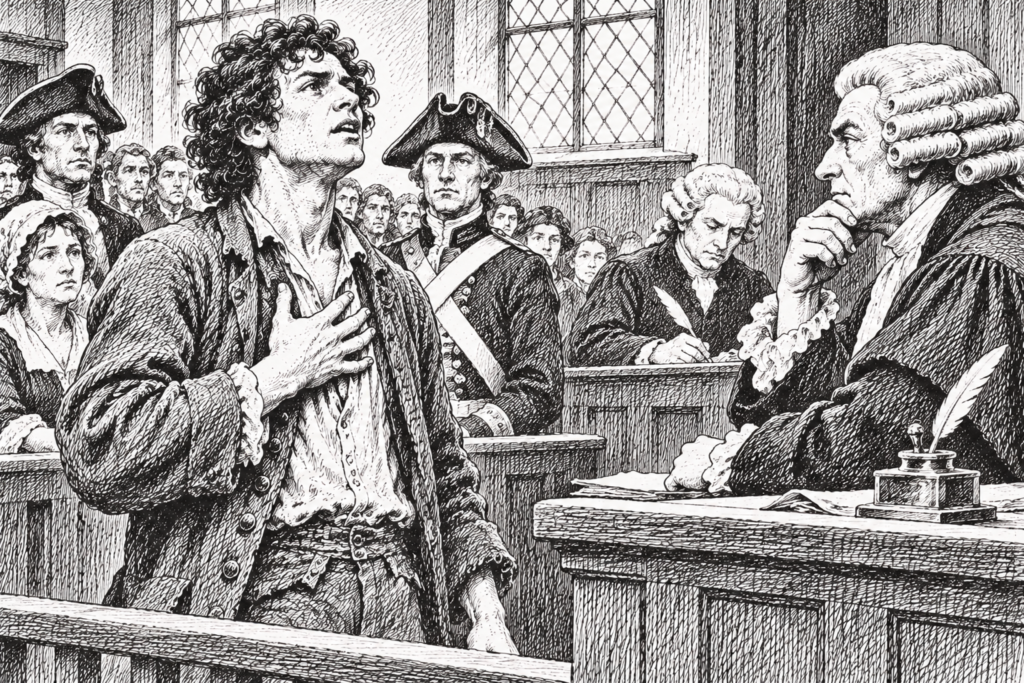
The details reached the prison, as news from the town often did. Jack heard the story and, made a remarkable declaration.
He claimed that he and Thomas Rooke had committed the burglary.
It was not a casual remark that could easily be dismissed. Jack repeated the claim and came close to swearing to it formally.
Rooke was now in danger of being implicated in a serious crime.
There was no stolen property in his possession to support the claim, and he had no convincing account to offer. Yet he persisted. Had he been permitted to swear to the confession, the consequences for Rooke might have been severe.
The real offenders were discovered before Jack could give formal evidence.
The truth came out, and Thomas Rooke escaped punishment for a crime he had not committed.
Jack was left to face the extraordinary nature of his own conduct.
A confession without a reason
In later years, Jack would look back upon the incident with an unusual degree of shame. He described his behaviour as infamous and wicked, and admitted that he could give no reason for it.
He did not say that he had been misunderstood, or that he had merely been joking. He acknowledged that he had made a false confession and that he had nearly involved an innocent man in a serious prosecution.
It was unable to explain what he hoped to gain. Perhaps he wanted to appear important in the eyes of those around him. Perhaps he enjoyed the attention that came from claiming responsibility for a notorious burglary. It may have been an impulse born of boredom, bravado or some private resentment.
What makes the incident so disturbing is that Jack had nothing obvious to gain from it. His earlier thefts had been committed for money, food, clothing or drink. Here, he was prepared to endanger another man’s liberty without any apparent reward.
It was one of the few occasions when he offered no excuse for himself.
Back to Blean
When his month of imprisonment was completed, Jack returned to Blean.
The parish officers had not given up on him. They were still prepared to help him find employment and make a more settled life for himself. Among those who particularly supported him were Mr Fleet and his family.
Their kindness mattered. Jack had been in trouble repeatedly, and there were many people who might have considered him beyond help. Yet Mr Fleet and his family were willing to give him another opportunity.
Jack went to work.
For approximately three months he earned his living honestly. The work was familiar, and he was capable of doing it well. He had grown up in a family where labour was part of everyday life, and his father had taught him the value of working in the countryside. There was no reason why Jack could not have continued in that way.
Mr Fleet and his family seem to have offered him practical encouragement rather than merely good advice. They gave him the chance to earn money and to show that he could be trusted.
For a while, he appeared to be making use of it.
Then he visited the home of a thatcher named Hobday.
The half-guinea
Jack had been drinking with Ned Hobday when he noticed him give his wife half a guinea.
It was money intended for her to take to market. She accepted the coin and placed it on the corner of the mantelpiece.
Jack saw where she put it.
He said nothing, but the sight of the half-guinea awakened an old habit of mind. He began to think about how easily he might take it.
There was no need to break into the house or wait until night. He knew the people, and he had been sitting with Hobday as a companion. The opportunity was there, and Jack began considering how to use it.
After a while, the men prepared to leave for work.
Jack set off with Hobday, but deliberately allowed himself to fall behind. He watched until the thatcher was some distance ahead, then looked back towards the house.
Mrs Hobday had gone outside to fetch water from the pond.
Jack stopped.
“She’ll not be long,” he thought.
He turned and made his way back to the house. The door offered no difficulty, and he went inside. The half-guinea was still on the mantelpiece.
He took it.
Then he left, caught up with Hobday and continued towards work as though nothing had happened.
The theft had been carried out without a struggle or a sound. Jack had used the ordinary movements of the household to his advantage, taking the money while the woman was away and her husband was out of sight.
He had stolen from a man who had been drinking with him and who had no reason to suspect that his companion would turn against him.
For a time, neither Hobday nor his wife knew what had happened.
Mrs Hobday’s distress
It was some time before Jack heard that the missing money had caused trouble in the household.
Hobday had blamed his wife for losing the half-guinea, and Jack understood that she had been treated badly as a result. The precise nature of what happened he did not know, but he was sufficiently troubled by the news to admit that he had taken the coin.
He seems to have hoped that his confession would remove the blame from her.
When he next had an opportunity to speak to Hobday, he told him plainly.
“I took the half-guinea,” he said.
Hobday looked at him in disbelief.
“You?”
“Yes. I saw you give it to your wife. I went back to the house when she had gone to the pond.”
Hobday did not believe him.
“Don’t make a jest of it, Kirby.”
“I am not joking. I took it.”
But Hobday refused to accept the confession. He could not imagine that a man who had been working alongside him would steal from his own house. He thought Jack was trying to make light of the matter. Whatever the reason, the admission achieved nothing.
The money was still gone, and Mrs Hobday had already suffered the consequences of its disappearance.
Jack had been moved to confess, but even then he had not thought to return the coin.
It was a curious mixture of conscience and selfishness. He wanted to put an end to the suspicion surrounding the woman, but he was not prepared to surrender the money he had stolen.
And soon he was stealing again.
Geese at Swinfield Minnis
Jack went to Swinfield Minnis, where he stole three couple of geese.
He knew the value of poultry and had long been familiar with the business of carrying stolen birds into Canterbury. The geese were taken away and sold for two shillings a couple, bringing him six shillings in all.
It was a familiar transaction, and one that required little explanation between Jack and the person buying the birds.
The money would not last long.
His three months of honest work had come to an end, and the theft from Hobday had been followed by another offence. Jack was returning to the habits that had already brought him before the magistrates more than once.
It was around this time that he met William Mutton again.
Mutton returns
Jack and Mutton had known one another for several years. They had shared adventures, travelled together and been involved in thefts on both sides of the county. Their friendship had survived periods of separation, and it did not take long for them to fall back into one another’s company.
They spent time together in Canterbury.
There was money to be spent, and neither man was inclined to keep it for long. They drank and enjoyed themselves until their funds were exhausted.
Then they began looking for more.
Jack’s next visit was to a house at Blean belonging to John Pym.
He entered through a back window and searched the house. From a cupboard he took a silver teaspoon marked with the initials I.E., two or three pounds of bacon and a red cloak.
The spoon was sold for one shilling and threepence, while the cloak brought him two shillings and sixpence.
The bacon was useful in another way. It could provide food for Jack and his companions, or be shared with those whose company he sought.
There was something particularly uncomfortable about this theft. John Pym was a cousin of his mother, Mary Kirby, and Jack was therefore stealing from someone within his own wider family circle.
But family connection was no longer much of a protection against him. He had stolen from people who had once employed him and from households where he had been known since childhood. He was now prepared to take from relatives as readily as from strangers.
Thomas Cullen’s household
The thefts continued.
Jack went to the house of Thomas Cullen, one of Mrs. Cath Cullen’s sons, at Blean and stole two couple of geese and three couple of fowls.
He took the birds to Canterbury and sold them to his usual customer at the usual price.
The following theft was from the widow Wilkinson, also at Blean. Jack stole three couple of fowls and sold them to a man called William Soames for one shilling and sixpence a couple.
Soames was evidently willing to buy poultry from Jack, and the two men soon made a further arrangement.
Jack offered to supply him with two geese.
“I can get you a pair,” he told him.
“When?”
“Tomorrow. I’ll leave them where you can collect them.”
Soames agreed.
Jack placed the two geese in a lodge on St Thomas’ Hill, where Soames was able to find them the following day. The arrangement was convenient for both men. Jack did not need to meet his buyer in public with the birds, and Soames could collect them at a place and time of his choosing.
But Soames made a mistake.
He offered the geese for sale at a price so low that they attracted attention. He and the birds were stopped, and enquiries revealed that the geese belonged to Mr Lawson of Blean.
Soames was brought to trial and convicted. He was sentenced to be whipped at the cart’s tail.
Jack had arranged the theft and the delivery, but it was Soames who suffered the public punishment.
The episode showed how readily Jack’s dealings could draw other people into trouble. His buyers were not always safe from the consequences of handling stolen property, particularly when they attempted to sell it in circumstances that aroused suspicion.
Jack himself escaped.
He had become increasingly confident in his arrangements. He was no longer simply taking whatever he happened to find and carrying it into Canterbury. He was organising deliveries, agreeing prices and leaving stolen animals for others to collect.
It was a small trade, but it was becoming an established one.
A journey to Whitstable
After leaving Mutton in Canterbury, Jack went to Whitstable.
There he found a Flushing jacket* hanging at the salt-pans*, together with a pair of sea-boots belonging to Thomas Webb.
He took both.
The jacket was sold in Canterbury for fourteen shillings, and the boots for four shillings and sixpence. They were useful articles, particularly to anyone working around the shore, and Jack had little difficulty turning them into money.
He was soon back in company with Mutton.
This time the two men went to Swalecliff, ostensibly to hunt rabbits. They were in the neighbourhood when they noticed shirts hanging on a line in a garden.
The family were at dinner.
Jack and Mutton looked at the washing.
“New shirts,” one of them might have remarked.
“There’s no one about,” said the other.
They took nine of them.
The shirts were carried away and sold in Canterbury for three shillings apiece, bringing them twenty-seven shillings.
It was a substantial return. The family had been occupied with the ordinary business of a meal, and their washing had been left outside for a short time. Jack and Mutton had taken advantage of that simple domestic moment.
By now, Jack had returned fully to his old way of life. He could work honestly, and people had been willing to help him, but the attraction of quick money remained stronger than the security of regular employment.
His association with Mutton had resumed, and together they were again moving between the villages and Canterbury, taking what they could and finding buyers for it.
The theft of nine shirts was profitable enough.
But their next venture would be far more serious.
* a Flushing jacket —a stout, double-breasted seaman’s coat made of flushing, a heavy, coarse woollen cloth originally imported from Flushing (Vlissingen) in Holland
* salt pans — shallow, coastal basins into which seawater was trapped at high tide and evaporated by sun and wind (or gentle boiling) to harvest sea salt—a major coastal industry in eighteenth-century Britain before inland brine mining took over
Part IV – The Price of Crime
Chapter Twelve – The Old Women at Blean