1791
The Albemarle was ready to sail.
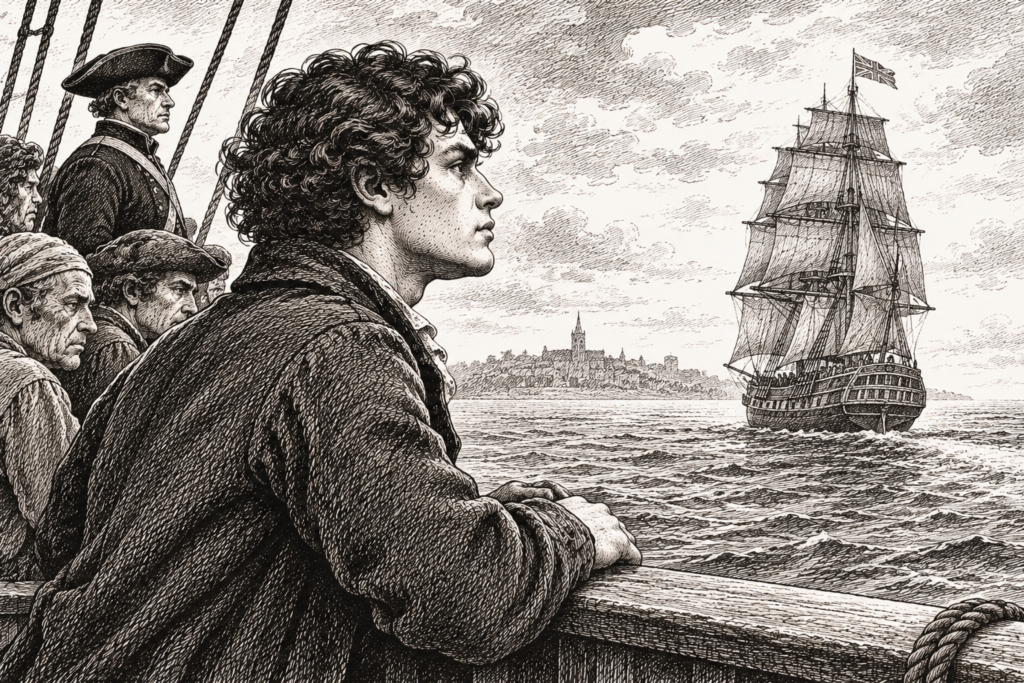
On 27 March 1791, Jack Kirby stood among the 282 male convicts who had been brought aboard at Portsmouth. Around him, men were being counted, directed and settled into the crowded quarters below deck. Some were quiet, others restless. A few tried to make light of their circumstances, but the laughter was uneasy.
For Jack, the moment was difficult to comprehend. He had spent more than two years waiting for transportation. Now, at last, he was leaving England.
He looked towards the harbour, where the familiar outline of the land seemed to offer one final connection with everything he had known.
“Come on, Kirby,” a man called from behind him. “There’s no use staring at it. It won’t follow us.”
Jack turned. It was a fellow prisoner he had come to know during the preparations for embarkation.
“I was only looking,” he replied.
“You’ll have plenty of water to look at soon enough.”
The man laughed, but Jack did not join him. He had no idea whether he would ever see England again.
As the men were taken below, the noise of the harbour gradually faded. The space allotted to them was cramped, and there was little room to move freely. They were surrounded by strangers, each with his own history and private fears.
“Have you ever been to sea?” Jack asked the man beside him.
“Once. Not like this, though.”
“What was it like?”
“Depends on the weather. You’ll soon find out.”
Jack settled himself as best he could.
He had spent his life in the countryside, among woods and fields, and had never been required to endure the confinement of a long sea voyage. He had no knowledge of what lay ahead, only the certainty that the ship would carry him further from home with every passing day.
The first days at sea
The departure was not quite as Jack had imagined it. There was no grand moment in which the ship slipped away from the shore and carried its passengers into a new world. There was shouting, movement, orders and the constant business of getting a large vessel under way.
The prisoners were kept under close watch. Soldiers and sailors moved about the decks, and the men below were left to grow accustomed to the unfamiliar motion of the ship.
For those who had never travelled by sea, the first days were particularly unpleasant.
Jack found himself unsteady when the vessel rolled. The air below deck was oppressive, and the smell of the crowded quarters became harder to bear as the ship moved further from land.
His new acquaintance, who had seemed so confident at Portsmouth, was less cheerful now.
“I told you the sea was no place for me,” the man muttered, sitting with his head in his hands.
“You said you’d been to sea before.”
“I said once. I didn’t say I enjoyed it.”
Jack managed a smile.
“You’ll be all right when you get your legs.”
“I’d settle for keeping my stomach.”
There was little Jack could do for him. He was not feeling particularly well himself, but he was determined not to complain. He had endured hunger, cold and imprisonment before. He told himself that this was simply another hardship to be got through.
The days passed slowly. The prisoners had little to occupy their minds beyond the immediate concerns of food, rest and the movements of the ship. They listened for news from the sailors and tried to discover how far they had travelled.
Some talked of the settlement awaiting them. Others spoke of escape, though no one seemed able to explain how such a thing might be accomplished.
“There’s nowhere to go,” Jack said one day, when a man suggested that they might somehow take a boat.
“There’s always somewhere to go.”
“Not in the middle of the ocean.”
The man shrugged. “You never know.”
Jack looked at him with some amusement. “I think we can safely say that the sea is not much like the lanes around Canterbury.”
The ninth of April
On 9 April, the voyage was interrupted by an event that would be remembered aboard the Albemarle long after the ship reached its destination.
The vessel had become separated from other transports in the fleet. That separation, together with the circumstances aboard, formed the setting for an attempt by some of the convicts, acting with the assistance of certain members of the crew, to seize control of the ship.
The first warning came in the confusion of voices and hurried footsteps above.
Jack looked up.
“What is it?” someone asked.
“I don’t know.”
There was a sudden commotion, followed by a shout. Men began moving about, trying to understand what was happening.
“Stay where you are!” another prisoner called. “You’ll make it worse.”
But the noise continued. There were hurried commands, the sound of men running and then a sharp report that seemed to silence everything for an instant.
Jack stared towards the hatchway.
“Was that a gun?” he asked.
No one answered.
The prisoners waited, listening. Then came more shouting, and the sound of men being driven back below.
Only later would the full account become clear.
The master, George Bowen, had been alerted to the attempt. He armed himself with a loaded blunderbuss and fired at one of the mutineers, William Syney, who was in the act of striking the man at the wheel with a cutlass. The shot wounded Syney in the shoulder. Seeing what had happened, the other men involved retreated below, where Bowen, his officers and some of the sailors pursued and secured the ringleaders.
The two men identified as the principal leaders were Owen Lyons and William Syney.
A decision was then made that would cast a shadow over the remainder of the voyage. Lyons and Syney were hanged at the fore yardarm. Two seamen who had assisted the convicts were put in irons and later left at Madeira to be returned to England.
For those who had been nowhere near the mutiny, the consequences were still profound. The ship had become a place of greater suspicion. The officers were alert to any further sign of disorder, and the prisoners must have understood that the slightest appearance of rebellion could bring terrible consequences.
Jack would have had little reason to welcome such a development. He had been sentenced to transportation, and his only hope now was to survive the voyage.
That evening, the man who had spoken so confidently of escape sat beside him in silence.
“They hanged them,” he said at last.
“So I’ve heard.”
“Just like that.”
Jack looked at him. “What did you expect?”
“I don’t know. A trial, perhaps.”
The man shook his head.
Jack said nothing. He had seen men condemned and punished before. He had watched William Mutton go to the gallows. But there was something particularly dreadful about witnessing death in the middle of the ocean, far from any town or familiar place.
“Keep your head down,” he said eventually. “That’s all we can do.”
The long crossing
After the mutiny, the Albemarle continued her voyage.
The men had to settle once more into the daily struggle of life aboard ship. The sea offered no relief from their confinement, and the passing weeks brought little change to their circumstances.
The prisoners were dependent upon the arrangements made for them. Their food, their quarters and their access to fresh air were controlled by the ship’s officers. The voyage was long, and the conditions were difficult. Crowding, poor sanitation and disease were persistent dangers,
Jack found ways to pass the time. He talked with some of the other prisoners, listened to the sailors’ conversations whenever they were within earshot, and watched the sea whenever he was allowed on deck. There was little else to occupy him.
One afternoon, he fell into conversation with a man who had been standing beside him at the rail.
“Have you any notion how long we’ll be out here?” Jack asked.
The man shrugged. “Long enough, I should think. The sailors say we have a great distance yet to go.”
Off the Cape of Good Hope
By the latter part of August, Jack had grown noticeably weaker.
The voyage had been long, and the close quarters below deck had taken their toll. The air was often heavy, the movement of the ship relentless, and the days seemed to merge into one another. He had tried to keep his spirits up, but there were times when even conversation became an effort.
His companion noticed the change.
“You’re not looking well, Kirby.”
Jack turned his head towards him. “I’ve felt better.”
“You ought to tell someone.”
“And what would they do? Give me a comfortable bed and a bottle of wine?”
The man gave a faint smile. “You might at least get something to drink.”
Jack attempted to laugh, but the effort brought on a fit of coughing. He leaned back against the timber, closing his eyes until it passed.
“It’s this place,” he murmured. “I was never made for being shut up.”
“None of us were.”
For a while they sat without speaking. Above them came the familiar sounds of the ship: the tread of sailors, the creaking of timbers and the occasional shout of an officer giving orders. The sea continued its movement around them, indifferent to the men being carried across it.
As the days passed, Jack became less able to rise.
On the morning of 27 August 1791, he lay quietly in his place below deck. The ship was somewhere off the Cape of Good Hope, still making its way towards New South Wales.
A fellow prisoner approached and crouched beside him.
“Jack?”
There was no answer.
“Kirby, can you hear me?”
He reached towards him, then drew back. Jack was no longer breathing.
The man remained there for a moment, looking down at the still figure. He had known Jack for only part of the voyage, but the sight of another prisoner dying so far from home was a sobering one.
He rose and went to find an officer.
There was little ceremony. The ship could not stop, and the living had to continue with the business of the voyage. The officer made the necessary arrangements, and Jack’s death was entered into the record.
Later, his body was brought up onto the deck.
The wind was fresh, and the sea stretched away on every side. A few of the prisoners were permitted to stand and watch from a distance. Some had known him; others had scarcely noticed him during the passage. Yet death has a way of quietening even the most indifferent company.
The burial was conducted with little more than a few words. The few men stood silently as Jack’s body, wrapped for the occasion, was committed to the water.
For a brief moment it remained upon the surface before the sea took it down.
Jack Kirby was twenty-nine years old.
The ship reaches Port Jackson
The Albemarle continued towards New South Wales, and on 3 October 1791 she arrived at Port Jackson.
Thirty-two convicts who had embarked aboard the Albemarle died during the passage. That number included the two men executed following the mutiny.
The surviving prisoners were brought ashore and entered into the arrangements of the new colony. They would begin the sentences that had taken them from England, working under the authority of the settlement.
Jack had been sentenced to seven years’ transportation, but he had not lived to serve them. The journey that was intended to take him to a new life had ended before he reached land.
The family left behind
In Kent, life continued.
Mary Kirby had no way of knowing precisely what had happened to her son. She had known that he had been sentenced to transportation, but nothing more.
She lived for many years after his departure and remained in the parish of Blean. Her other children continued their own lives. Nathanael married Anne Darby; Susannah later married William Ansell; Samuel entered the Royal Navy. Joseph, the youngest, remained in Kent and eventually married Anne Clements.
The family carried on, as families do, through marriages, children, work and the ordinary concerns of daily life.
But Jack was absent from it all.
The end of Jack Kirby
Jack’s life began in Blean on 30 November 1761, in the parish of Saints Cosmus and Damian.
He was born into a working family, the son of Nathaneal Kirby and Mary Pym. His childhood was spent among the lanes, fields and woods of the Kentish countryside. His father was an industrious man, and Jack learned the practical work of rural life while still young.
The death of his father in 1776 marked a turning point. Jack was only fourteen, and the years that followed took him away from the honest work expected of him.
He became involved with men who encouraged theft. At first his offences were small, but they grew in number and seriousness. He stole from employers, neighbours and strangers. He took clothing, household goods, animals and money. He became involved in burglaries and more dangerous criminal ventures.
He was not without charm or intelligence. He could be amusing company, and he was capable of showing kindness, even when it sat uneasily beside his selfishness. But he was also impulsive, proud and easily led by his own appetites. Again and again, he was given opportunities to change his course.
He did not take them.
William Mutton, his close companion, was executed in 1786. Jack survived, returned to crime and continued to disappoint those who tried to help him. His final conviction came in January 1789, when he was found guilty of stealing four geese belonging to Edward Smith.
The sentence was transportation for seven years.
He spent more than two years awaiting his removal from England. During that time, his account of his criminal life was published in Canterbury, giving the public a printed record of his offences and his own reflections upon them. In March 1791, he embarked aboard the Albemarle.
Five months later, he was dead.
He never reached the settlement where he was expected to serve his sentence. He never had the opportunity to begin the life that transportation was supposed to impose upon him. The young man who had once known every path and woodland around Blean died thousands of miles from home, in a place he had never intended to visit.
His story survives because he told it, and because someone thought it worth printing.
Behind the list of offences was a man: a son, a brother, a friend and, at times, a troublesome companion. He was neither a hero nor simply a name on a criminal record. He was a young man whose choices brought suffering to others and ultimately destroyed his own prospects.
His life was short, and his end was far from home.
John “Jack” Kirby, born in Blean on 30 November 1761, died at sea off the Cape of Good Hope on 27 August 1791, aged twenty-nine.
THE END