circa 1784
Jack Kirby had been back in Blean long enough to find his way into trouble again.
He knew the village and its surrounding lanes as well as any man who had grown up there. He knew the farms, the cottages and the larger houses, and he knew which families kept poultry, which had useful stores of food and which might leave a door unfastened while they were occupied elsewhere. He also knew the people. Some had known him as a boy, others remembered his father, and a few had once been kind to him when he was in need.
One of those was Mrs Cath Cullen.
She had employed Jack after his father’s death, when he was still young and Mary Kirby was struggling to keep her family together. Mrs Cullen was a widow, and there was work to be done around her house and animals. Jack had helped with the cattle and undertaken various outdoor tasks, earning a little money that his mother could ill afford to be without.
It had been a useful arrangement for them both, until Jack betrayed her trust.
He had stolen a table spoon and a tea spoon from her house and sold them in Canterbury for one shilling and eightpence. Mrs Cullen had suspected him and told him not to return. It was a small theft, but it had marked the end of a kindness that had been offered to him at a difficult time in his life.
Years had passed since then. Jack had stolen from many other households, but he had not forgotten the widow. Nor, it seemed, had he forgotten the details of her home.
Mrs Cullen was now an elderly woman. Her husband Thomas had died in 1777, and she had managed her household alone ever since. She was accustomed to doing much of the work herself, though she sometimes needed assistance with the heavier tasks.
Jack knew that she was often occupied with her animals.
And one day, he took advantage of it.
Mrs Cullen’s house
The widow was outside milking when Jack entered her house.
He did not need to force a door or make any elaborate plan. He knew the place and understood that she would be occupied for a little while. He went inside and began looking through the household possessions.
He found a red cloak, two white aprons and a white muslin apron embroidered with flowers.
The flowered apron was a particularly pretty article. The muslin was finer than the ordinary aprons, and someone had spent time decorating it with small embroidered flowers. It was the sort of thing a woman might keep for special occasions or wear when she wished to look particularly neat.
Jack took all four garments.
He left the house and carried them away, eventually selling the lot to his usual correspondent in the Borough at Canterbury for eleven shillings and sixpence.
It was a good return for a few minutes’ work, and Jack might have thought no more about it had the matter ended there.
But Mrs Cullen was distressed by the loss, and her distress was soon to become known to him.
Tea at Mary Kirby’s
A few days later, Mrs Cullen called at Mary Kirby’s house.
It was an ordinary neighbourly visit. The two women sat together and talked, and before long the conversation turned to the theft.
Jack was there.
Mrs Cullen explained what had happened. She had lost her red cloak and three aprons, including the white muslin one with the embroidered flowers. She had made enquiries, but had so far discovered nothing.
“I cannot think who would have taken them,” she said. “I have always been careful enough with my things, and I cannot imagine anyone coming into the house while I was outside.”
Mary expressed her sympathy.
“Have you any idea who it might have been?”
“No. I have wondered whether the girl could have had something to do with it, but I cannot bring myself to believe it. She has been with me long enough, and I have no reason to think she would steal.”
She paused before adding, “I should forgive whoever took them, if only I could have my flowered apron back.”
Jack sat quietly.
He knew exactly where the garments had gone, and there was little chance that Mrs Cullen would recover anything through her enquiries.
But it was the mention of the servant girl that troubled him. The girl had done nothing wrong, yet suspicion was beginning to fall upon her simply because Mrs Cullen could find no other explanation.
Mary continued to offer comfort, and the conversation moved on. Jack said nothing to betray himself.
Yet the widow’s words stayed with him.
He could have ignored them. He had stolen from her twice now, and he had little reason to expect that she would forgive him. But the thought of an innocent girl being blamed for his actions seems to have disturbed him.
That evening, he went back for the apron.
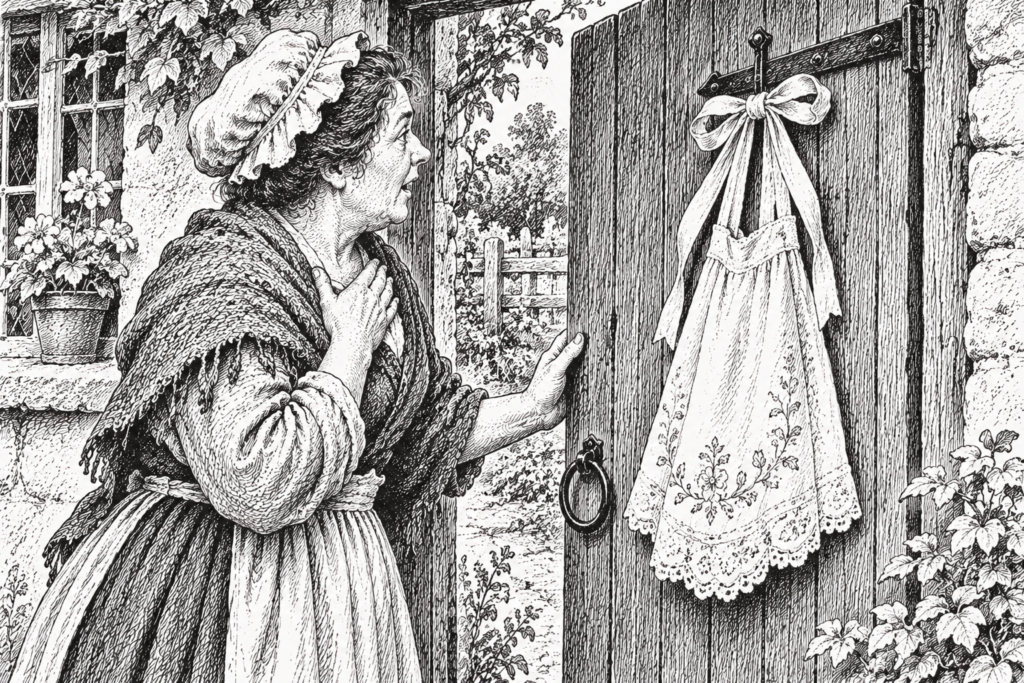
He knew where it was to be found, and he retrieved it without difficulty. Then, under cover of darkness, he returned to Mrs Cullen’s house and tied it to the back door.
He did not knock or wait to see whether anyone had noticed him. Having left the apron where it could be found, he went away again.
The flowered apron
The next morning, Mrs Cullen discovered the apron.
She was surprised to find it hanging at the back door. It was the one article she had particularly wanted returned, and there it was, apparently brought back by whoever had taken it.
She wondered whether the thief had felt ashamed, or whether someone had found the apron and wished to return it without becoming involved in the matter.
Whatever the reason, the apron was back, and the servant girl could no longer reasonably be suspected of having taken it.
The other articles, however, were still missing.
Jack did not return the red cloak or the two plain aprons. He did not offer Mrs Cullen the eleven shillings and sixpence he had received for them. His act of restitution was limited to the one possession she had asked for.
When he next had an opportunity to speak to her, he made his part in the affair known.
He told her that he had been the person who tied the flowered apron to her door.
Mrs Cullen must have been astonished.
“You took it?” she might have asked.
Jack admitted that he had.
“And the other things?”
He did not deny that he had taken those too.
“You might have left them alone,” she said. “You know I have no great store of things, and I have done you no harm.”
Jack had no very good answer to that.
He told her that she might guess who had taken the rest of the articles.
It was an extraordinary way of making a confession. He had revealed enough for Mrs Cullen to know the truth, but he did not offered to make good the loss. He felt a certain sense of satisfaction in letting Mrs Cullen know that he had been clever enough to take her things and then return one of them without being discovered.
Mrs Cullen had once given him work when he was a boy without a father. He had repaid her kindness by stealing from her, and now, after years of further offences, he had done so again.
The flowered apron was back in her possession, but her trust in Jack Kirby was gone for good.
The barn at Blean
Jack’s brief moment of conscience did not prevent him from returning to theft.
Only a few days later, he was involved in another venture, this time with another companion, John Brown.
They had their attention on Mr Strood’s barn, where wheat was stored.
The two men discussed the prospect of taking some of the grain. It was a different kind of theft from the taking of clothing or poultry. Wheat was heavy, and they would need some means of carrying it away.
“We cannot take much between us,” John remarked.
“We need not carry it,” Jack replied. “There is a horse close enough.”
They knew of a stable about a mile from the barn. It was a bold plan, but the men were accustomed to finding ways around practical difficulties. They went to the stable and took a horse, then brought it to the barn.
They loaded two sacks of wheat.
The horse was useful, but they had another problem. They did not want to be seen leading it through the district with stolen grain upon its back. As they made their way away from the barn, they noticed two asses on the Common.
Jack looked at them and saw a better arrangement.
“We can put the sacks on those,” he said. “The horse can go back where we found it.”
John agreed.
They returned the horse to its stable and transferred the sacks, placing one on each ass. It was an unusual way of transporting stolen wheat, but it allowed them to remove the grain without keeping the borrowed horse any longer than necessary.
The two men brought the sacks into Canterbury.
There, a man called White sold the wheat for three shillings a bushel.
The transaction was completed, and Jack had once again turned stolen property into money.
But the night’s work was not finished.
The geneva at Harbledown
That same night, Jack and his companion went to Harbledown.
Their next target was William Sandy, from whom they stole two half-ankers* of geneva. The spirit was carried away in a sack, and the men took it to a house where they left it.
They may have thought that they had managed the theft successfully. They had already removed the wheat and sold it in Canterbury, and the geneva was now safely out of Sandy’s possession.
But they had overlooked something.
When William Sandy entered the house where the sack had been left, he recognised it.
It was his own.
He had no difficulty understanding what had happened, and he lost little time in sending for a constable.
Jack was soon secured.
The authorities were then informed of the theft from Mr Strood, and Jack remained in custody until Mr Strood arrived. Faced with the evidence against him, Jack confessed to stealing the wheat with his companion.
The two thefts, which the men had thought separate and manageable, had brought them into serious trouble.
Before Mr Duncombe
On 24 November 1784, Jack was committed to St Dunstan’s Gaol by Mr Duncombe.
The wheat and geneva thefts were brought before the court at the Old Castle in Canterbury. Jack and his companion, John, were both convicted.
The punishment was public and humiliating. Jack was sentenced to be whipped twice at the cart’s tail and imprisoned for one month. John was to receive one whipping.
A public whipping was intended to shame as much as to punish. It was not something that could be endured privately and forgotten. The condemned man was taken through the streets behind a cart, exposed to the gaze of anyone who cared to watch, while the punishment was administered. Jack had already acquired a reputation, but each public appearance of this kind made it harder for him to return unnoticed to ordinary life.
Jack might have used the time during his one month imprisonment to consider what he was doing with his life. Instead, before his release, he became involved in an incident that was stranger and more troubling than any of his ordinary thefts.
* anker —An old Dutch and English liquid measure, commonly used for spirits, containing ten old wine gallons, or about 8⅓ Imperial gallons