1784
By the summer of 1784, Jack Kirby had become well known in the villages around Blean, though not always for reasons that would have pleased his mother. He had acquired a reputation for being quick-witted, daring and difficult to keep out of trouble. He could be entertaining company when he chose, and there were those who enjoyed his jokes and admired his confidence. But there were others who had learned to be wary of him. A man who could laugh his way out of one difficulty might be planning another before the laughter had died away.
Jack himself gave little thought to what people said. He was still young enough to believe that most troubles could be talked away, and sufficiently pleased with his own cleverness to suppose that those who took offence were generally lacking in humour.
It was at a dance at the Hare and Hounds, at Blean, that he found himself involved in an incident which would bring him before the magistrate.
The evening was lively. The public house had drawn people from the surrounding farms and cottages, and the room was crowded with young men and women who had come to enjoy the music and escape, for a few hours, the routine of their daily lives. There was dancing, drinking and plenty of conversation. Jack was in his element. He knew several of those present and moved easily among them, exchanging jokes and making himself agreeable wherever he thought it might serve him.
Among the young women there was Mary Strood, daughter of William Strood, who kept the Red Lion on the Whitstable Road. Mary was still a young girl, helping her family with the everyday work of the inn and its household. She had come to the dance with others from the neighbourhood, and Jack had noticed her during the evening.
Whether he wished to tease her, attract her attention, or simply amuse himself, it was not long before he found an opportunity for mischief.
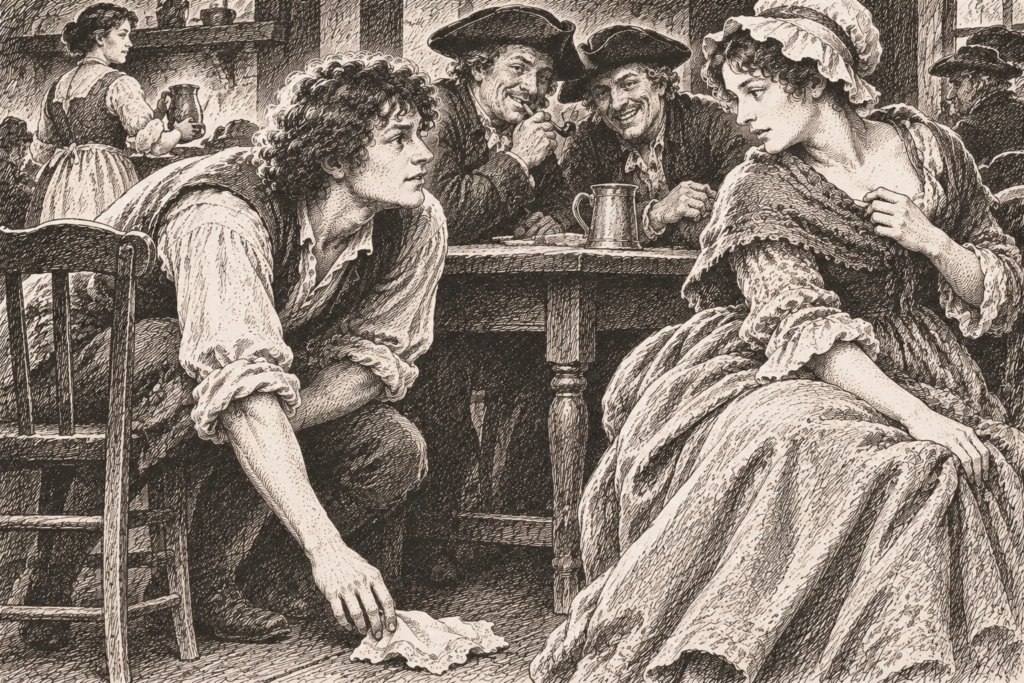
As Mary passed close to him, Jack reached out and snatched a handkerchief from her hand.
She turned sharply.
“Mr Kirby! Give that back.”
Jack had already slipped away into the crowd. He looked over his shoulder, grinning, and raised the handkerchief just enough for her to see that he had it.
“You’ll have to catch me first,” he called.
“It’s not yours,” Mary replied, annoyed by the laughter of those who had witnessed the exchange.
“No, but it is a very fine one.”
“Jack Kirby, give it back!”
He might have returned it there and then. Instead, he kept it, apparently satisfied with the small commotion he had caused. Mary was embarrassed, and the amusement of the others only made matters worse. She did not wish to make a scene, so she turned away and tried to forget the incident.
Jack thought little more of it that night. He had no intention of keeping the handkerchief. He had taken it as a joke and imagined that he could return it the following day, when he might have another opportunity to tease its owner.
The next day he went to the Red Lion, on the Whitstable Road.
It was a busy house, with the usual coming and going of customers, travellers and those who had business with William Strood. Jack entered as though he had every right to be there, greeting those he knew and settling himself among the company. The handkerchief was arranged conspicuously about his neck. He had chosen to wear it where Mary might notice it, believing that she would recognise it and that he could return it without further embarrassment.
He was drinking when James Strood, William’s son, caught sight of it.
James looked at the handkerchief, then at Jack.
“Where did you get that?”
Jack glanced down, as though he had forgotten he was wearing it.
“This old thing?”
“I asked where you got it.”
“Borrowed it.”
“From whom?”
Jack smiled. “You have a great many questions, James.”
James was not amused. He knew the handkerchief, or at least recognised it as belonging to his sister. He went to find his father.
William Strood was not far away. When James told him what he had seen, William came across to Jack, his expression already darkened.
“Kirby, I want to know how you came by that handkerchief.”
Jack looked up at him. “Why, Mr Strood, is there something wrong with it?”
“You know very well what I mean. Where did you get it?”
Jack took the handkerchief from about his neck and held it between his fingers.
“I took it from your daughter at the dance last night.”
William’s expression hardened.
“You took it from Mary?”
“Only as a joke. I meant to give it back.”
“And you thought the best way to do that was to wear it round your neck in my house?”
Jack shrugged. “I thought she would see it and ask for it.”
“Then why did you not simply return it to her last night?”
Jack had no very convincing answer. He was not accustomed to explaining himself to men who questioned his behaviour, and William’s manner was beginning to irritate him.
“I did not mean to keep it, I tell you. There was no harm intended.”
William turned towards the younger members of his family.
“Fetch Mary. I want to know whether she gave this to him.”
Mary was called from her work. She came into the room uncertainly, aware from the faces of those waiting that the matter had become more serious than she had expected.
Her father held up the handkerchief.
“Mary, is this yours?”
She looked at it. Jack watched her, still expecting that she would recognise it and confirm what he had said. He had imagined the matter would be settled with a few words, perhaps a scolding from William and an opportunity for him to make light of the whole business.
But Mary hesitated.
“I don’t know, Father.”
Jack stared at her.
“Of course you know. It was yours last night.”
Mary looked uncomfortable. “I don’t know what you mean.”
“Come now,” Jack said, his voice losing some of its amusement. “I took it from you at the dance.”
William’s eyes narrowed.
“You took it from her?”
“It was only a joke.”
“A joke?” William repeated. “You think it is a joke to take a young girl’s belongings and then come into my house wearing them?”
Jack tried to laugh, but the sound was not convincing.
“I have told you I meant to return it.”
Mary remained silent. She was young, and the attention of the men had become uncomfortable. She may have been embarrassed by the original incident, and now, with her father questioning her in front of Jack, she had no wish to be drawn further into it.
William looked again at the handkerchief.
“Mary says she does not know it.”
“She knows perfectly well,” Jack replied. “She was wearing it last night.”
“Then perhaps you had better explain yourself to someone who can decide what is to be done with you.”
Jack’s manner changed. He had come to the Red Lion expecting to amuse himself, not to be treated as a thief. He resented William’s tone, and even more the fact that James had been the one to raise the alarm.
There was, perhaps, another reason for the Stroods’ suspicion. Jack’s name was not unknown in the neighbourhood. His dealings with young women, like his dealings with other people’s property, had not always inspired confidence. William may have regarded the handkerchief as more than a childish prank. He had a daughter to protect, and little reason to accept Jack’s explanation at face value.
“There’s no need to make such a business of it,” Jack said.
“There is every need,” William answered. “You will not come into my house and make free with my daughter’s things.”
Jack was taken before Colonel Charles Webb, the local magistrate. The matter, which had begun with a handkerchief at a village dance, now became a formal accusation. Jack was questioned and the circumstances were reported. Whatever he thought of William Strood’s conduct, there was little he could do to prevent the matter proceeding.
On 16 July 1784 he was committed to St Dunstan’s Gaol, to await trial at the Maidstone Assizes.
The prospect of another spell in custody did not improve his temper. He considered himself badly treated. In his own mind, he had not stolen the handkerchief in any serious sense. He had taken it in a moment of mischief and intended to return it. That Mary had denied it, and that William Strood had chosen to make a formal complaint, seemed to him an unnecessary cruelty.
He had no great confidence in the justice of the proceedings, but he was sufficiently familiar with the courts to know that confidence alone would not secure his release.
At Maidstone, however, the case did not proceed as expected. No bill was found against him, and Jack was discharged by proclamation. He had spent time in gaol and endured the uncertainty of the Assizes, only to walk away without a conviction.
William Mutton was also at Maidstone. He had been tried for stealing wearing apparel from a fellow servant and was acquitted. The two men left together, relieved to be free, but in no mood to reflect upon the advantages of a fresh beginning.
On the journey home, the conversation turned to their recent troubles.
“You were lucky enough,” Mutton remarked, “to get away without a bill.”
“Lucky?” Jack looked at him. “I should never have been there.”
“Strood thought otherwise.”
“Strood is a fool.”
“He had you taken before Webb.”
“He had me taken for a handkerchief. A handkerchief, Mutton! I told him exactly how I came by it. I said I meant to give it back.”
Mutton gave a short laugh.
“And the girl denied it?”
“She did.”
“Then I suppose her father believed her.”
“Her father believed what he wanted to believe. His son had seen it round my neck and that was enough for him. They made a great affair of it, as though I had broken into the house and carried off the family silver.”
Mutton considered this.
“You do not like Strood.”
“I have no reason to like him.”
“Nor he you, I should imagine.”
Jack turned to him.
“He has made a fool of me. That is what I shall remember.”
Mutton glanced at him. He knew Jack well enough to recognise when an injury had become something more than an inconvenience. Jack could be careless about many things, but he did not readily forgive anyone who, in his opinion, had made him look foolish.
“What do you propose to do about it?” Mutton asked.
Jack looked ahead along the road.
“I have not yet decided.”
But the idea had already begun to take shape.
They reached home with their freedom restored and their pockets no fuller than when they had left. For a day or two they went about their business, though neither man showed much inclination for honest employment. The familiar temptations of drink, company and easy money soon drew them together again.
It was about three days after their return from Maidstone that they began to discuss the Red Lion.
The house stood on the Whitstable Road, and Jack knew enough about its arrangement to believe that there might be an opportunity to enter it without being seen. He had been there often enough to observe the movements of the household, the position of the doors and windows, and the places where provisions were kept.
Mutton listened as Jack described what he had noticed.
“You have been studying the place,” he said.
“I have eyes, have I not?”
“And what do you think we shall find?”
“Enough to make the journey worthwhile.”
“Strood keeps a good house.”
“He keeps a good cellar, too.”
Mutton smiled. “So this is about the handkerchief?”
“It is about Strood thinking he can have me sent to gaol whenever he pleases.”
“You were discharged.”
“After being locked up and dragged to Maidstone. He had no business making such a fuss.”
Mutton knew better than to argue. Jack had persuaded himself that the proposed burglary was a matter of justice, or at least retaliation. It was easier to accept that explanation than to admit that they wanted the contents of the inn.
They agreed to make the attempt that night.
The hour was late when they approached the Red Lion. The road was quiet, and the household had settled for the night. They waited until they were satisfied that no one was moving about, then made their way towards the cellar window.
Their first attempt to gain entry was unsuccessful. The usual means of access had been secured, and they could not simply walk into the house as they might have done during the day.
Jack examined the cellar window.
“There,” he whispered. “That is the way.”
An iron bar was fixed across the opening. Between them they managed to remove it, and Jack worked at the window until there was room enough to enter. He slipped inside first, followed by Mutton.
The cellar was dark and close. They stood for a moment, listening. There was no sound from the rooms above, and the house remained still.
Jack found a sack, which they could use to carry away what they intended to take. But the cellar was not the part of the building they wanted. The provisions were kept beyond a locked door leading towards the wash-house.
They worked at the door until it gave way.
Beyond it lay the stores of the inn. There was pork in quantity, and the two men set about removing it. They took approximately four scoreweight, leaving one piece behind.
Jack was not entirely without a sense of humour, even at such a moment.
“Leave that one,” he said.
Mutton looked at him. “Why?”
“Strood may want a dinner.”
Mutton gave a quiet laugh.
“Very considerate of you.”
“I would not have him say we left the family with nothing to eat.”
They continued their work. From the cupboard they took two bottles of brandy and two bottles of geneva*. They also found a pair of stockings in a dresser, which went into their collection, together with a pair of shoes belonging to the waggoner.
The cupboard door presented another difficulty. Rather than force the lock and risk making too much noise, they cut through its leather hinges and removed the door.
By the time they had finished, they had taken a substantial quantity of property from the house. The men retraced their way through the cellar, climbed out through the window and replaced the iron bar as best they could.
They left the Red Lion without being discovered.
The following day, the pork had to be disposed of. Jack knew a man in the Borough at Canterbury who was prepared to buy such goods, and the two men took the meat there. It was sold, and the proceeds divided between them. The brandy and geneva offered further opportunities for enjoyment, while the other articles could be disposed of or kept.
For Jack, the burglary had brought a satisfaction beyond the money. He had entered William Strood’s house and taken a considerable quantity of its contents. The man who had accused him over a handkerchief had now been made the victim of a much more serious offence.
He could tell himself that the matter was settled.
But the consequences of the theft were not so easily controlled. The loss from an inn was likely to be noticed, and William Strood was not a man who would overlook a burglary in his own house. The missing pork, the bottles, the stockings and the waggoner’s shoes would all have to be accounted for. The damaged cupboard and the disturbed cellar would make it clear that someone had entered deliberately.
Jack, however, was not thinking about what might follow. He was pleased with himself. He had been sent to gaol and discharged without a bill, and now he had repaid the man he blamed for his misfortune.
Mutton was less inclined to attach any great significance to the matter. To him it was another successful night’s work, and he was chiefly interested in what they might do next.
The two men had discovered that they worked well together. Mutton was willing to follow Jack’s plans, while Jack enjoyed having a companion who could be trusted to take part in an undertaking without asking too many questions. Their partnership was becoming more settled, and the offences they committed were growing bolder.
The handkerchief had been a small thing: a moment of mischief at a dance, followed by a quarrel in an inn. But Jack had allowed wounded pride to turn it into something much more serious. William Strood had believed he was defending his daughter; Jack believed he had been insulted and treated unjustly. Neither man was inclined to give way.
And while the Stroods counted their losses, Jack Kirby and William Mutton were already looking towards their next opportunity.
* geneva – the old formal and excise name for gin (from the Dutch jenever, juniper), now chiefly applied to imported Hollands spirit.