1789–1791
The transfer from Canterbury came without ceremony.
Jack had been told that he was to leave St Dunstan’s, but he knew little about where he was going or how long he would remain there. He gathered what few belongings he had, if indeed there was anything worth gathering, and waited for the officers to take him away.
The journey towards the Medway was a strange one. He had travelled those roads before, but always as a free man, with some purpose of his own. Now he was being taken under guard, with no say in where he went or when he might return.
When they reached Chatham, the first thing he noticed was the river.
It was a busy place, quite unlike the quiet lanes of Blean. Vessels lay at anchor, boats moved between the banks, and the great naval establishment dominated the town. Men were at work along the waterfront, and everywhere there was the noise and activity of ships.
Jack looked towards the water.
“Never been much of a sailor,” he remarked to the man beside him.
The prisoner gave a short laugh. “You’ll have time enough to learn.”
“Are we going aboard a ship, then?”
“That’s what they tell us. Better get used to it.”
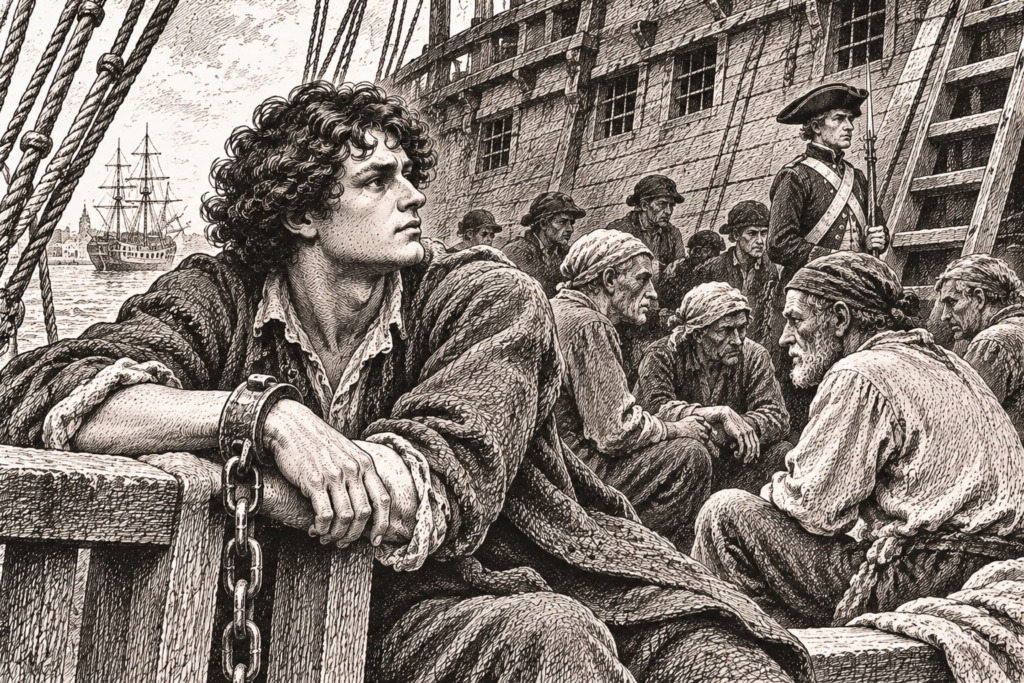
Jack placed aboard the Perseverance, one of the old naval vessels now serving as a prison hulk. Its decks, once crowded with sailors, had become the confined quarters of men awaiting transportation. For Jack, accustomed to the familiar streets and lanes of Kent, the vessel represented a new and more forbidding kind of imprisonment. His sentence had taken him from the world he knew, and here, among the other condemned men, he would wait for the day when he must leave England behind.
Aboard the Perseverance
The first impression was the smell.
It was close and unpleasant below deck, a mixture of damp wood, stale clothing, unwashed bodies and the confined air of too many men living together. Jack followed the officer down into the space where the prisoners were kept.
Men looked up as he entered. Some were lying down, others sitting against the sides of the vessel. A few were talking quietly, while one man coughed persistently in a corner.
“Another one for Australia,” someone called.
“Looks like it,” replied another.
Jack was directed towards an available place.
“That’s where you’ll sleep,” the officer told him. “Keep out of trouble, and do as you’re told.”
Jack glanced at the narrow space.
“Comfortable enough,” he said.
The officer gave him a hard look. “You’ll find it comfortable enough if you know what’s good for you.”
When the man had gone, a fellow prisoner moved closer.
“First time on a hulk?”
“First time on this one.”
“Then you’ll soon learn. What’s your name?”
“Kirby. John Kirby, though most call me Jack.”
“I’m Harris,” the man replied. “Been here some time. Where are you from?”
“Blean. Near Canterbury.”
“Ah. I’m from Essex. What did they send you up for?”
“Four geese.”
Harris looked at him, then laughed.
“Four geese! They must have been fine fat ones.”
“They weren’t worth seven years, if that’s what you mean.”
“None of us thinks our own crime worth the punishment. You’ll find that out.”
Jack smiled. He was not unused to men making light of their circumstances, and he recognised the value of a little humour in an uncomfortable place.
“What about you?” he asked.
“Burglary. Or so they say. I’ve had a few dealings with the law before, but this time they mean to send me away.”
“Have you been here long?”
“Long enough to know that waiting is the worst part.”
Learning the rules
Jack soon discovered that life aboard the hulk was governed by a routine very different from anything he had known.
The prisoners were watched, counted and given instructions by the officers. There was little privacy and no opportunity to wander about as he pleased. The vessel was crowded, and the men had to make the best of the space allotted to them.
Some had been confined for a considerable time. Others, like Jack, had arrived after a sentence of transportation and were waiting to be sent overseas.
The older prisoners knew the ways of the ship. They understood when to keep quiet, when to obey without argument and which officers were most likely to punish a man for the smallest offence.
Jack was quick to observe.
He had spent years learning how to judge people. In Canterbury, he had known which acquaintances could be trusted, which dealers would buy stolen goods and when it was wise to leave a place before trouble arose. On the hulk, those skills would serve him differently.
“Don’t argue with the warders,” Harris advised him one day.
“I don’t make a habit of arguing.”
Harris gave him a knowing look.
“Perhaps you haven’t met the right warder yet.”
Jack laughed, but he took the advice.
There was little to be gained by making enemies among the men who controlled his daily life. He had already learned that imprisonment could be uncomfortable enough without inviting punishment.
The food was plain, the quarters cramped and the air often unpleasant. The men had little choice but to endure the conditions. Some appeared to bear it better than others, while those who were ill or weak struggled with the confinement.
Jack had always been accustomed to movement. Even during his periods of honest employment, he had spent much of his day outdoors. He had worked in woods, fields and farmyards, and had been able to walk the countryside whenever he pleased.
Now he was confined within a vessel on a river.
He could see the world beyond the ship, but could not enter it.
Stories from home
The prisoners found ways to pass the time, and conversation became one of the few diversions available.
Jack occasionally spoke about his home. He told Harris about the countryside around Canterbury, the village of Blean and the woods where he had worked. He described the local markets and the public houses, and the people who had been part of his life.
“Do you miss it?” Harris asked him one evening.
“It’s home, isn’t it?”
“Not much to miss about my home.”
“Perhaps not. But I’ve lived there all my life.”
“Got a wife?”
“No.”
“Family?”
“My mother, brothers and a sister.”
He did not say much more.
There were things he might have told Harris: that his father had died when he was still a boy, that his mother had struggled to raise the family, and that he had repeatedly disappointed those who had tried to help him. He might have spoken of William Mutton, though that was a name he perhaps preferred not to remember too often.
Instead, he changed the subject.
“What about you? Anyone waiting for you?”
Harris shook his head.
“Not now.”
There was no need to ask further.
Jack had always been sociable, but prison brought a different kind of companionship. Men talked because there was little else to do. Some spoke of their families, others of their crimes, and many of the place to which they were being sent.
Australia was a word that seemed to dominate every conversation.
The country beyond the ocean
Few of the prisoners knew much about Australia.
Some had heard that it was a land of great heat, strange animals and unfamiliar people. Others repeated stories of hardship and disease. There were rumours about the work convicts would be expected to undertake, and about the possibility of being allowed to live more freely once their sentences had been served.
Jack listened to these accounts with varying degrees of interest.
“Have you any idea what it’s like?” he asked Harris.
“Not really. I’ve heard enough to know it isn’t somewhere I’d choose to go.”
“Do they have farms there?”
“Probably.”
“Woods?”
“Perhaps. Why?”
“I’ve worked in woods most of my life. I suppose I’ll find something to do.”
Harris looked at him.
“You think you’ll be given a choice?”
Jack smiled faintly.
“I’ve always managed to find something.”
It was the sort of answer he might once have given in Canterbury, when he had been confident that another opportunity would always present itself. But the circumstances were now very different. He was no longer free to choose where he went or whom he worked for.
The men had little reliable information about the settlement. Some imagined that they might eventually make a new life for themselves; others expected only punishment and hard labour. There was no certainty about what awaited them.
For Jack, the uncertainty was perhaps the most difficult part.
The long wait
The months passed.
Jack remained aboard the Perseverance, where the days followed much the same pattern: the opening of the hatches, the movement of prisoners, the calls of the guards and the slow passage of time. He had grown accustomed to the confinement, though not to the uncertainty of it. He knew that he was to be transported, but he had no idea when a ship would be ready to take him.
The transportation system was slow, and men could remain in custody for many months while arrangements were made. Jack’s future depended upon the availability of a vessel. At times the men must have wondered whether they would ever be sent away.
“Any news?” Jack asked Harris one morning, when he noticed a group of prisoners gathered near the hatchway.
“They’re making ready for another voyage to Botany Bay. That’s what I’ve heard.”
“Have they said when?”
Harris shook his head. “No. But it seems we’re not to be left here for ever.”
Jack looked towards the narrow strip of sky visible above them.
“One might almost wish they would make haste,” he said. “At least then we should know what we’re facing.”.
“Another month, perhaps?”
“Or another year. You can’t hurry the Navy.”
It was an answer he did not particularly like.
He had already spent months waiting, and the thought of another year in confinement was discouraging. Yet there was nothing he could do to hasten matters.
He had once been impatient with the slow progress of honest work. Now he had no choice but to wait for other men to decide his future.
A different kind of notoriety
News of the pamphlet occasionally reached Jack aboard the Perseverance, though never in any detail. He had no means of knowing how many copies had been sold, or how far beyond Canterbury his account had travelled.
One afternoon, Harris returned from a conversation with a newly arrived prisoner.
“There’s a fellow here who says he’s heard of you,” he remarked.
Jack looked up.
“Has he?”
“Apparently there’s a little pamphlet about a thief. A fellow called Kirby. He says it was being sold in Canterbury.”
Jack smiled.
“Then it must be me.”
“Have you really had your life printed?”
“Something of it.”
“What sort of things does it say?”
“Enough to keep a reader occupied, I should think.”
Harris laughed. “And what does it say about the man himself?”
“That depends upon who is reading it.”
The matter might have ended there, but a few days later another prisoner, an older man who had come down from London, mentioned having seen a copy of a small pamphlet about a notorious Kentish robber. He could not remember the title, nor whether he had actually read it, but he recalled the name Kirby.
Jack listened with evident satisfaction.
“Well,” he said, when the man had finished, “it seems I have travelled further in print than I ever managed on my own two legs.”
Harris laughed at that, but Jack’s amusement was not entirely assumed. For a moment he seemed pleased that something of him had escaped the walls of the prison.
Yet the pleasure could not last. Whatever interest his story had aroused in England, it made no difference to his circumstances. He was still confined aboard the hulk, still under sentence of transportation, and still waiting for the ship that would carry him away.
The other men soon lost interest in his literary distinction. They had their own stories, their own misfortunes and their own reasons for being there.
On the Perseverance, a man’s reputation counted for very little. His future depended not upon what he had done, but upon where the authorities intended to send him.
March 1791
News of the forthcoming embarkation gradually reached the prisoners. There was talk of ships being prepared and of men being selected for the voyage to New South Wales. Nobody seemed to know exactly when the transfers would begin, or which vessel would take them.
For Jack, the news brought the first real sense that his long confinement might be nearing its end. He had little to prepare. He possessed no home to leave behind, no furniture or belongings to pack, and no property worth protecting. His most valuable possessions were memories of the life he had known.
One evening, Harris turned to him.
“Looks as though our waiting may be nearly over.”
“Have you heard something?”
“They’re talking about moving men. Some are to go aboard the transport ships. I don’t know when, but it won’t be long.”
Jack was quiet.
“Are you frightened?” Harris asked.
Jack considered the question.
“I don’t know what to expect.”
“Neither do I.”
“Then I suppose we’ll find out together.”
Harris nodded. Neither man had anything more to say.
The Embarkation
The news came one morning, when the prisoners were still gathered in the narrow space between the sleeping quarters and the hatchway.
A warder appeared with a list in his hand. He called out several names, pausing after each while the men stepped forward. Some seemed to understand at once what was happening; others looked uncertain, glancing from one another to the warder.
When Jack heard his own name, he moved forward.
“Kirby?”
“Yes.”
“You are to be transferred. Make ready. You’ll be leaving with the others.”
“Leaving for where?”
“Portsmouth. You’ll learn the rest when you get there.”
Jack looked towards the men still standing behind him. Harris was watching.
“Looks as though it’s our turn,” Harris said.
Jack gave a small nod. He had imagined this moment often enough, but now that it had come he found himself strangely unprepared for it.
There was little to gather. A few worn possessions, a change of clothing and whatever small things a man had managed to keep through months of confinement. Jack had no bundle of any consequence. Everything he had once possessed, or thought he might possess, belonged to another life.
The journey south was uncomfortable and tiring. The men were kept together, watched by their guards and given little opportunity to speak freely. Jack had travelled many roads in his time, but never under such circumstances. Once he had been free to choose his direction, to take a turning or disappear down a country lane. Now every movement was decided for him.
As the days passed, the familiar landscape of Kent gave way to country he knew less well. He watched through the openings in the carriage or wagon whenever he could, trying to catch some glimpse of the world beyond the road. He wondered whether he would ever see the fields around Blean again, or the woods where he had spent so much of his youth.
At Portsmouth, the men were brought towards the harbour. The place was alive with activity. Sailors moved along the quays, carts carried provisions towards the ships, and officers and officials hurried between vessels. The air was filled with the cries of men, the creaking of ropes and the smell of tar, salt water and smoke.
Jack stood among the other prisoners, guarded and uncertain, looking towards the ships.
“Which one’s ours?” someone asked.
A man nearby pointed towards a vessel lying at anchor.
“That may be her.”
Jack followed his gaze. The ship looked larger from the water than any vessel he had known at close quarters. Men were moving across her decks, and boats passed between her and the shore.
“That’s the Albemarle,” a guard said. “You’ll be going aboard her.”
The prisoners were brought aboard in groups. Jack climbed the gangway, conscious of the guards behind him and the unfamiliar movement of the vessel beneath his feet. He found himself on a deck crowded with men, some silent, some talking nervously, others staring towards the shore.
He turned once more towards the harbour.
Somewhere beyond it lay the roads that led back into Kent. Beyond those, Canterbury, Blean and the familiar countryside of his childhood. He thought of his mother, of his brothers and sisters, and of the people whose lives had crossed his own. He wondered whether any of them would ever hear where he had gone.
He had spent much of his life moving from place to place, often to escape the consequences of what he had done. But this was different. There would be no slipping away down a dark lane, no hiding in a barn or finding shelter in a familiar village. The ship would carry him where others had decided he must go.