1787
Jack Kirby’s return to stealing gathered pace during the weeks following the Michaelmas cock-fight. The money he had won and the proceeds of his thefts had disappeared almost as quickly as they had come. He had returned to the familiar company of Canterbury, and once again he was moving between the villages, looking for opportunities to take whatever might be sold.
His recent encounters with Mr Twyman had shown how easily a theft could bring unwanted attention. Yet the prospect of being caught did not appear to deter him. If anything, each successful escape seemed to encourage him to take another chance.
He had become accustomed to living from one dishonest venture to the next.
Mrs Wilkinson’s poultry
One evening Jack went to the house of the widow Wilkinson at Blean.
The widow’s poultry offered an easy opportunity. Jack entered the premises and stole three and a half couples of fowls – seven birds in all.
He carried them to Canterbury, where he sold them for one shilling and sixpence a couple. The sale brought him a little over five shillings, enough to provide another short period of spending.
But Jack did not put the money aside. He remained in Canterbury, where he lost it at cards.
Gambling was another means by which his money disappeared. He could earn a little through honest work, make a profitable theft or win a wager, but he seemed unable to retain his money for long. A few hours in company, a game of cards and the expectation of another night’s entertainment could leave him with nothing.
Once his money was gone, he went looking for more.
The geese in the wood
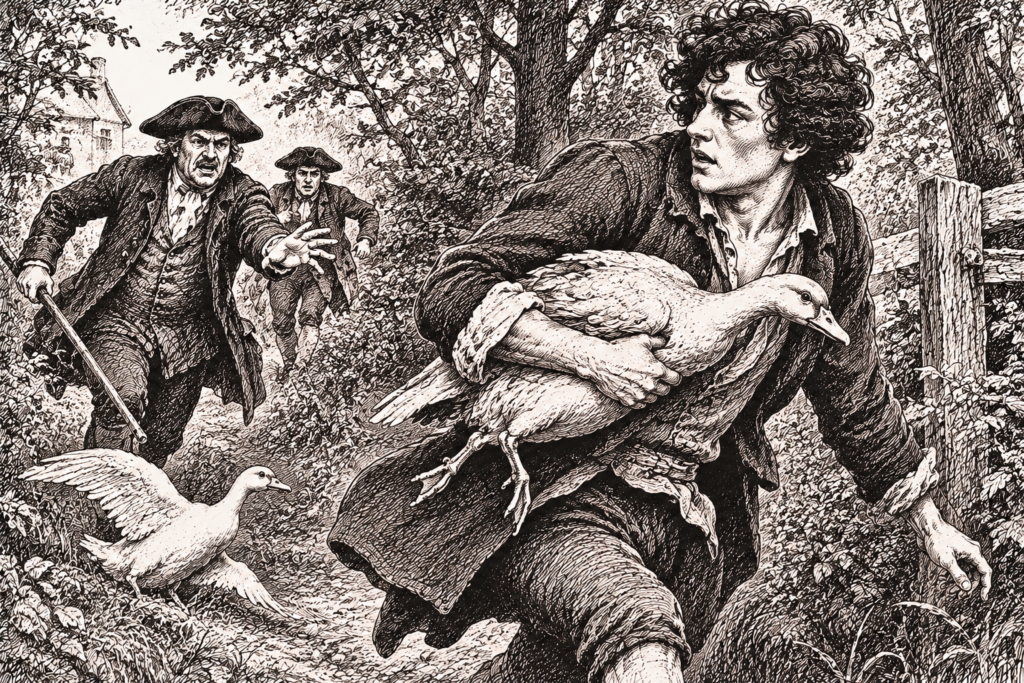
His next visit was to Robert Hayward’s property in the Wood at St Stephen’s.
Jack stole two geese.
This time, however, he was discovered.
He had barely made his escape when someone raised the alarm and pursued him. He managed to get away, but in the course of the chase he dropped one of the geese. He continued with the other.
It was a narrow escape, and one that might reasonably have persuaded him to leave the neighbourhood for a while. Instead, he went on to another familiar household.
He went back to Mrs Cullen’s at Blean and stole two geese, bringing both safely to Canterbury.
A companion at Milton Chapel
Soon afterwards, Jack travelled with one of his companions to Mr Sankey’s at Milton Chapel.
They arrived at about eight o’clock in the evening.
The arrangement of the house offered an opportunity. Two boys were in the stable, while the waggoner and his mate had gone to bed. Jack’s companion went into the kitchen, presumably to discover whether it was possible to enter the house without being seen.
He soon returned.
“Well?” Jack asked.
“I don’t like it,” the man replied. “There are people about.”
“Where?”
“In the kitchen. I think we’d best leave it.”
Jack looked towards the house. He had not come all that way to turn back without making an attempt.
“Show me the way upstairs,” he said.
His companion hesitated, then indicated the route. He was evidently unwilling to go further himself, but Jack was not so easily discouraged.
He entered a chamber where the master and the waggoner were sleeping. The room was dark and quiet. The men were asleep, and Jack had to move carefully to avoid waking them.
He noticed a watch lying near the head of the bed. He took it, along with two pairs of stockings and a silk handkerchief.
Then he got away.
The theft was more successful than the attempt at Hayward’s. No one raised an alarm, and Jack and his companion were able to leave without being stopped.
The stolen articles were taken to Canterbury. The watch brought eleven shillings, the stockings two shillings and the silk handkerchief one shilling and sixpence.
Once again, the two men returned to their usual Canterbury rendezvous and spent the money.
The house of William Stone
Jack’s next burglary was closer to home.
He went to the house of William Stone, near Blean. This time he gained entry by removing a pane of glass from a window.
Inside, he stole two shirts, a round frock, part of a meat pie, two plum puddings and part of a breast of mutton.
The choice of food is striking. The house contained clothing that could be sold, but Jack also took whatever provisions he could carry. The meat and puddings were not goods that would bring him a useful return through a pawnbroker or dealer. They were food for immediate consumption.
The shirts were sold for two shillings each. A man named White disposed of the gaberdine – the round frock – for two shillings at a place near Canterbury.
Jack had once again obtained a mixture of cash and provisions from a single visit.
But this time the theft was to bring him into direct contact with the law.
The hen-house at Blean
At about midnight on the same night, Jack went to the hen-house of John Dove at Blean.
He stole one fowl.
It was a small theft, and perhaps one that Jack expected to complete without difficulty. He had taken poultry from houses throughout the district and had often escaped detection.
But as he was leaving, Mr Dove and another man seized him.
“Hold him!” one of the men cried.
Jack struggled, but the two men had caught him before he could get away. They held him prisoner for the rest of the night.
For Jack, the situation was now very different. He was no longer able to disappear into the darkness or make his way back to Canterbury. He had been caught in the act, and the men who had apprehended him could keep him until he was brought before a magistrate.
The following morning, 7 February 1787, he was taken before a magistrate and committed to St Dunstan’s Gaol.
He was to be tried at the next Assizes for stealing the fowl.
There was another matter to be dealt with as well. Jack had failed to pay the ten-shilling fine imposed for taking hedge-stakes from Mr Twyman’s property. He had been allowed three days to pay, but instead he had gone away to Hastenleigh and continued stealing.
The authorities now ordered that he should be publicly whipped for running away and failing to pay the fine.
It was a serious turn of events. Jack had been free for only a relatively short period, and already he was back in St Dunstan’s Gaol.
A second charge
The charge relating to John Dove’s fowl was not the only difficulty awaiting him.
The burglary at William Stone’s house had also come to light.
On the Saturday following Jack’s arrest, Mrs Stone was going to market when she noticed the round frock he had stolen hanging at a salesman’s door in St Dunstan’s. She recognised it and made enquiries.
The salesman had obtained it from White.
When White was questioned, he told the authorities where he had got it, and a further charge was laid against Jack for breaking into William Stone’s house and stealing the property.
Jack’s position looked precarious. He had already been committed for trial, and the additional charge threatened to extend his imprisonment. He could no longer rely upon the possibility that the matter would be treated as a minor theft or that the owner might not be able to identify the property.
The next Assizes would decide his fate.
The difficulty of the parish boundary
When the Assizes came on, Jack was first tried for stealing the fowl from John Dove.
He was acquitted.
But immediately afterwards he was arraigned on the charge of breaking into William Stone’s house and stealing the shirts and other goods.
The case seemed straightforward. Mrs Stone had identified the frock, and White had explained how it had come into his possession. Jack’s own account does not suggest that he denied taking the property.
Instead, he challenged the location of the house.
William Stone had stated that his house stood in the parish of Saints Cosmus and Damian, Blean. Jack asked the judge for permission to address him.
“Your Honour, may I ask the witness a question?”
The judge allowed him to proceed.
“Mr Stone,” Jack said, “are you certain your house stands in the parish of Blean?”
Stone confirmed that it did.
Jack persisted. “I believe it stands in the Church Liberty, and not in the parish itself.”
The judge questioned Stone further. Under examination, Stone acknowledged that the house stood in the Liberty of Christ Church and not in the parish of Blean, as he had previously sworn.
The distinction proved decisive.
The judge directed the jury to discharge Jack.
It was an extraordinary escape. Jack had not been acquitted because the property had not been stolen or because the evidence had failed to connect him with the burglary. The case failed because the location of the house had been incorrectly stated, and the legal distinction between the parish and the liberty had become crucial.
Jack had once again avoided conviction.
Another chance
He returned to Blean.
There was no indication that the acquittal had changed his outlook. He had escaped the consequences of the Stone burglary through a legal technicality, but he had still been caught stealing from John Dove and had faced the prospect of public whipping for failing to pay the earlier fine.
His record was now substantial. He had stolen poultry, clothing, household goods and money. He had broken into houses and stables, and had been imprisoned repeatedly.
Yet he was still young, and there were people prepared to employ him.