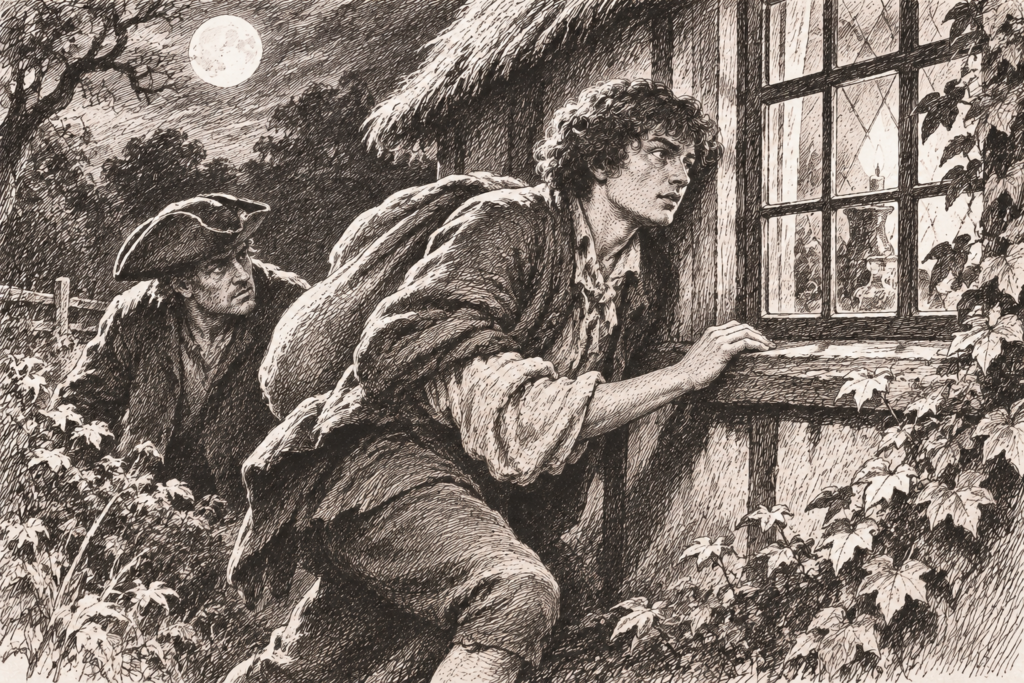
circa 1778–1780
By the time Jack was approaching seventeen, he had become a familiar face in certain parts of Canterbury, where he had found a circle of young men whose company he preferred to the routine of work and household responsibilities.
Thomas Rooke was by now his closest acquaintances. Thomas was a little older than Jack, or at least appeared more worldly. He knew the public houses, the streets and the people who frequented them. He was quick to make friends and had a ready answer for most questions. He also seemed to have a remarkable ability to find someone willing to buy almost anything, provided the price was right.
Jack found him entertaining and useful company. Thomas, in turn, valued Jack’s knowledge of the countryside around Canterbury. Jack knew the farms, the lanes and the habits of many of the people who lived in the villages.
There were usually three or four other young men with them. Their circumstances varied. Some found occasional work as labourers or farm servants, while others had no settled employment at all. They were not particularly interested in the prospect of spending their days working for a modest wage. They preferred to drink, gamble and enjoy themselves, and when their money ran short they looked for ways of replenishing it.
Their gatherings often began innocently enough. They might meet in a public house, play cards, discuss the day’s news or make arrangements to go somewhere together. But as the evening wore on, conversation frequently turned towards money and the possibility of obtaining it without too much effort.
Jack was learning how these young men operated. He was not the most experienced among them, but he was beginning to understand that his knowledge of the surrounding villages could be put to use.
One evening, while they were together in Canterbury, the conversation turned to Mr Edward Sandy of Blean.
A visit to Mr Sandy
Jack knew the Sandy property well. The family was established in the village, and the house had a lodge and stable. There was poultry kept on the premises, and Jack knew that a quantity of fowls could be found there.
Thomas listened as Jack described the place.
“Is there much poultry there?” he asked.
“Enough to make it worth our while,” Jack replied.
“And who keeps watch?”
“That depends on the hour. There are people about during the day, but it is quieter later on.”
One of the other young men leaned forward.
“Could we get in without being seen?”
Jack considered the question. He knew the approaches to the property and had some idea of where the birds were kept.
“I think so. There are several ways of getting close without going by the front of the house.”
Thomas looked at the others.
“Then perhaps we should pay Mr Sandy a visit.”
There was some discussion about the number of men required. They decided that five would be sufficient. It would be easier to divide themselves around the property, with some keeping watch while the others went in search of the poultry.
The plan was not particularly elaborate, but they were confident that they could manage it.
They agreed to meet later that evening.
Jack returned to Blean before the appointed hour. He did not tell his mother where he intended to go, and she had no reason to suspect that he was preparing for anything unusual. He was accustomed to spending evenings away from home, and Mary had become resigned to the fact that he was increasingly difficult to keep under her eye.
After dark, Jack made his way to the meeting place. The others were already there, and they set off together towards Sandy’s property.
It was around ten o’clock when they arrived.
The night was quiet. They separated, each taking up a position intended to prevent anyone from surprising the others. Jack and his companions approached the lodge and set about removing the poultry.
They managed to take eighteen fowls, or nine couple, and also found a pair of boot-shoes in the stable.
The work was completed without anyone raising an alarm. The men gathered what they had taken and made off, carrying the poultry and shoes away from the property.
They were pleased with themselves. The theft had been straightforward, and they had obtained enough goods to make the evening worthwhile.
Thomas was in particularly good spirits.
“That was easier than I expected,” he remarked as they moved away from the house.
“There’s no reason to make a difficult job of it,” Jack replied.
One of the others laughed.
“Perhaps we should find another place before the night is over.”
Jack had not yet considered doing so, but the suggestion was not unwelcome.
The tithe feast at the Hare and Hounds
As they made their way home, they learnt that a tithe feast was being held that evening at the Hare and Hounds on the Common.
The public house was a familiar meeting place for people from the surrounding farms and villages. On this particular evening it was unusually busy. Farmers, farm workers and neighbours had gathered there, and the rooms were full of conversation and laughter.
The feast was an occasion for people to enjoy themselves after the business of the agricultural year. Tithes had long been part of rural life, and the arrangements surrounding them could bring landowners, farmers and church representatives together. Such occasions were not always conducted without disagreement, but once the business was concluded there was often an opportunity for a meal and some drinking.
At the Hare and Hounds, the atmosphere was lively.
The landlord and his family were kept busy serving ale and bringing food to the tables. Tankards were being filled, plates passed from hand to hand and conversations carried on across the room. Men who had spent the day working in the fields were glad of an opportunity to sit down, while others had come simply to enjoy the company.
There was talk of the harvest, the condition of the roads, the price of grain and the usual affairs of the neighbourhood. Some of the older men sat together discussing matters of business, while younger ones were more interested in the beer and the general entertainment.
Jack and his companions were passing near the public house when he noticed Mr Foreman and another neighbour going inside.
He knew that Foreman had a lodge nearby.
Jack slowed his pace and watched the two men disappear through the doorway.
Thomas noticed him looking.
“What have you seen?”
“Foreman has gone into the Hare and Hounds.”
“Well, what of it?”
“His lodge is close by. If he is going to remain here for the evening, there may be an opportunity.”
Thomas looked towards the public house.
“Is there anything worth taking?”
“Geese,” Jack replied. “There are four, or thereabouts.”
One of the others was less enthusiastic.
“We’ve already got the fowls. Why not leave it there?”
“Four geese would be worth having,” Thomas said. “We need only two men.”
Jack agreed that he would go with one of the others. The remaining men could continue on their way, and the two who went to the lodge would rejoin them afterwards.
They did not spend long discussing the matter. The attraction of obtaining more goods was too strong, and Jack was confident that he knew enough about the place to make the attempt.
The four geese
The two men approached Foreman’s lodge.
They were careful as they made their way towards the geese, but the birds were restless. As they attempted to remove them, one began to make a considerable noise.
The disturbance alarmed Foreman’s servant, who came running out of the house in his shirt. He had heard the geese and realised that something was wrong.
The men were already moving away, but the servant saw one of them leaving the lodge. He hurried towards the neighbouring property of Mr Bird, hoping to raise the alarm and obtain assistance.
Jack and his companion managed to escape with the four geese. They hurried away from the immediate neighbourhood, but they knew that the servant had seen someone, and there was a possibility that he might recognise them.
“We cannot carry these about with us,” Jack said.
“Why not?”
“Because if we meet anyone, we shall have to explain what we’re doing with four geese at this time of night.”
His companion agreed.
They found a suitable place in the wood and concealed the birds, intending to return for them later. Jack knew the surrounding countryside well and was able to choose a spot where the geese would not be immediately discovered.
Once they had hidden them, they considered what to do next.
It was then that Jack suggested going to the Hare and Hounds.
His companion looked at him in surprise.
“What business have we there?”
“To drink a little beer.”
“After what has just happened?”
“All the more reason. Foreman’s man has seen someone leave the lodge. If he comes looking for us, it will be useful to have been seen elsewhere.”
His companion hesitated, but Jack was persuaded that the idea had merit.
They made their way to the public house.
An unexpected alibi
The Hare and Hounds was still crowded when Jack entered. The feast was in full swing, and the noise inside made it difficult to hear individual conversations. Men were laughing, drinking and talking, and the landlord was moving between the tables with the assistance of his family.
Jack found a place and ordered beer.
He was careful not to appear hurried or anxious. He had no wish to attract attention, and he knew that the more naturally he behaved, the less likely anyone was to question his presence.
His companion sat nearby.
For a few minutes they drank quietly, listening to the conversations around them. Jack was conscious of the possibility that Foreman’s servant might arrive, but he did not know whether the man had recognised either of them.
Then the door opened.
Foreman’s servant came in, accompanied by Mr Bird.
The servant was still agitated. He spoke to those nearby, explaining that someone had been stealing the geese from the lodge. He described hearing the birds make a noise, running out of the house and seeing a man leaving the premises.
Several people began asking questions.
“Did you see who it was?” one man asked.
“Not clearly,” the servant replied. “I saw a man coming out of the lodge, but it was dark.”
“Was he carrying anything?”
“I could not say. I ran towards Mr Bird’s house as soon as I saw him.”
Mr Bird added that they had gone back towards the lodge but had been unable to find the thief.
Jack listened without appearing particularly interested.
The servant then noticed him.
He looked at Jack for a moment, apparently considering whether he might have been the person he had seen. Jack knew that he was familiar with the area and that the servant might have reason to suspect him.
But then the man remembered something.
“Had I not seen you here,” he said, “I might have thought you were the fellow I saw coming out of the lodge.”
Jack looked up from his beer.
“Why should you think that was me?”
“Well, you know the place, and you were about thereabouts.”
“But I’ve been here drinking,” Jack replied.
Mr Bird looked towards the servant.
“That is true enough. We have seen him here.”
The servant appeared satisfied. The fact that Jack had been in the public house seemed to settle the matter, and the conversation moved on to other subjects.
Jack said little more. He remained with his beer, allowing the evening to continue around him.
His companion was equally relieved, although he was careful not to show it.
When they eventually left, Jack could scarcely believe how fortunate they had been. The very man who might have identified him had been persuaded that he could not have been responsible because he had seen him in the public house.
Outside, his companion laughed quietly.
“That was a close thing.”
“Not so close,” Jack replied. “We were seen here, and that is what matters.”
“Foreman’s man might have recognised you.”
“He might have done. But he did not.”
They made their way back towards the place where the geese had been hidden.
The proceeds
The following day the men met again to dispose of what they had taken.
The poultry from Mr Sandy’s property was sold in Canterbury. They received one shilling and eightpence for each couple of fowls, while the four geese from Foreman’s lodge brought two shillings. The pair of boot-shoes fetched twenty pence.
The money was divided among the men.
There was no great fortune to be made from the night’s work, but the proceeds were enough to provide several evenings of drinking and entertainment. The men were pleased with the result, and there was little discussion of the possibility that either Mr Sandy or Mr Foreman might discover who had taken their property.
Thomas was particularly pleased with Jack’s contribution.
“You knew where to go, and you knew how to get us there,” he said. “And then you managed to put yourself in the very place where Foreman’s man would look for you.”
Jack smiled.
“It was fortunate that he came into the house.”
“Fortunate? I’d call it clever.”
Jack did not disagree.
He was beginning to enjoy the regard in which the others held him. His liked being treated as someone whose opinions mattered. For a young man who had often been criticised by his father for his idleness and lack of application, this was a welcome change.
He was also discovering that the company he kept offered rewards that were immediate. The money might not last long, but there was always another evening, another public house and another opportunity to find more.
A growing circle
The thefts from Mr Sandy and Mr Foreman were among the first occasions on which Jack had worked with a group of young men in this way. They had been successful, and the experience encouraged further discussions about what might be obtained from other properties.
Jack continued to spend time with Thomas Rooke and the others. They met in Canterbury, sometimes at the same public houses and sometimes in different parts of the town.
However, Jack was still living at home, and Mary continued to expect him to contribute what he could. He did not always have money to give her, and she was not pleased when he returned late or failed to explain where he had been.
Yet he was increasingly reluctant to spend his time at home. He preferred the company of his new acquaintances, who did not question his habits or remind him of the responsibilities he ought to be undertaking.
Thomas Rooke was particularly influential. He knew how to make things happen and seemed to have a solution whenever the group needed money. Jack was learning from him, although he was also developing ideas of his own.
His knowledge of the countryside gave him an advantage. He knew which farms were close to the main roads, which houses had outbuildings and where animals were kept. He also understood the habits of the people who lived there.
The men had begun to recognise that Jack could provide information that they did not possess themselves.
It was not long before he was invited to join them in other ventures.
There was, however, another young man whose acquaintance Jack was soon to renew, and whose influence would prove far greater than that of Thomas Rooke.
His name was William Mutton.
Jack and Mutton (as he was known) were almost the same age, both having been born in November 1761. They had known something of the same world, although their family circumstances and experiences had been different. Mutton came from Kingston, but he had connections that brought him into the Canterbury and Blean neighbourhood.
At this stage, Jack had not yet formed the close association with him that would later become so important. Their paths were about to cross more frequently, and before long the two young men would become inseparable companions.
For the present, Jack was content with the company he had found and the money he was able to obtain. The countryside around Blean was familiar, Canterbury offered excitement, and there seemed to be no shortage of young men willing to join him in whatever enterprise might provide their next evening’s entertainment.