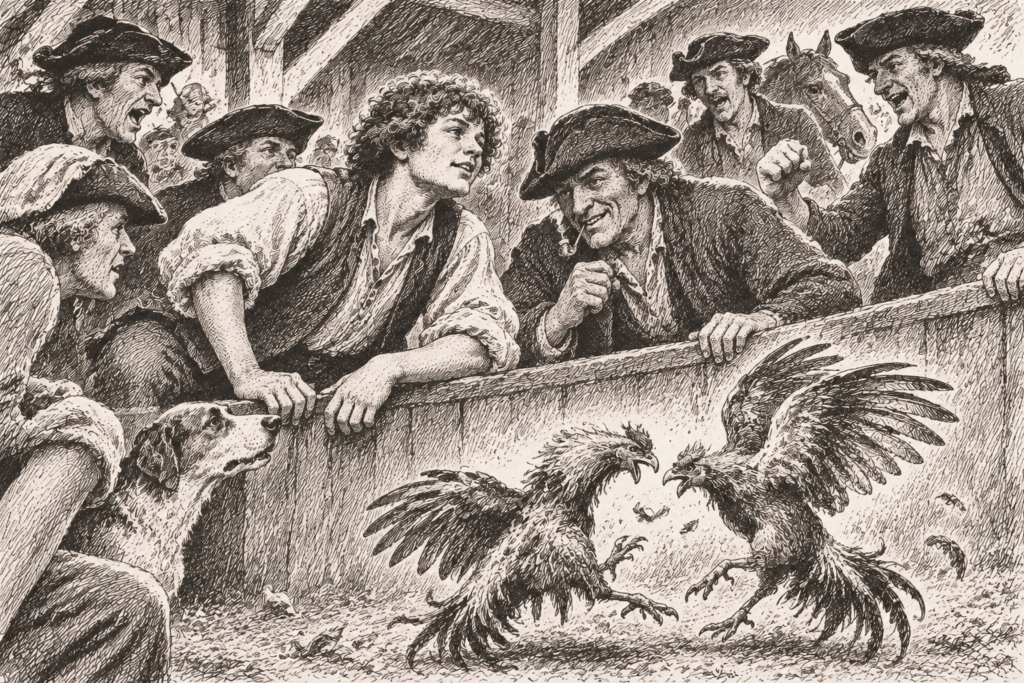
circa 1780–1783
The Boxing Day match at the Red Eagle had been talked about in Canterbury for several days. Jack had heard of it while drinking with some acquaintances, and the prospect of making a little money from the occasion appealed to him.
He had already discovered that there were people willing to wager considerable sums on the outcome of a cockfight. A good gamecock could attract a great deal of attention, and a man who could provide one without having to pay for it was in a favourable position.
Jack knew where he might find such a bird.
Mr Twyman of Blean kept several gamecocks, and one in particular had caught Jack’s attention. It was a fine, strong bird, with the sort of appearance that would attract interest at a match. Jack had seen it in the yard often enough to know its habits.
A few nights before Boxing Day, he went to Twyman’s premises and stole it.
He took the cock to a friend who was willing to enter it in the match. Beforehand, the bird was cut out of its feathers, changing its appearance so much that anyone who knew it would have difficulty recognising it.
“Are you sure this is the one you want to enter?” his friend asked, turning the bird over in his hands.
“Why not? He’s a strong cock.”
“He looks a little the worse for wear.”
“That won’t trouble him in the pit. He’s got plenty of fight in him.”
His friend was not entirely convinced, but Jack assured him that the bird would do well. They agreed that Jack would receive five shillings for lending it for the first battle, with a little more if it proved successful.
The match at the Red Eagle attracted a lively crowd. Men came in from the villages, and there was no shortage of spectators willing to stake money on their favourite birds. Jack did not need to take an active part in the fighting. He was content to wait and hear how his cock performed.
It won its first battle.
The victory caused some excitement, and the bird was entered for a second contest. It won again, and Jack received a further two shillings and sixpence.
His friend returned with the money and a broad smile.
“Well, you were right about him. He’s a fine fighter.”
“I told you so.”
“You might have told me he was worth more than five shillings.”
Jack laughed.
“You had your share of the business. I had mine.”
The cock was returned to Jack. He took it back to Blean and put it into Twyman’s yard among the other birds. Its altered appearance was enough to deceive its owner, who supposed it to be a strange cock that had found its way in among the hens.
For a fortnight Jack left it there, apparently satisfied that the trick had succeeded. Then he returned and stole the same bird again.
This time it was entered in another match at the Red Eagle. It won its first battle but was killed in the second.
Jack had made money from the bird twice, and there was now no danger of its being recognised by its owner. He gave the matter little further thought.
His attention had already turned to something else.
The dogs at Blean
Jack had always been interested in dogs. As a boy he had followed the hounds whenever he could, and his knowledge of the countryside had made him familiar with the packs kept by the local gentlemen.
He understood that a good hunting dog was valuable. He also knew that people who wanted dogs for hunting or breeding were sometimes willing to pay well for them.
One of the dogs he had noticed belonged to Edward Sandy, the same Mr Sandy whose poultry he and his companions had taken some time earlier. Sandy kept a bitch at his property in Blean, and Jack knew where she could be found.
He also knew that Mr Wootton owned a dog which was kept at Peyton’s.
Jack decided to take both animals.
He managed to remove the bitch from Sandy’s and the dog from Peyton’s without being challenged. Once he had them, he set off towards Folkestone, where he knew a man who regularly dealt in animals.
The man’s name was Samuel Pike. He was not a particularly sociable fellow, but he was practical and knew the value of a good dog. Jack had dealt with him before and had found him willing to pay for animals that were brought to him.
Pike examined the two dogs when Jack arrived.
“Where have you found these?”
“One is a bitch, the other a dog. Both are good animals.”
“I can see that. But are they used to hunting?”
“They know what they’re about.”
Pike looked them over, paying particular attention to their condition.
“Seven shillings and sixpence for the pair,” he said at last. “And I’ll give you a puppy as well.”
Jack considered the offer. He had hoped for a little more, but the puppy might be worth something in Canterbury.
“Very well,” he replied. “We’ll settle it.”
He left Folkestone with the puppy and returned towards Canterbury. At the Compasses in St Peter’s, he found a huntsman who was interested in buying it. The man paid five shillings, and Jack was once again satisfied with the result of his journey.
But he had not finished with dogs.
The composition
The following morning, Jack was on his way towards Old Park when he came across a pack of hounds. He believed they belonged to Mr Dean, although he was not certain of their ownership.
The dogs had been out and were tired. They were moving about together, some resting while others wandered in search of water.
Jack stopped to watch them.
He knew that it was difficult to approach a strange pack and simply lead away two hounds. They were trained to remain together, and a dog that became separated might bark or run back towards the others. But Jack had discovered a way of attracting their attention.
He carried with him a small quantity of what was known as composition. It was a prepared, strongly scented mixture, used to entice dogs by appealing to their sense of smell. Jack had found that a hound which might otherwise ignore a stranger could be persuaded to follow the scent. He kept some with him whenever he intended to deal with dogs, and he had become confident in its effectiveness.
He took a little from his pocket and allowed the dogs to catch the smell.
At first they merely looked towards him. Then one of them, a liver-coloured hound with a white circle around its body, began to approach. A red and white bitch followed.
Jack did not hurry. He allowed them to come closer, offering the scent again and moving away a little at a time. The other dogs showed some interest, but the two he wanted were the most persistent.
When he was sufficiently far from the pack, he turned and led them away.
It was a simple deception, but it worked.
Jack took the hounds to Folkestone and found Pike.
The dealer recognised him at once.
“Back again, are you?”
“I’ve brought you something.”
Pike looked at the two animals and smiled.
“More hounds! Where did you find these?”
“Out towards Old Park.”
“They look a useful pair.”
“They are.”
Pike examined them, then offered five shillings for each. Jack accepted. He was beginning to understand that Pike was becoming a reliable source of money, and that a man who regularly bought dogs might also be persuaded to take other things.
While they were settling the payment, Pike mentioned that he had another use for Jack.
“I’ve been wanting an old horse,” he said. “Nothing too fine. I need one to feed my dogs.”
Jack looked at him.
“Would you take one if I could find it?”
“If it was suitable, certainly.”
“I could bring you one tomorrow.”
Pike considered this.
“Then do so. I’ll pay you fourteen shillings.”
Jack agreed. He had no particular horse in mind at that moment, but he knew the farms around Blean well enough to find one.
He left Pike with the hounds and set off for home.
The mare from Broomfield
That evening Jack went into Broomfield, near Blean church. Mr Smith kept a mare there, and Jack had noticed the animal on previous occasions.
He took it from the property and rode through the night towards Folkestone.
The journey was long, but Jack knew the roads. He arrived at about eight o’clock the following morning, tired but pleased to have completed what he had promised.
Pike was ready for him.
“Well, you’ve kept your word,” he said, looking at the mare.
“I said I would.”
Pike examined the animal briefly and paid the fourteen shillings. The mare was taken away, and Jack did not ask what became of her. He had been paid, and that was all he wanted to know.
Pike appeared impressed by his reliability.
“You have a knack for finding what I need,” he remarked. “There may be more business between us.”
“That would suit me.”
“Have you any more dogs?”
Jack knew that he had two hounds belonging to a subscription pack concealed at home. He had taken them some time earlier and had kept them out of sight.
“I may be able to find you a pair,” he said.
“Bring them tomorrow, if you can.”
Jack returned to Canterbury and made arrangements to take the animals to Folkestone the following day.
He was as good as his word. Pike paid seven shillings and sixpence for each dog, and they were subsequently shipped to France.
Jack now had a regular contact who was prepared to buy the animals he brought. He was no longer relying entirely on chance encounters or persuading someone in Canterbury to take a stolen dog. He knew where he could go, what Pike wanted and roughly what he could expect to receive.
The money was soon spent, however, and Jack decided to remain in Folkestone for a day or two with an acquaintance there.
The sound of the hounds
Jack had not forgotten his interest in hunting. One morning, while he was staying in Folkestone, he heard the cry of the hounds and went out to see the hunt.
The sound brought back something of the pleasure he had known as a boy, when he followed the dogs through the countryside around Blean. He joined the people watching the hunt and went along for a time, enjoying the movement and excitement.
Afterwards, he found an opportunity to enter the kennel.
He knew that the dogs would be settled there after the hunt, and he managed to remove two without being discovered. One was called Famous and the other Doxey.
He took them back to Canterbury and sold them for eight shillings.
The theft was not without risk. These were known hounds, and anyone familiar with the pack might recognise them. Jack nevertheless believed that he could dispose of them before questions were asked.
He also had a puppy which he had stolen a short time earlier. He was later informed that it belonged to the same huntsman to whom he had sold Famous and Doxey. Whether the man had recognised the puppy or simply learnt of its ownership, Jack did not know.
He decided to take it back to Folkestone.
This time he travelled with the puppy and a noted bitch of his own. He sold the puppy to Pike for three shillings and left the bitch in the care of his friend, George Hales, who was pleased to have a good hunting dog to use.
“You can leave her with me,” George said. “I’ll see that she’s properly looked after.”
“She’s a good bitch. Don’t let anyone take her from you.”
“I think I can manage that.”
Jack was content to leave the animal there. He had sold what he wanted to sell, and he could always return for the bitch when he wished.
A change of mind
For all his activity, Jack was not entirely without moments of reflection. There were times when he thought seriously about the life he was leading and wondered whether he ought to find some regular employment.
He had periods when he kept away from his companions and tried to earn money honestly. He knew that his mother would welcome such a change, and he was not unaware of the disappointment he had caused her.
On one occasion, after returning to Canterbury, he resolved to put an end to his dealings in stolen goods.
He had money enough for the moment and thought he might do better by finding work. He had known the woods since childhood and could earn a living as a labourer. There was no reason, he told himself, why he could not return to something like the life his father had led.
For a short time he kept to his resolution.
But it did not take long for his old acquaintances to find him. They were in difficulties themselves, without money and, as Jack later described it, without even sufficient food.
They approached him with a suggestion that they should go out together.
Jack refused at first.
“I’ve had enough of it,” he told them. “I’m going to leave that sort of work alone.”
One of the men laughed.
“Since when have you become so particular?”
“I’m serious. I’ve made up my mind.”
“We’re not asking you to do anything very difficult. Only come with us tonight.”
Jack shook his head.
“You know what I think of it.”
But the others continued to press him. They reminded him of the money he had made, the good times they had enjoyed and the fact that he had never been short of company when he was willing to join them.
Jack listened. His resolve began to weaken.
He knew that returning to them would mean returning to the same habits he had tried to abandon. Yet he found it difficult to refuse their entreaties, particularly when they were so persistent.
In the end, he agreed.
It was a decision he would soon regret, although not sufficiently to prevent him from making the same choice again.
The poultry at Sandy’s
One of the places Jack knew particularly well was the property of Edward Sandy at Blean. He had already stolen fowls from there with his companions, and he was familiar with the arrangement of the house and outbuildings.
He knew that Sandy kept poultry and that the birds were worth taking.
One evening, Jack went to the property at about nine o’clock. He did not immediately approach the house. Instead, he concealed himself on the gratten-wall, where he could watch and listen without being seen.
He remained there for some time.
Eventually, Sandy came outside and spoke with a waggoner. Their conversation concerned the work of the day, and Jack listened carefully. During it, he heard that a key was kept in a hole in the wall.
That was just what he needed.
He waited until the men had finished and the house had settled. Then he made his way to the place where the key was hidden, found it and used it to gain access.
Inside, he took nineteen fowls, leaving an old cock and a stag behind.
He got away without being disturbed and carried the birds to a place where he could arrange their sale. They were disposed of for one shilling and sixpence a couple.
Jack had now robbed Sandy’s property on more than one occasion. He knew the family, knew the premises and had learnt something of the habits of those who worked there. The familiarity made the theft easier, but it also meant that he was taking advantage of people who had known him since he was a boy.
He did not dwell on that thought.
The rabbits at Wildcourt
A few nights later, Jack turned his attention to Mr Fleet’s property at Wildcourt.
Fleet kept rabbits, and Jack knew that there were enough to make a worthwhile theft. He went there after dark and took eight and a half couple.
He was able to remove them without attracting attention. The rabbits were taken to Canterbury and sold through the same sort of contacts he had used before.
The proceeds provided money for himself and his companions, and once again the group spent much of it as quickly as it had been obtained.
Jack was becoming accustomed to this pattern. He would find something to take, arrange a sale and spend the money. When it was gone, he would look for another opportunity.
There was little thought of saving for the future. The immediate pleasure of having money in his pocket mattered more.
The geese at the Hare and Hounds
His next theft was to bring an end to his freedom for a time.
The Hare and Hounds on the Common was familiar ground to Jack. He knew Mr Lawson, who was associated with the public house, and knew that geese were kept there.
He decided to take two.
He went to the premises and managed to remove the birds. But this time he did not have a ready buyer waiting for him, and he took them to a publican outside Westgate in Canterbury.
The publican looked at the geese and asked where they had come from.
“From a man who has no further use for them,” Jack replied.
The man was not entirely satisfied.
“Whose are they?”
“That need not concern you.”
“It concerns me if I am expected to buy them.”
Jack tried to persuade him, but the publican recognised the birds as belonging to Lawson. He was unwilling to complete the transaction.
Word soon reached the authorities.
Jack had been fortunate on earlier occasions, but his luck was running out. The theft was reported, and he was apprehended. He was taken before the magistrates and committed to St Dunstan’s Gaol on 23 November 1783.
As he was led away, he could see the familiar streets of Canterbury around him. He had spent so many evenings there in the company of his friends, drinking, gambling and arranging the sale of stolen goods. Now he was being taken through the town under arrest.
He had always believed that he could find a way out of difficulty. If one buyer refused, there was another. If someone became suspicious, he could move elsewhere. If a theft went wrong, he could leave the neighbourhood for a while and return when the danger had passed.
But this time he had been caught.
For the first time, Jack was to discover what it meant to lose his liberty.
Part III – A Life of Crime
Chapter Five – An Old Companion