1783–1784
Jack had not expected to spend the winter in St Dunstan’s Gaol. Until his arrest over the two geese, he had managed to avoid any serious consequences for his activities. He had been questioned and suspected on occasion, but he had always found a way to escape trouble.
Now he was confined in Canterbury, waiting to appear before the Quarter Sessions at the Old Castle.
The first few days were uncomfortable. Jack was accustomed to going where he pleased, meeting his friends and finding amusement whenever he had money in his pocket. The restrictions of prison life were difficult to accept. He was obliged to remain where he was told, eat what was provided and wait for the proceedings to take their course.
He was also anxious about the charge. Mr Lawson had recognised the geese, and the publican to whom Jack had tried to sell them was likely to be called upon to give evidence. Jack knew that the circumstances looked bad.
One morning, another prisoner asked him what he was expecting.
“To get out of here,” Jack replied.
“That is what we’re all hoping for.”
“I’ve done nothing that can be proved.”
The man laughed.
“That is not always the same thing.”
Jack gave him an unfriendly look and turned away.
He had begun to understand that the case would depend upon what the witnesses could actually establish. Lawson might say the geese were his, but had anyone seen Jack take them? Had the publican seen him steal them, or merely brought him into possession of birds that he claimed to have obtained elsewhere?
Jack was determined not to make matters worse by saying too much.
When his case came before the court, he pleaded not guilty. The prosecution called the witnesses who could speak to the missing geese and their subsequent appearance at the publican’s house. But the evidence did not establish beyond doubt that Jack had taken them from the Hare and Hounds. The publican could describe the attempted sale, and Lawson could identify his birds, but neither could say that he had witnessed the theft itself.
Jack’s counsel made much of this.
“My client is accused of stealing two geese,” he said. “Yet no witness has seen him take them. The fact that he offered them for sale is suspicious, perhaps, but suspicion is not proof.”
The magistrates and jury considered the evidence. Jack waited anxiously, trying to read their expressions.
When the decision was given, he was acquitted.
For a moment he scarcely believed it. Then he realised that he was free to leave.
Outside, the air seemed unusually fresh. He stood for a little while, looking at the familiar streets, and felt the satisfaction of a man who had escaped something unpleasant.
He had been fortunate. He knew that much. But rather than take the experience as a warning, he regarded it as another example of how easily he could get himself out of difficulty.
Back in Blean
When Jack returned home, Mary was relieved to see him.
She had worried during his imprisonment, although she had tried not to show it to the younger children. She had heard enough about the circumstances of his arrest to know that he had been in serious trouble, and she feared that he might be sent away or kept in prison for a long time.
“Thank God you’ve come home,” she said when he entered.
Jack put down his belongings.
“It was not as bad as you feared.”
“You were in gaol, Jack. I don’t know how you can speak of it so lightly.”
“I was acquitted. They could not prove anything.”
Mary looked at him.
“That does not mean you did nothing.”
Jack avoided her eyes.
“I have had enough of it for now.”
She wanted to believe him. There had been so many disappointments since Nathaneal’s death, and she still hoped that her eldest surviving son might settle into a more dependable life. He was old enough to work and strong enough to earn his living. There was no reason why he should continue to spend his time with men who brought him nothing but trouble.
A few days later, the parish officers of Blean made arrangements to help him return to work. They provided him with tools, and Jack was given an opportunity to earn money in the woods.
He was glad of the assistance. He had little money left, and the prospect of regular work was welcome enough, at least for the moment.
The tools were not elaborate: those needed for the ordinary work of cutting and preparing timber and underwood. Jack knew the woods well, having spent so much of his childhood there with his father. He understood the work and was capable of doing it when he chose.
For two or three months he worked steadily.
The days were spent among the trees, cutting, gathering and preparing wood. It was familiar labour, and there were times when Jack almost seemed to have returned to the life he had known before his father’s death. He was paid for his work and had enough to contribute something towards the household.
Mary was pleased by the change.
“You’re looking better,” she remarked one evening as he came in.
“I’ve been working hard.”
“And you have money in your pocket?”
“A little.”
“Then perhaps things are beginning to improve.”
Jack said nothing. He was not displeased with the work, but he did not find it particularly satisfying. The hours were long, the pay modest, and the evenings quiet. He had become accustomed to a more exciting existence, and he missed the company of the men with whom he had spent so much time in Canterbury.
He was also beginning to think that he could earn more money in a single night than he could make in several days in the woods.
It was during this period that William Mutton came to see him.
The return of William Mutton
Jack knew Mutton from earlier days. They had moved in some of the same circles, and there was a familiarity between them that did not require much explanation. Mutton was a man who enjoyed company and had little inclination to settle into a quiet routine.
He appeared at the Kirby home one afternoon while Jack was away at work.
Mary answered the door.
“Is Jack at home?”
“He’s working in the woods. Who shall I say has called?”
“William Mutton. He’ll know me.”
Mary looked at him with some reserve. She had heard the name before, though she could not have said precisely how well she knew the man.
“Would you like to wait?”
“I’ll come back later. Tell him I’ve called.”
When Jack returned that evening, Mary mentioned the visitor.
“William Mutton came looking for you.”
Jack looked up.
“Mutton? Did he say where he was going?”
“No. He said you would know him.”
Jack seemed pleased.
“I haven’t seen him for some time.”
“Is he a friend of yours?”
“An old acquaintance.”
Mary did not pursue the matter, although she was not entirely reassured. She had hoped that Jack’s return to work would bring a change in his habits, and she was not keen to see old companions appearing at the door.
Mutton returned the following day.
This time Jack was at home. The two men greeted one another warmly, and it was clear that they were pleased to meet again.
“Well, Jack, I hear you’ve been keeping yourself busy.”
“There’s work enough in the woods.”
“That sounds a dull business.”
“It pays.”
Mutton laughed.
“Then you must be doing better than I am.”
They sat together for a while, talking about people they knew and what had happened since they had last spent time together. Mutton had his own stories to tell, and Jack was interested to hear what had become of their old acquaintances.
Before long, the conversation turned to Canterbury.
“Come into town with me,” Mutton suggested. “We’ll have a drink and see who’s about.”
Jack hesitated.
“I’ve been working all day.”
“Then you’ve earned yourself a drink.”
Jack glanced towards the room where his mother was occupied. He knew that she would not approve, but he was not inclined to refuse.
“Very well. Give me a few minutes.”
Mary saw them preparing to leave.
“Don’t be late, Jack.”
“I won’t.”
“And don’t spend all the money you’ve earned.”
Jack smiled, but made no promise.
The two men set off towards the Common.
The Red Lion
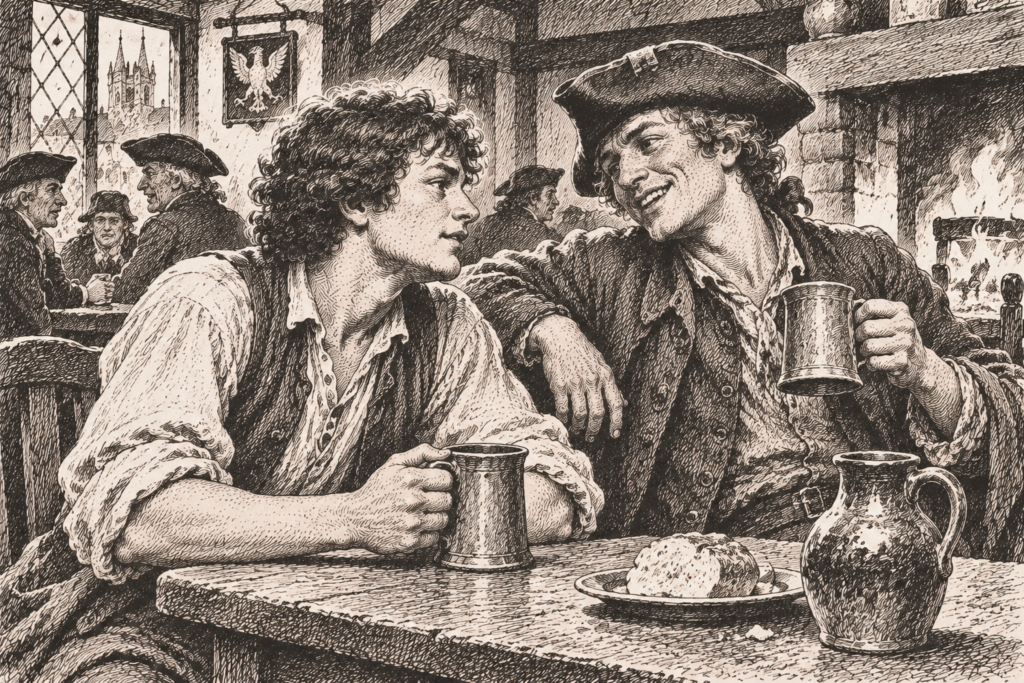
The Red Lion was a familiar stopping place for people travelling through the neighbourhood. It attracted local labourers, waggoners and men from the surrounding villages, and there was usually someone to talk to.
Jack and Mutton settled themselves inside and ordered beer.
They had plenty to discuss. At first they talked about their work and the people they knew. Then they began to recall earlier adventures and the sort of money they had once been able to make.
Mutton was not impressed by Jack’s account of working in the woods.
“Two or three months cutting timber,” he said. “And what have you to show for it?”
“Some money.”
“How much?”
“Enough.”
“Not enough to keep you here drinking all evening, I should think.”
Jack laughed.
“You’ve always been able to spend money faster than you can earn it.”
“That is because I know how to enjoy myself.”
They ordered more beer. As the afternoon passed into evening, other customers came and went. The landlord was busy, and the room became noisier. Jack and Mutton remained at their table, talking and drinking.
They had not intended to spend the whole evening there, but neither was anxious to leave.
At some point Mutton noticed that their money was nearly gone.
“That is the trouble with drinking,” he said. “It takes all your money and leaves you wanting another pot.”
“Then we should have stopped earlier.”
“Perhaps. But there is no use regretting it now.”
Jack looked around the room.
The Red Lion was a substantial house, with a number of rooms and a busy household behind the public bar. A waggoner was staying there, and the horses would need attention early in the morning. Jack noticed the arrangements around the back of the building and began to consider whether there might be something worth taking.
Mutton followed his gaze.
“What are you looking at?”
“Nothing in particular.”
“That usually means something.”
Jack lowered his voice.
“There’s plenty in this house that could be carried away.”
Mutton looked around more carefully.
“Such as?”
“Hams. There’s some hanging in the chimney. And there are other things in the rooms.”
Mutton leaned back.
“Do you know how to get in?”
“Not yet.”
“Then perhaps we should find out.”
The two men were now looking at the house with a different purpose. They paid attention to the doors, the rooms and the movement of the people working there. They did not make an immediate attempt. Instead, they remained until they had a better understanding of the household routine.
By the time they left, they had spent all their money.
They parted for the night, but neither had forgotten what they had discussed.
Four o’clock in the morning
Jack returned to the Red Lion early the following morning.
The hour was still dark, and there was little movement outside. He waited near the back of the house, keeping out of sight.
Mutton joined him.
“Have you been here long?”
“Not long.”
“Anything happening?”
“Not yet.”
They waited quietly.
Before long, the waggoner appeared. He was preparing to attend to his horses and left the back door on the latch as he went outside.
Jack watched him disappear towards the stables.
“Now,” he whispered.
The two men slipped through the back door.
Inside, the house was quiet. They knew that the family and guests were still asleep, and they moved carefully through the rooms.
The three hams were hanging in the chimney. Jack and Mutton removed them and gathered the other things they had noticed the previous evening: a large table spoon, a tea spoon and about half a pint of halfpence from a cupboard.
Mutton examined the hams.
“These will fetch something.”
“Don’t stand there admiring them. We need to get out.”
They gathered the goods and made their way back through the door.
The waggoner was still occupied with his horses. Neither man was seen, and they managed to leave the premises without raising an alarm.
Once they were safely away, Mutton laughed.
“That was worth getting up for.”
Jack was pleased with the result. They had taken a good quantity of food, some silver and a little money, and had done so without waking anyone.
They made their way towards Canterbury.
The sale in the Borough
The hams were bulky, and the two men needed to dispose of them without attracting too much attention. They took them into the Borough, where they found someone willing to buy them.
Their correspondent examined the meat.
“Where did you get these?”
“From a house where they had more than they needed,” Mutton replied.
The man looked at him.
“That is not much of an answer.”
“It is the only one you’re going to get.”
He weighed the hams and agreed to pay fivepence a pound. Jack and Mutton accepted the price.
The silver and halfpence were also disposed of, and the two men divided the proceeds.
For a time they enjoyed having money again. They spent it in Canterbury, drinking and entertaining themselves. There was no attempt to put anything aside, and before long the proceeds of the Red Lion theft had disappeared.
Mutton was the first to suggest that they should go their separate ways.
“I have some business elsewhere,” he said.
Jack was not particularly concerned.
“I may go back to Blean.”
“Will you be staying in the woods?”
“For a while, perhaps.”
Mutton laughed.
“Then I shall have to come and rescue you again.”
They parted without making any firm arrangement to meet.
Jack returned to Blean. He had been away from the woods for longer than he intended, and he knew that his mother would ask where he had been. He had little to show for the money he had earned or the time he had spent with Mutton.
Mary was waiting when he came in.
“You have been away most of the night.”
“I was in Canterbury.”
“With that friend of yours?”
“Yes.”
She looked at him carefully.
“I thought you were going to make a fresh start.”
“I am working, Mother.”
“That is not what I mean.”
Jack was silent.
Mary had no proof of what he had been doing, but she knew that his old habits were returning. She had seen it before: the late nights, the money spent as quickly as it came, and the companions who appeared whenever Jack had something to offer.
She turned back to her work.
Jack went upstairs, leaving her with her worries.
The time he had spent in the woods had not been wasted entirely. He had earned some money and had shown that he was capable of working honestly. But the arrival of Mutton had reminded him of another life, one that promised more excitement and quicker rewards.
The two men had discovered that they worked well together. Mutton was bold and sociable, while Jack knew the local countryside and had a growing understanding of the opportunities around Canterbury.
Their theft at the Red Lion was modest, but it marked the beginning of a partnership that would soon become far more serious.
For now, they had gone their separate ways. It would not be long before they met again.