1785
Jack Kirby’s escape from St Dunstan’s Gaol left him once again at liberty, but he knew that he could not remain in the neighbourhood indefinitely. His recent troubles had made him too well known, and the authorities would hardly be pleased to discover that a prisoner sentenced to remain in gaol had slipped away before he could be returned to his cell.
For a short time, he kept out of sight. But Jack had never been particularly good at remaining idle. The habits he had acquired over several years were difficult to put aside, and the prospect of making a little money was soon more tempting than the uncertain safety of doing nothing.
Almost immediately after his escape, he returned to stealing.
His first opportunity came at Dean-strood Common, where he stole three couple of fowls belonging to Mr Anderson. The birds were taken away and sold at Boughton for five shillings. It was a modest return, but Jack was not inclined to refuse money simply because the amount was small.
He had scarcely finished disposing of the fowls when he turned his attention to animals at Tyler Hill. There he stole a mare, an ass and a foal belonging to William Tylor. The animals were removed from the property and taken to Boughton, where the ass and foal were sold for nine shillings.
Jack was moving about with some confidence, but his position was becoming increasingly precarious. He had escaped from gaol, and anyone who recognised him might reasonably suspect that he was involved in the thefts taking place in the surrounding villages. He was also taking risks in places where his face was familiar.
Yet the prospect of a quick profit continued to outweigh his caution.
While at Tyler Hill, he noticed three shirts lying over a hedge. Whether they had been put there to dry or left temporarily by someone working nearby, Jack saw an opportunity and took them. He carried the shirts away and sold one at Boughton for three shillings. The other two he kept for himself.
It was a careless decision. The shirts were not simply anonymous goods which could be passed from one buyer to another. They belonged to someone who might recognise them, and Jack had no particular reason to suppose that their owner would not make enquiries.
He was soon to discover just how quickly a small theft could lead to another arrest.
Some time later, while travelling at Ospringe, Jack was recognised and taken by two post-boys. They knew enough about him, or had sufficient reason to suspect him, to detain him and take him towards Canterbury.
Jack was in no position to resist them openly. He was outnumbered, and the two men were determined to bring him back. For the time being, he had little choice but to accompany them.
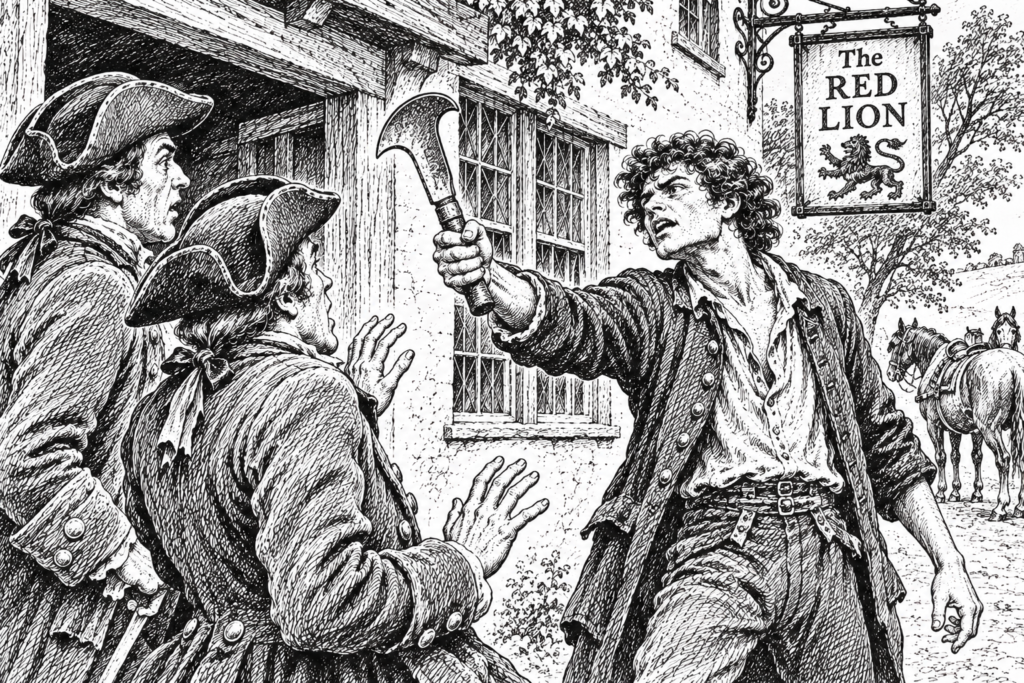
The journey was interrupted when they stopped at the Red Lion, a half-way house on the road to Canterbury. The post-boys went inside, and Jack found himself with a brief opportunity to consider his position.
He was not a man who readily accepted defeat. As he looked about the premises, he noticed an agricultural bill lying in the window. He seized it.
The post-boys had not expected their prisoner to arm himself, and when Jack threatened them with death if they pursued him, they were forced to reconsider their position.
“Keep back!” he shouted, raising the bill.
One of the men moved towards him, but Jack stepped forward.
“I mean it. Come after me and you will have cause to regret it.”
The two men hesitated. They had been responsible for bringing him into custody, but they were not prepared to risk serious injury in trying to hold him. Jack took advantage of their uncertainty and made his escape.
He had once again slipped away from those who were attempting to take him back to gaol.
It was a bold and dangerous act, and one which would have done little to improve the post-boys’ opinion of him. They had been charged with taking a prisoner to Canterbury and had allowed him to escape in circumstances which they could hardly explain away.
Jack, meanwhile, was free. He had the two remaining shirts in his possession, and he may have thought that the incident was behind him. But the post-boys were not prepared to let the matter rest.
About three days later, they came upon him again at Judge Folly Hill.
This time there was no convenient implement lying in a window, and Jack was unable to repeat his earlier escape. The same two men took him into custody and brought him back to St Dunstan’s Gaol.
The shirts had provided the reason for his arrest. He was taken before Colonel Webb, where the matter was connected with the theft of Mr Calvert’s property at Tyler Hill. Mr Calvert lodged a detainer against him on 28 October, and Jack was to be tried at the Old Castle in Canterbury.
For a second time, he found himself behind the walls of St Dunstan’s.
He must have wondered whether his luck had finally deserted him. His first escape had lasted only a few days, and the post-boys who had allowed him to get away had now succeeded in capturing him again. The prospect of another trial and a further period in gaol was hardly encouraging.
Yet once again, the proceedings did not result in a conviction, and he was discharged.
Jack had escaped punishment, but he had little reason to believe that he could safely remain in Blean. His name was now associated with several recent thefts, and his escape from custody would hardly be forgotten. He needed to get away from the immediate neighbourhood, at least for a while.
It was at this point that William Mutton came back into his life.
A few days after Jack’s release, he fell into company with Mutton. The two men had been companions for some time, and they knew one another’s habits well. Mutton was familiar with the difficulties Jack was facing and understood that it would be unwise for him to remain in the Canterbury district.
“You cannot go on like this,” Mutton remarked when they met.
“Like what?”
“Being taken, escaping, and being taken again. They will have you back in gaol before long.”
“They have not managed to keep me there yet.”
“Not for want of trying.”
Jack laughed, but he knew that Mutton was right. His recent freedom had been short-lived, and he could not expect to escape every time he was caught.
“I have no wish to stay here,” he admitted. “There are too many people who know me.”
“Then come away with me.”
“Where?”
“Sussex. I used to live near Cowbridge. There may be opportunities for us there.”
Jack considered the suggestion. A journey away from Blean offered the prospect of a fresh start, at least temporarily. He had no intention of giving up his old habits, but he could see the advantage of operating somewhere less familiar.
“Very well,” he said. “Let us go.”
They set out together for Sussex.
As Mutton had lived in the Cowbridge area he knew something of the surrounding farms and roads, it was a useful advantage. Jack was accustomed to finding opportunities wherever he went, but having a companion who knew the district made their journey easier.
It was not long before they found what they were looking for.
At Cowbridge, they discovered a farmer’s stable in which a valuable black mare was kept. The animal had a flagged tail, and its appearance suggested that it was worth considerably more than the ordinary farm horses they might encounter.
Mutton knew the area, and the two men were able to make their arrangements without attracting immediate attention. They stole the mare from the stable and took her away.
Jack was pleased with their success.
“She is a fine animal,” he remarked.
“Worth a good deal more than the last one we had,” Mutton replied.
“Sixteen pounds, perhaps.”
“Then we shall not get sixteen for her.”
“No. But I know a man who will take her.”
Jack had his acquaintance at Folkestone in mind. The man had bought stolen animals from him before, and Jack believed he would be willing to purchase the mare.
They made their way back towards Kent and eventually took the animal to Folkestone. Their friend agreed to buy her, but offered only seven guineas, despite the mare being worth about sixteen pounds.
Jack was not entirely satisfied with the price, but he had little choice. A stolen horse was not something he could easily sell openly, and the buyer knew that Jack was anxious to dispose of her.
“Seven guineas,” the man said. “That is what I will give you.”
“She is worth more than twice that.”
“Then you should take her somewhere else.”
Jack looked at him. He knew that the man was unlikely to improve his offer.
“Very well. Seven guineas.”
The money changed hands, and the mare was taken away. She was subsequently sent to France, beyond the reach of anyone who might have recognised her.
Jack and Mutton had made a considerable sum from the theft, though not nearly as much as the animal was worth. They were satisfied enough. The immediate danger had passed, and they now had money to spend.
They returned to Canterbury and fell in with their usual companions. For a time, they lived comfortably, spending their money on drink, company and whatever diversions took their fancy. They had no great interest in keeping their gains for long, and it was not until every farthing had been spent that they began to consider what they might do next.
Their money gone, they returned to Blean.
Jack had not forgotten the Red Lion on the Whitstable Road. He had already burgled William Strood’s house with Mutton in revenge for the handkerchief affair, and the two men knew that there were provisions to be found there. Whether they were motivated by resentment, the prospect of an easy profit, or simply the knowledge that the house was worth another visit, they decided to break in again.
They chose a night when the household was settled and the road quiet.
The Red Lion was a substantial inn, and its stores were valuable. There was pork kept on the premises, and Jack and Mutton knew that a quantity of meat could be sold in Canterbury without too much difficulty. They were also familiar with the Borough, where they had a correspondent willing to buy stolen goods.
During the night they broke into the house and stole five scoreweight* of laying pork.
It was a considerable quantity, and the men had to remove it carefully. They made their way away from the inn with their stolen goods and took the pork to Canterbury.
Their correspondent in the Borough was known as Rosy P. He was prepared to buy the meat at fourpence a pound, and the two men were able to turn their night’s work into money.
The sale was completed, and once again Jack had profited from a visit to the Red Lion.
There was something particularly audacious about returning to the same house after having already burgled it. William Strood had been the cause of Jack’s earlier imprisonment, and the inn had already suffered a substantial loss at the hands of Jack and Mutton. Yet the men had returned, apparently confident that they could take what they wanted and escape notice.
Jack had little reason to believe that his fortunes would improve if he continued in this way. He had been arrested twice, escaped once, and been discharged after a further accusation. He had travelled into Sussex to avoid the attention of those who knew him, stolen a valuable horse and returned to Kent to resume his old activities.
The money from the mare had lasted only a short time, and the pork from Strood’s inn would soon be spent as well.
There was always another opportunity, another house or another animal to steal. Jack had become accustomed to living from one successful theft to the next, and he showed little inclination to consider where that life might eventually lead.
But his next venture would bring him into contact with someone whose kindness he had known since childhood: the widow Cath Cullen, whose house at Blean he had once entered as a young servant.
He had not forgotten her, and she had not forgotten him.
* scoreweight – an old mercantile reckoning by the score of twenty pounds avoirdupois