1786–1787
The execution of William Mutton left Jack to face the consequences of the burglary at Blean alone.
He had escaped the gallows, but he had not escaped punishment. The court had ordered him to remain in gaol for twelve months unless he could find sufficient sureties for his good behaviour. In other words, he might be released before the twelve months had passed, but only if he could find people willing to guarantee that he would keep the peace.
For Jack, that was a difficult condition to meet.
He had little money, no settled employment and a reputation that was hardly likely to encourage respectable neighbours to put their own property at risk on his behalf. He had given evidence against Mutton, but his cooperation had not erased his part in the robbery. The authorities knew that he had entered the house, helped to terrorise the two women and shared in the proceeds.
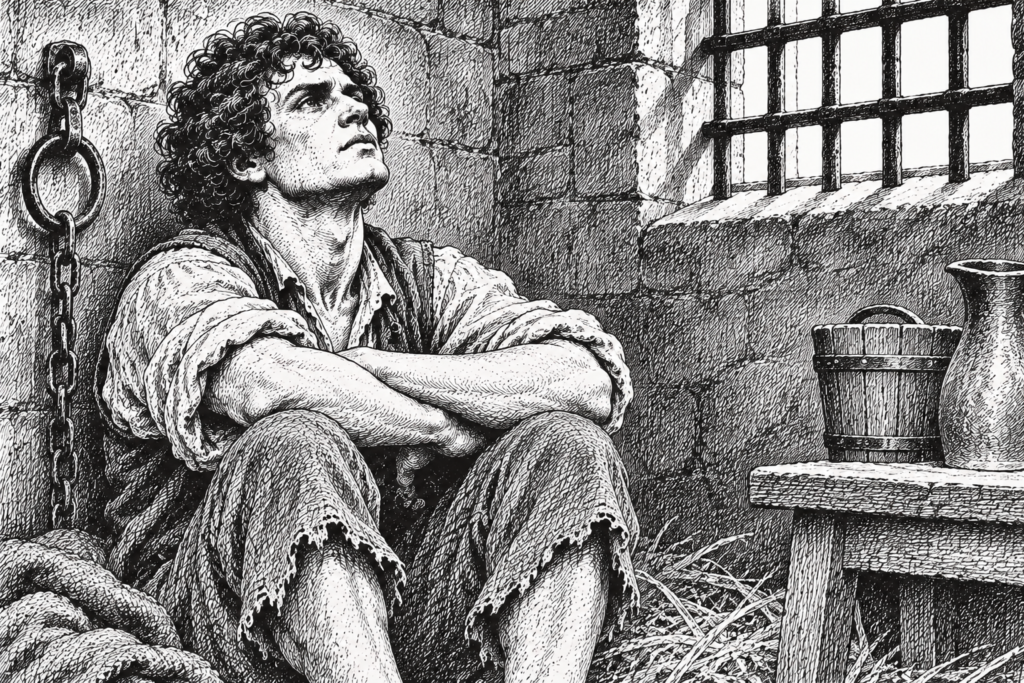
He therefore remained at St Dunstan’s Gaol.
The empty place beside him
Mutton’s absence must have been keenly felt.
For several years the two men had been companions. They had travelled together, stolen together and shared the rewards of their crimes. Their friendship had survived periods of separation, and even after Jack had given evidence against him, Mutton had continued to speak to him.
Now he was gone.
He had, at least, been spared the same end as his companion.
But there was a price attached to that survival. Jack knew that Mutton had been condemned for a crime in which they had both taken part. He had saved himself by telling the authorities what had happened, and the knowledge could not have been entirely comfortable.
There were no more journeys with Mutton, no more evenings spent drinking together in Canterbury, and no companion with whom to discuss their next opportunity. The partnership was finished.
Jack was left with his own thoughts and the prospect of a long confinement.
The waiting
The months at St Dunstan’s passed slowly.
Outside, the countryside continued its familiar course. The seasons changed, harvest was gathered, and the roads between Blean and Canterbury remained busy with farmers, carriers and travellers. Jack, who had spent so much of his life moving about the district, was now unable to go where he pleased.
He could no longer call at a public house, visit an acquaintance or wander through the woods. He could not earn money by working, nor could he spend it in the company of the people who had so often encouraged him to seek more.
His circumstances were especially frustrating because he had not received a fixed sentence of twelve months. The court had left open the possibility of release if he could find sureties. That meant he might have been able to leave earlier, but he had no obvious means of doing so.
He must have wondered whether anyone would come forward.
Perhaps he thought of his mother and the family at Blean. His father’s reputation had once been a source of respect for the Kirby household, but Jack’s own behaviour had brought embarrassment and trouble. Mary had already endured the loss of her husband and the burden of raising the younger children. It is difficult to imagine that Jack would have wished to add to her difficulties, though he had done so often enough.
He may have hoped that someone who remembered his father would be prepared to help him. Yet there was a difference between feeling sympathy for a young man and putting one’s own money at risk to guarantee his conduct.
No one appears to have been willing to do so.
As the months went by, Jack had little choice but to wait.
The name he would carry home
There was another matter that troubled him as he thought about his eventual return to Blean.
The burglary at Mrs Brett and Mrs Widdett’s house had been a particularly cruel offence. It was not simply a matter of stolen silver or money. The women had been threatened in their bedrooms, and their home had been invaded by men who had shown little regard for their age or helplessness.
Jack had taken part in it.
He might have hoped that his decision to turn King’s evidence would distinguish him from Mutton in the eyes of the authorities. But the two women had no reason to regard him as less responsible. He had been one of the men who entered their home, and he had helped to keep them silent while the robbery continued.
He would be returning to a small parish where people knew one another. News travelled quickly, and the story of the burglary would not be forgotten simply because Mutton had been executed.
Jack had once been the son of an industrious and respected man. Now he was known as a thief who had helped rob two elderly women and then given evidence against his companion.
It was not a reputation that could easily be put aside.
A disturbance at Blean
While Jack remained in gaol, the two women were to suffer another alarm.
In October 1787, more than a year after the original burglary, someone attempted to break into the house of Mrs Brett and Mrs Widdett again.
It was early on a Wednesday morning. The intruder did not succeed in gaining entry. The women managed to raise the alarm by ringing a hand-bell and calling to their neighbours from a chamber window. Faced with the prospect of discovery, the would-be burglar abandoned the attempt.
The incident was reported in the Kentish Gazette and it recalled the earlier robbery and named Mutton and Kirby as the men responsible. It also referred to Mutton’s execution and Jack’s imprisonment, explaining that Kirby had been ordered to remain in gaol until he could find security for his good behaviour.
The report stated that no person had appeared against him at the last Maidstone Assizes and that he had consequently been discharged.
It went on to describe him as having lurked about the parish of Blean, to the great terror of the two elderly women.
The attempted burglary was not attributed to Jack, but the report mads clear that his name remained associated with the women’s fear. Even after Mutton’s death, they had reason to remember the men who had broken into their home.
For Mrs Brett and Mrs Widdett, the return of an unknown intruder must have brought back memories of that terrible night. The hand-bell and the cries for help were enough to drive him away, but the sense of insecurity remained.
The gates open
When the prison gates opened in 1787, Jack was still only twenty-five.
The familiar roads lay before him again. He could return to Blean, walk into Canterbury and seek out the people he knew. Yet he could not expect to be received as though nothing had happened.
The parish officers had once provided him with tools and helped him return to work after an earlier imprisonment. Whether they would be prepared to show him the same kindness again remained to be seen.
He would also have to face his neighbours.
Some might have remembered his father and felt sympathy for the family. Others would have regarded Jack with suspicion or anger. Mrs Brett and Mrs Widdett, in particular, had every reason to be distressed at the prospect of his return.
Jack could not change what had happened. He could only decide what to do next.
A fresh beginning?
There was, at least, a possibility of returning to honest employment.
Jack knew how to work in the woods. He had earned money by in this way on several occasions. He was not incapable of making a living honestly, nor was he without people who might employ him if he showed himself willing.
In the months that followed, he would work again. His was first employed by Mr Glover in Mrs Webb’s wood, followed by further work for Mr Dove. He earned good wages and considered himself to have worked industriously.
But a prison sentence, even one that lasted more than a year, could not by itself change a man’s habits.
Jack returned to Blean with his freedom restored, but with little else. He was without a settled future, and still drawn towards the quick rewards of the life he had led.
For a time, he worked honestly.
But it would not last.