1788
Jack Kirby had once again escaped conviction. His acquittal at the Assizes, following the affair at William Stone’s house, had brought him back to Blean, but it had done little to improve his reputation. He was still known as a man who could not be trusted, and there were few households in the neighbourhood where his presence would have gone entirely unnoticed.
Yet he was fortunate in one respect. There were still people prepared to employ him.
Perhaps they hoped that regular work might at last persuade him to abandon his dishonest ways. Perhaps they simply needed men who knew the woods and were willing to labour for their wages. Whatever their reasons, Jack found employment with Mr Glover in Mrs Webb’s wood.
Mrs Webb’s wood
The work suited him.
Jack had grown up in the woodland country around Blean. His father had taken him into the woods when he was a boy, and he had learned how to handle tools, cut timber and gather the scattered branches and undergrowth that could be put to use. The work was familiar, and he was strong enough to undertake it without difficulty.
He applied himself with what he later described as the greatest industry.
The summer passed, and he earned a good deal of money. There was a satisfaction in receiving wages for work completed, and for a time he had no need to seek out the dealers and acquaintances who had helped him dispose of stolen property.
He was also able to enjoy something that had become increasingly unfamiliar to him: the confidence of an employer.
A man who turned up when expected, worked steadily and completed the task given to him might be regarded differently from one who was constantly suspected of theft. Jack seemed, for a while, to be making a fresh beginning.
At the end of the summer, however, he found himself working for a man who knew rather more about his character than most.
John Dove, who had recently apprehended him over the theft of a fowl, looked after a wood and needed labourers. Despite their previous encounter, he employed Jack for five weeks, paying him an average of about thirteen shillings a week.
It was a considerable improvement on the uncertain proceeds of petty theft.
Dove had every reason to be cautious, but perhaps he believed that Jack’s willingness to work was genuine. Jack, for his part, had little reason to complain. The wages were regular, and the work was within his abilities.
For five weeks the arrangement continued without apparent difficulty.
The remaining timber
When the work was finished, Dove allowed Jack to collect the sticks scattered about the wood.
There was always material left behind after a wood had been worked: branches, pieces of cut timber and smaller lengths that could be gathered for fuel. It was common enough for such remnants to be put to use rather than left to decay.
Dove’s son had already taken away two loads.
Jack began gathering what remained.
He worked at it until he had collected enough to make a load of his own. He loaded the timber onto a waggon and set off towards Canterbury, expecting to sell it.
He may have thought himself fortunate. The work had cost him little beyond the effort of gathering and loading the wood, and he stood to receive a useful sum without having to steal anything.
The load was worth fifteen shillings.
But before he could receive the money, Dove appeared with another man.
“Where are you taking that wood?” Dove demanded.
“To Canterbury,” Jack replied. “I’m going to sell it.”
“You have no right to sell it.”
“I had leave to gather what was left in the wood.”
Dove was not satisfied. He accused Jack of taking wood belonging to a gentleman in the neighbourhood, and the disagreement quickly became more serious. The two men stopped him before the sale could be completed.
They insisted that the load contained timber which did not belong to Jack. They took charge of the waggon, reloaded the wood and drove it away to the gentleman’s house.
Jack’s account maintained that he had permission to gather the scattered sticks. He also insisted that there were not three faggots in the load that could properly be claimed as the gentleman’s property.
But the accusation was not easily dismissed. Dove had employed him and allowed him to collect the remaining wood; the question was whether Jack had taken more than he had been given permission to take.
Jack did not remain to argue.
While Dove and his companion dealt with the waggon, he ran away.
It was a curious ending to a period of honest employment. For five weeks he had earned his wages without difficulty, and now, over a load of wood, he found himself fleeing from the very man who had trusted him with work.
Another theft from Mr Twyman
That same evening, Jack returned to a familiar way of obtaining money.
He went to the stable of Mr Twyman at Blean and broke in, stealing a jacket and a pair of pumps.
It was a particularly reckless choice. Mr Twyman had already encountered Jack over the hedge-stakes, and Jack had previously stolen from his property. He was taking a considerable risk by returning to the same household.
But caution had never been one of Jack’s strongest qualities. He seems to have been more concerned with the immediate need for money than with the possibility that his latest theft might bring him to the attention of the authorities.
The jacket was sold for two shillings and the pumps for one shilling and sixpence.
It was not a large return, but Jack had once again avoided leaving empty-handed.
He was now in the position of a man who had fled from an accusation of stealing wood and, before the day was over, had committed another theft.
The running match at Mersham
Jack next went to a running match at Mersham.
Such gatherings offered more than the spectacle of a race. Men might compete for money or wagers, and spectators came from the surrounding villages to watch, meet acquaintances and enjoy an afternoon away from their ordinary occupations. There would be opportunities for conversation, betting and drinking, and Jack was well acquainted with that kind of company.
He may have expected to spend the day without attracting particular notice.
But he was recognised.
A constable took him into custody and brought him before a magistrate. The complaint concerned the load of wood, and John Dove’s oath was the basis of the charge.
Jack was committed to St Dunstan’s Gaol on 21 June 1788.
The Kentish Gazette of 24 June gives a fuller account of the matter. It reported that John Kirby had been committed on the oaths of Joseph Dove, Edward Sandy and others, charged with stealing and carrying away a load and a quarter of bundle wood, containing about sixty-two bundles, from a wood belonging to William Deedes, Esquire, in the parish of Whitstable, on 18 June.
The newspaper account makes clear that the accusation concerned a substantial quantity of timber, rather than simply a few scattered branches. It also names several witnesses, including Joseph Dove and Edward Sandy, whereas Jack’s own account places John Dove at the centre of the confrontation.
The two accounts do not give precisely the same picture, but they agree on the essential matter: Jack had been accused of taking a load of wood and had been sent to gaol to await trial.
Back in St Dunstan’s
For Jack, the return to prison must have been a bitter disappointment.
He had spent the summer working for Mr Glover and had then been employed for five weeks by Dove. He had earned regular wages and had been allowed to collect the remaining timber.
Now he was back behind the walls of St Dunstan’s.
He may have felt that he had been treated unfairly. In his own account, he was quite clear that he had been given permission to gather the wood. He did not regard himself as having stolen a load of timber in the ordinary sense. The dispute, as he saw it, concerned what he had been entitled to take after the work in the wood had finished.
But there was another side to the matter. Dove had employed him and had given him an opportunity to earn an honest living. Whatever the original permission had covered, the load had been challenged before Jack could sell it. And his decision to run away had done little to make his explanation appear convincing.
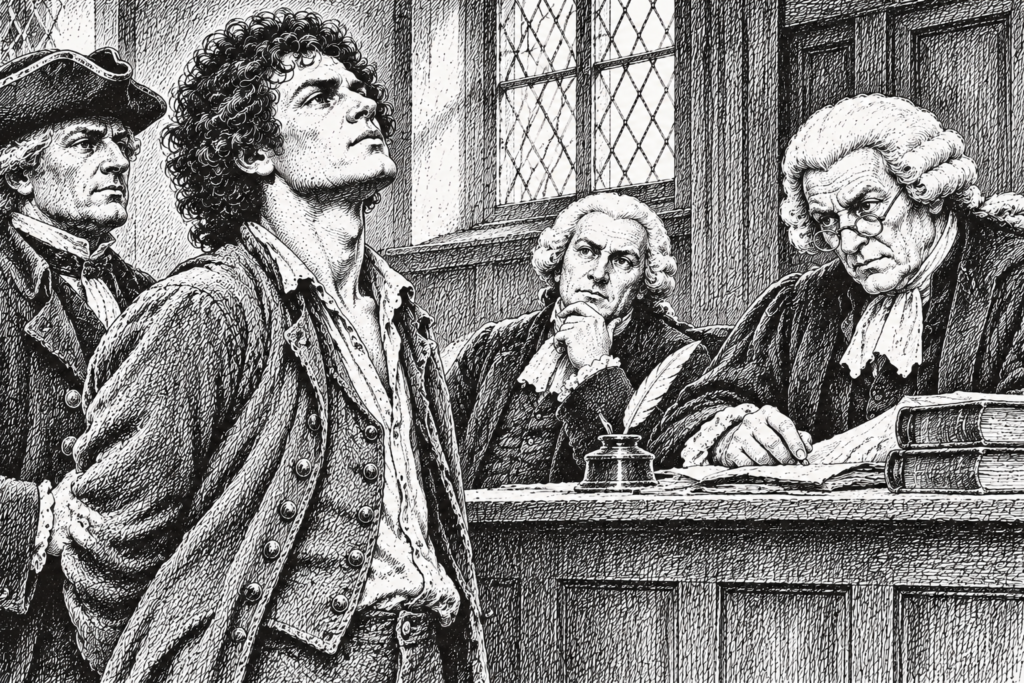
The case would now be decided at the Assizes.
When Jack was brought to trial, it appeared that he had indeed been given leave to pick up the wood. The judge directed the jury to acquit him.
Once again, Jack escaped conviction.
The Kentish Gazette of 11 July 1788 confirms the outcome, recording his acquittal for stealing sixty-two bundles of bundle wood, the property of William Deedes, Esquire.
It was another reprieve, but it did little to improve his standing in the neighbourhood. The accusation had brought him back to prison, and the circumstances had once again involved a man who had previously employed him.
Jack returned to Blean.
For the moment, he was free, and there was work to be had. Mr Twyman, despite the earlier thefts from his property, employed him in cutting wheat. The harvest would provide an opportunity to earn money before the autumn work of hop-picking began.
Jack took it.
For a time, at least, he appeared willing to work again.
But the summer’s events had shown how easily an ordinary dispute could bring him into trouble, and how quickly he could abandon honest employment when tempted by the prospect of something easier. His acquittal had given him another chance, but it had not changed the habits that were leading him towards a final and more serious offence.