1788–1789
Jack Kirby returned to Blean and once again he found work.
Mr Twyman, despite the earlier thefts from his property, employed him in cutting wheat. It was seasonal labour, familiar to Jack from his younger days, and he worked until the harvest was finished. Then came the hop-picking.
For two weeks and three days he picked hops, earning fifty-six shillings.
It was a good sum of money. He had worked hard for it, and for a brief time he was able to enjoy the satisfaction of having money in his pocket without having stolen it.
But Jack’s difficulty was never simply finding work. He could work when he chose, and he was capable of earning a respectable wage. What he could not seem to manage was keeping the money once he had it.
At Michaelmas he returned to the company of his old female acquaintances. The money he had earned during the harvest and hop-picking soon disappeared.
He was once again without funds, and once again looking for an opportunity.
The house at Mrs Pout’s
His next opportunity arose through his work for William Strood.
Strood had an old haystack to move, and Jack went to help. During this period Mrs Underdown came to visit Mrs Pout, with whom she lived. Jack knew the house and, more importantly, knew that it had been left without anyone to watch it.
The work was continuing outside, and the men would ordinarily have taken a rest at noon. Jack had other plans.
Instead of lying down with the others, he slipped away to the house.
A pane of glass was missing from one of the windows. Jack used the opening to gain entry and made his way into the fore-room. From there he went upstairs, where he found clothing belonging to Richard Atwood.
He took a coat and waistcoat, together with two chequered shirts.
The theft was accomplished without interruption. Jack returned to his work, and the stolen goods were later sold. The coat and waistcoat brought half a guinea, while the two shirts fetched four shillings.
It was a useful return for a short absence from the haystack.
The following day, Jack encountered Atwood.
A conversation with Richard Atwood
Atwood spoke to him about the burglary.
He explained that someone had entered the house and stolen a coat, a waistcoat and two shirts. He seemed more puzzled than alarmed, and told Jack that he had no suspicion of him.
“You were at Mr Strood’s,” Atwood said. “You were not away from the work, so I cannot think it could have been you.”
Jack listened without betraying himself.
Atwood continued, explaining that, had Jack been the thief, he would have expected him to take considerably more than the few articles that were missing.
Jack could hardly resist the opportunity for a remark.
“You may be assured,” he replied, “I should not have got off with such few things.”
It was a startling answer. Atwood might have taken it for a joke, or simply another of Jack’s careless observations. He apparently did not recognise the confession hidden within it.
Jack had stolen from the man’s house and was now standing before him, discussing the burglary as though he had no part in it.
The conversation ended without suspicion falling upon him.
The wrong man
There were, however, others who came under suspicion.
A young man who had recently quarrelled with his father and left home led some people to suspect that he might have been responsible for the burglary. He was apprehended and brought before a magistrate. But there was insufficient evidence against him, and he was released.
Mrs Underdown was also affected by the affair, and she was later turned out of her lodgings. Suspicion surrounding the burglary contributed to her difficulties.
Once again, Jack had escaped while other people suffered the consequences of his actions.
He did not appear to be troubled enough by this to change his behaviour.
Mr Neale’s poultry
Jack next went to the property of Mr Neale at Harbledown.
There he stole seven and a half couples of fowls – fifteen birds in all.
It was a substantial quantity, but poultry theft had become familiar work to him. He knew how to take the birds, where to sell them and what price he could expect.
He carried them to Canterbury and sold them for one shilling and sixpence a couple.
The proceeds provided him with another supply of money, and he remained in Canterbury with his usual companions until it was spent.
The pattern was now well established. Work brought him money, but he rarely kept it. Theft brought him money, but that too disappeared. He returned repeatedly to the same company and the same pleasures, and when his purse was empty he went in search of another victim.
He had been given opportunities to make a different life. Mr Glover had employed him in the woods; John Dove had given him five weeks’ work; Mr Twyman had taken him on during the harvest. Yet none of these periods of employment had lasted in any lasting sense.
Jack continued to move between honest labour and dishonesty, never quite abandoning either, but increasingly allowing the latter to determine the course of his life.
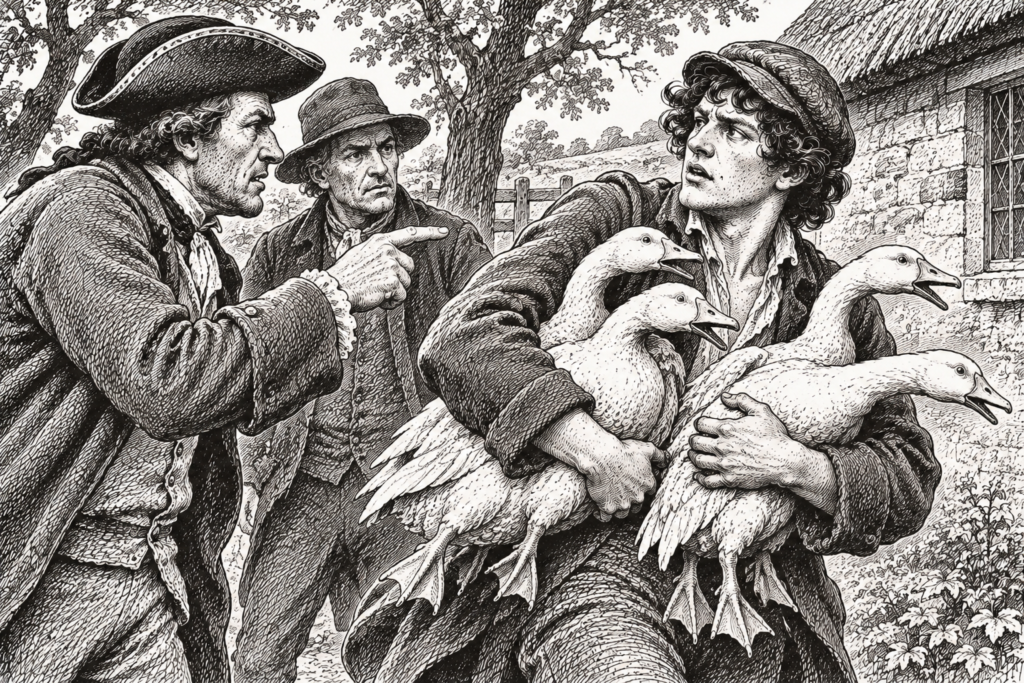
Four geese at Tyler Hill
His final theft took place at Tyler Hill.
There he stole four geese belonging to Edward Smith.
By this time Jack had stolen poultry from numerous farms and households in the district. He had often carried birds away without being seen, and had become accustomed to the risks. Perhaps he thought this venture would be no different.
But this time he was caught while carrying the geese away.
Edward Smith and William Bedwell were involved in bringing the charge against him. The men had sufficient evidence to identify the property and connect Jack with the theft. There was no convenient escape, no missing witness and no question of a boundary that might bring the proceedings to an end.
Jack was taken into custody.
The arrest took place in November 1788, and he was committed to St Dunstan’s Gaol to await trial.
It was a simple accusation, but it carried a consequence that Jack had so far managed to avoid.
The Old Castle, Canterbury
On Tuesday, 13 January 1789, Jack was brought before the court at the Old Castle in Canterbury.
He was now twenty-seven years old. Much of his adult life had been spent moving between work, theft and imprisonment. He knew the gaol at St Dunstan’s well, and he had stood before magistrates and judges on several occasions. Sometimes the evidence had been insufficient; on another occasion a legal technicality had secured his discharge. He had also been fortunate enough to avoid the consequences of some of his more serious offences.
This time the circumstances were different.
The charge was straightforward: stealing four geese, the property of Edward Smith.
Jack was found guilty.
The sentence was transportation for seven years.
For the first time, he could not expect to return to Blean after a short period in prison. He would be taken from Kent, separated from his family and sent to a distant land under a punishment whose hardships he could scarcely imagine.
The four geese had brought his criminal career in England to an end.
The end of the familiar road
It might seem an almost absurd conclusion to a life of crime that had included housebreaking, horse-stealing and highway robbery. After all his earlier offences, it was poultry that finally secured Jack’s transportation.
But the sentence was not a judgement upon four geese alone.
His repeated thefts had affected household after household. He had stolen from neighbours, employers and people who had known him since childhood. He had been publicly punished, imprisoned and given opportunities to reform. Even the execution of William Mutton, his close companion, had not persuaded him to abandon the life he had chosen.
The four geese were the offence for which he was finally convicted. They were also the end of his freedom.
For the people of Blean, the news that Jack Kirby had been sentenced to transportation must have brought a mixture of feelings. Some may have been relieved that he would no longer be moving about the parish, entering their houses and taking their possessions. Others may have felt pity for his mother, Mary, who had already endured the death of her husband and the difficulties of raising a family without him.
Jack’s brothers and sister had grown up in the same village, under much the same circumstances, but had not followed his path. His father had been remembered as an honest and industrious man. Jack, by contrast, had made himself known throughout the neighbourhood for a very different reason.
He was now to leave them all behind.
He would never again live the ordinary life of a Kentish labourer.
Part V – The Last Journey
Chapter Eighteen – A Life Set Down in Print