1789
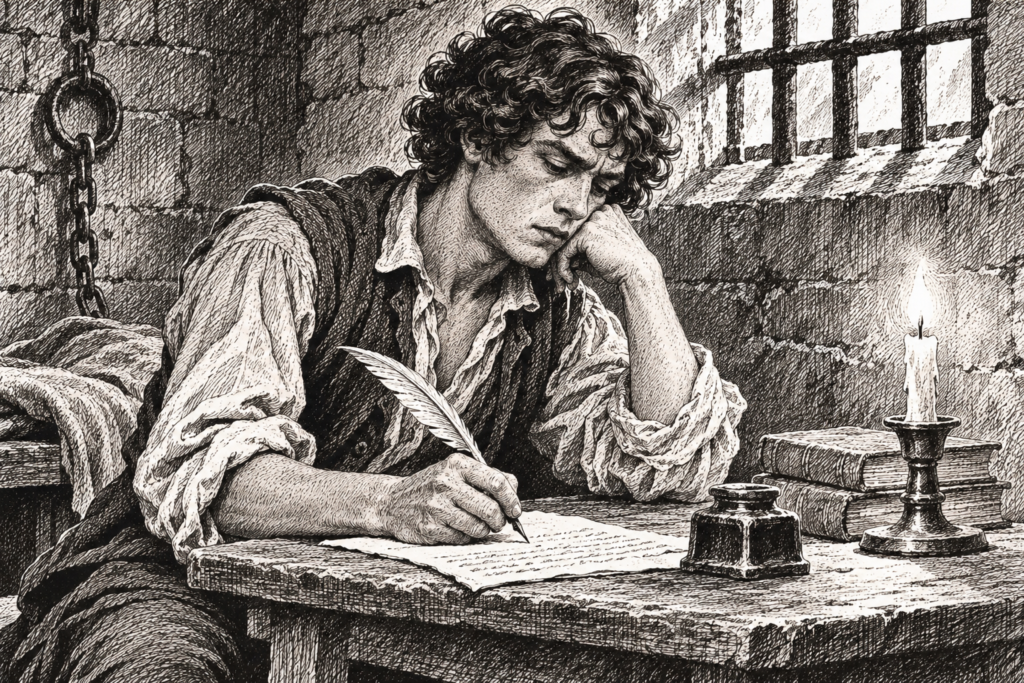
The winter had been a long one, and Jack Kirby was growing tired of the walls of St Dunstan’s Gaol.
He had known the place before. He knew the sound of the keys, the heavy opening and closing of the doors, the footsteps of the keeper making his rounds, and the peculiar silence that settled over the prison at night. On previous occasions he had entered expecting to leave again. This time was different.
He knew he was to be removed from England, from Kent, from the lanes and villages he had known since childhood. He had no idea when he would go, or what sort of life awaited him when he arrived.
One afternoon, as he sat on the edge of his narrow bed, he heard the keeper approaching.
“Kirby. You have a visitor.”
Jack looked up.
“A visitor? Who wants to see me?”
“Someone who has an interest in your story, apparently.”
The man who entered was not a relative or an old companion. He carried a small bundle of papers and regarded Jack with the curiosity of someone who had come to see a person whose reputation had preceded him.
“So you are John Kirby?”
“That is what they call me.”
“I have heard a good deal about you.”
Jack gave a faint smile.
“Then you have heard more than most.”
The visitor placed his papers on the table.
“I understand you have a mind to put your adventures into writing.”
Jack looked at him carefully.
“Who told you that?”
“It is being discussed. There are people who would pay to read an account of your life, particularly if it comes from yourself.”
Jack considered this. He had spent years making money by taking things that belonged to other people. The idea that his own experiences might now be worth something was an entirely different proposition.
“What sort of account would they want?”
“An honest one, I should think.”
Jack laughed.
“An honest account of a dishonest life?”
“That is precisely what might interest them.”
The visitor explained that there was an opportunity to prepare a small printed book, an account of Jack’s offences and the circumstances that had brought him to prison. It would be presented as a warning to others, particularly young men who might be tempted to follow the same path.
Jack was not entirely convinced by the suggestion that people would buy a book merely to be warned against crime. He knew very well that tales of theft, deception and daring escapes had a fascination of their own.
“Would anyone believe it?” he asked.
“If the account is properly attested, there is no reason why they should not.”
Jack looked down at the blank sheets.
“Then I shall have to remember a good many things.”
“Where shall we begin?” the man asked.
“Blean.”
“Your birthplace?”
“Yes. I was born there. My father was a labouring man, and we were never wealthy, but we had enough to live upon.”
“And your father?”
Jack paused.
“He is dead.”
The man waited.
“He was a good man,” Jack continued. “He worked hard. I don’t suppose he ever imagined that one of his sons would finish up in a place like this.”
“Did he know of your troubles?”
“Some of them. Enough, I expect.”
“And your mother?”
Jack shifted in his chair.
“My mother has had trouble enough without me.”
The man dipped his pen.
“Then perhaps we should make that clear. Your family should not be blamed for what you have done.”
Jack nodded.
“Put that down.”
The work continued over several days. Jack recalled the people he had known, the places where he had worked, the houses he had entered and the animals he had stolen. He described the tricks by which he had escaped detection and the occasions when his own confidence had nearly brought him to grief.
At times he became animated, particularly when recounting an ingenious deception or a narrow escape.
“You make it sound as though you enjoyed it,” the man remarked on one occasion.
Jack looked at him.
“Some of it I did.”
“And the people you robbed?”
“They were not always poor men.”
“That does not make it right.”
“No,” Jack replied. “I suppose it does not.”
He was less comfortable when the conversation turned to the people who had suffered through his actions. Some had lost valuable possessions; others had been left to answer for offences they had not committed. There were names he recalled readily and others he preferred not to discuss.
“Do you regret any of it?” the man asked.
Jack looked towards the small window.
“I have had time to think about it.”
“That is not quite an answer.”
“No. But it is the answer I can give you.”
As the account took shape, Jack began to understand that the pamphlet would present him to the public in a very particular way.
Its title was to be A Sketch of the Life of that notorious House-Breaker, Horse-Stealer, and Highway Robber, John Kirby.
Jack read the words when they were shown to him.
“Notorious,” he said, allowing the word to linger.
“It is a description likely to attract attention.”
“House-breaker, horse-stealer and highway robber. You have managed to make me sound a very busy fellow.”
“Have you not been?”
Jack smiled, but there was something else in his expression. For years he had been known in Blean and Canterbury as a troublesome young man, a thief who appeared and disappeared, sometimes in gaol and sometimes back upon the roads. Now his name was to be printed and sold.
He could hardly have imagined such a thing when he was a boy in the fields of Blean.
There was also to be a likeness of him.
A draughtsman came to the gaol and arranged to make a portrait in the prison ward. Jack was instructed to sit still while the man studied his face.
“Look towards the window,” the draughtsman said.
“Why?”
“It gives a better light.”
Jack turned his head.
“Will you make me look like a gentleman?”
“I shall draw what I see.”
“Then I fear you may disappoint your readers.”
The draughtsman did not reply, but continued his work.
Jack was curious about the finished picture. He had been accustomed to seeing his name written in court records and newspaper notices, but a portrait was something different. It would give strangers a face to associate with the stories.
For a man who had spent so much of his life trying to avoid recognition, it was a curious way to become known.