This case began with a dramatic newspaper account in The Star of Freedom on 17 May 1845.
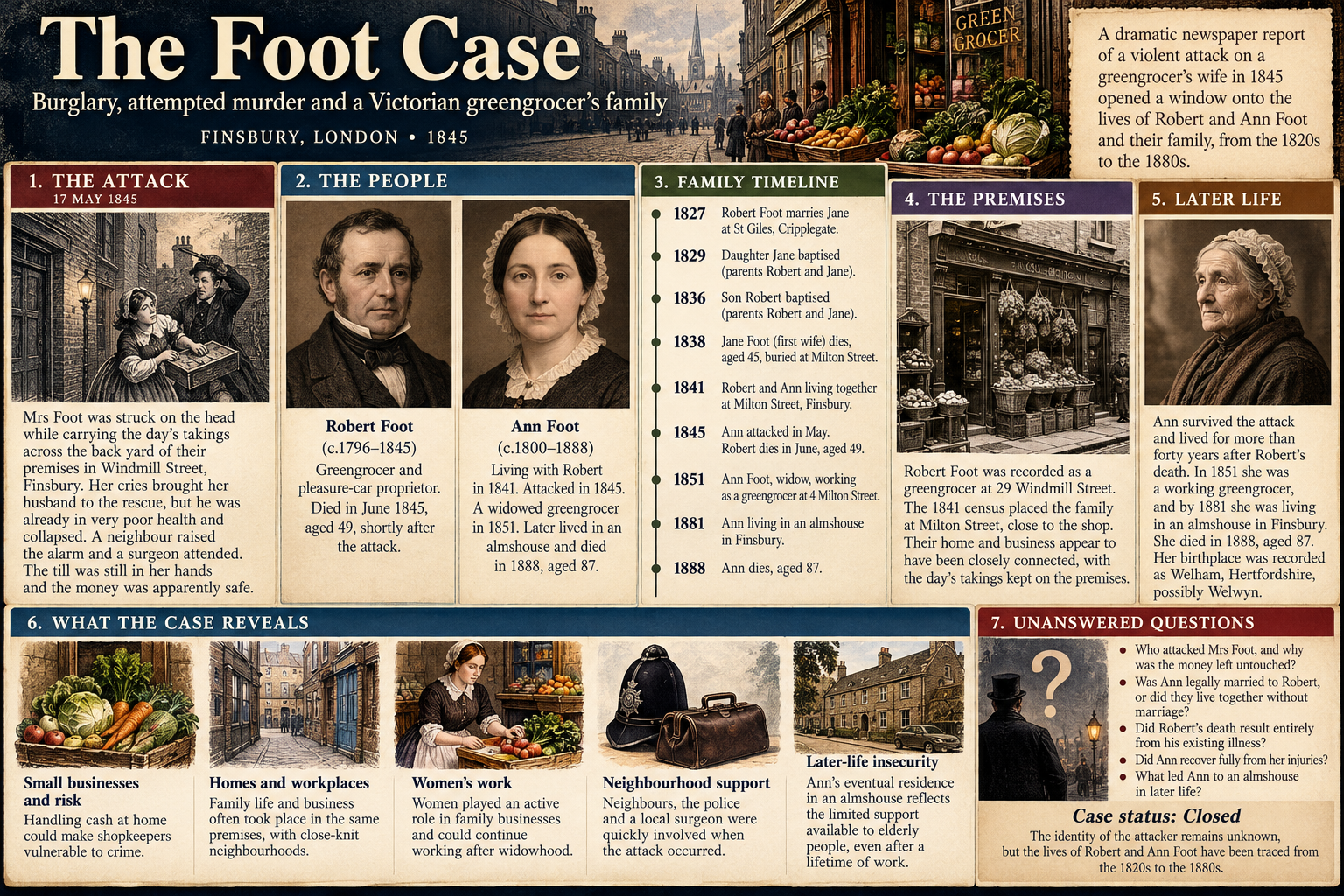
| BURGLARY AND ATTEMPTED MURDER. – Considerable sensation has been caused during the last few days, in the neighbourhood of Finsbury-square, by the fact of a burglary having been committed early on Sunday morning last, on the premises in the occupation of Mr. Foot, a greengrocer and pleasure-car proprietor, residing in Windmill Street, Finsbury., which was attended with circumstances of great violence to Mrs. Foot, the wife of the occupier. From inquiries since the occurrence it appears that after the shop was closed on Saturday night last, and shortly after Mrs. Foot had counted up the proceeds of the day, and was proceeding with the till across the back yard, she was suddenly struck a blow upon the head, which felled her to the earth, and instantly rendered her insensible. In her stupor she moaned most piteously, and her cries alarming her husband, who has been for some time near death, he summoned up all his energies, and attempted to gain the landing on the top of the stairs. From excessive weakness, however, the sufferer fell in the passage in a state of so much exhaustion that the circumstance has much retarded his recovery. Meantime the poor woman was writing with pain; copious streams of blood flowed from an extensive wound in the front of her head. A neighbouring cheesemonger having heard the cries of the injured woman, instantly hastened to the spot whence the sound proceeded, and having procured the assistance of the police, Mr. T. W. Walls, surgeon, of 9 Windmill Street, Finsbury-square was called up, and the premises as well as the wounds of the poor creature examined. Close to the spot where she fell a large piece of wood was covered with blood. The wound presented a most frightful appearance, extending for some length to the cranium. The main artery connected with the temple was divided, and a number of the minor vessels were severed. For some time after the occurrence it was feared that a fracture of the skull had taken place, nor is it now quite evident that such is not the case, as the sufferer is in a most deplorable condition from the consequences of the outrage, nor is it expected that she will be able to rise from her bed for some time to come. When found, the poor woman still grasped the till, the contents of which were safe. |
One particularly intriguing detail of this account was that Mrs Foot was still clutching the till when she was found, and the money was apparently safe. The report does not explain why the assailant failed to take it. The attack might have been interrupted, the assailant might have been disturbed, or the motive might have been more complicated than straightforward theft. We cannot determine which explanation is correct. The newspaper gives us a vivid account of the incident, but the identity of the attacker and the circumstances surrounding the assault remain unknown.
Reconstructing the Foot household
 The 1841 census records a Robert Foot, aged 45, living in Milton Street with a woman named Ann, aged 40. Their household also included Jane Foot, aged 12, and two younger people, William Willaby, aged 15, and Samuel Seaman, aged 11. The precise relationships of the latter two to the household remain unknown.
Initially, Robert’s occupation as a coal merchant appeared to complicate the identification, however, a trade-directory entry for Robert Foot, greengrocer, at 29 Windmill Street, provided a link to the newspaper’s Mr Foot.
Further research revealed an earlier family history. Robert Foot had married Jane Lenton in Cripplegate on 24 July 1827. Baptisms in December 1829 and January 1836 record children named Jane and Robert, with parents Robert and Jane.
Jane Foot was buried on 14 September 1838, aged 45, with Milton Street recorded as her address, and By 1841, Robert was living with Ann. We could not find a subsequent marriage  between them, so we cannot establish whether Ann was his second legal wife or whether their relationship was informal.
The 1851 census provides a compelling continuation of the story. Ann Foot, now a widow, was living at 4 Milton Street and working as a greengrocer with her children, Jane and Robert Foot.
We traced a possible continuation of her life through the later records. She appears to have remained in the Finsbury area, was recorded in an almshouse in 1881, and died in 1888 at the reported age of 87. Her birthplace was recorded in one census as Welham, Hertfordshire, leading us to consider whether she might have originated in Welwyn. A baptism for an Ann Waller in July 1800 was a possible lead, but we found no evidence establishing that this was our Ann.
The aftermath
Robert’s burial in June 1845, aged 49, only weeks after the newspaper report, gives the story a poignant conclusion. The newspaper already described him as desperately ill, and his death is consistent with that account.
Ann, by contrast, appears to have survived for more than four decades after Robert’s death. Her appearance as a working greengrocer in 1851 suggests that she was able to continue earning a living after the attack. We have no medical follow-up establishing the extent of her recovery. Her later life demonstrates survival, but does not prove that her injuries caused no lasting damage.
The vulnerability of small businesses
The incident illustrates just how closely a small shopkeeper’s livelihood could be tied to the household. The day’s takings were being handled at home after closing time, and the attack occurred while Mrs Foot was moving the money across the yard. Such a situation could expose shopkeepers to risks associated with handling cash, although we cannot tell whether the assailant had planned the attack.
Women’s economic contribution
Mrs Foot was handling the day’s takings in 1845, and in the 1851 census Ann was recorded as a greengrocer. These details are consistent with a woman playing an active role in a small family business. After Robert’s death, Ann apparently continued to earn her living. The case offers a useful reminder that women were not simply dependants within Victorian households. Some worked alongside their husbands, managed commercial tasks and continued businesses after becoming widows.
Widowhood, work and later-life insecurity
Ann’s later appearance in an almshouse raises questions about the circumstances of her old age. We do not know whether she lacked family support, had exhausted her savings, or entered the almshouse for another reason. Nevertheless, her life illustrates the importance of investigating what happened to people long after a dramatic event had passed from the newspapers.
CONCLUSION
The Foot case began with a single newspaper report of a violent assault in May 1845. Through census returns, trade-directory evidence and parish registers, we have reconstructed the household, traced Robert’s death shortly afterwards, and followed Ann into the second half of the nineteenth century.
We have not solved the crime in the sense of identifying the assailant. Nor have we established every detail of the Foot family’s relationships. But we have recovered something that the original report could not provide: a view of the lives that continued after the immediate drama.
The case reminds us that Victorian crime reports can be more than accounts of wrongdoing. When linked with ordinary administrative records, they can reveal the precariousness of small-business life, the economic contribution of women, and the long-term consequences of widowhood.
The most important achievement is not that we solved the crime, but that we followed its human consequences beyond the newspaper’s final paragraph.
Note: All images generated by ChatGPT