Our investigation began with a report in the Wiltshire Times of 19 December 1857.
| SUPPOSED MURDER AT MIDDLETON, NORFOLK. – Information was received from the Home-office to the effect that a strict investigation should take place into the circumstances attending the finding of a human skeleton, supposed to be the remains of a gentleman named Bell, who was missed at Middleton eight years ago, and has never since been heard of, and who was supposed to have been foully murdered at that place. It appears that this Mr. John Bell, at the time of his disappearance, was living upon his private means, and had reached nearly fourscore years. He had several relatives who exerted themselves to the utmost to discover when and under what circumstances his disappearance took place. All, however, that could be elicited was that on the 18 November 1849, the old gentleman was seen walking near a bridge in the vicinity of a field called, in the neighbourhood, the Four-Mile Field, on the London-road. An inquiry was set on foot, and rewards were offered from time to time till they increased to the sum of £120. Even that inducement failed to lead to any satisfactory result. In addition every river in the neighbourhood for some miles round was dragged, and every expedient that the circumstances of the case suggested was adopted. During these investigations a hat was found that was supposed to belong to the missing gentleman; and a canvas purse and a large knife were also found in a drain near Middleton. The purse which was quite empty was identified by his niece as the property of the missing man. The search continued for some months, but no further clue of any kind being obtained, it gradually cooled, and eventually ceased altogether. A few days ago a human skeleton was accidentally dug up. The site of the discovery is a small triangular-shaped piece of land adjoining Town-lane, leading from the Norwich turnpike road. The ground was formerly part of the property of a Mr. Wythes, who some years ago sold it to Mr. Edward Chilvers. It remained in his possession some time, and about eighteen months ago he sold it to a Mr. John Wicks, in whose possession it was at the time of the discovery. In the course of last week, Mr. Wicks ordered some of his labourers to plough this field; and while one of the men (Burton) was digging down about fifteen inches below the surface his spade came in contact with some bones. He proceeded to clear the earth away, and more became visible, until what appeared to be a whole skeleton was exposed to view. The neighbours think they are the remains of John Bell, and inquiry is being made |
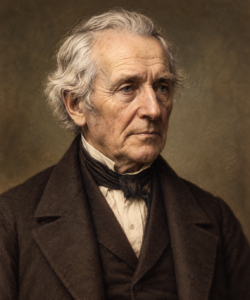 The circumstances were dramatic, but from the beginning we had to distinguish what was established from what was merely believed: the skeleton was thought to be Bell’s, but that identification was not conclusively demonstrated in the reports we found.
The first inquest report, published in the Stroud News and Journal on 26 December 1857, provided our first medical evidence. Two surgeons from King’s Lynn examined the bones: Thomas Masters Kendall considered the remains those of a male aged upwards of forty. The jaws and teeth were substantially complete, but the teeth were very worn. Martin W. P. Coulcher gave similar evidence and commented on the differing degrees of decay in the bones. He considered it possible that they had been buried for eight years. The remains were consistent with those of an older man, but the surgeons could not identify the individual as John Bell.
The position of the bones was also recorded. The right hand lay alongside the body, the right leg crossed over the left, and the head was nearer the surface than the rest of the skeleton. These details might have helped reconstruct the burial, but they did not establish how the man had died. The authorities therefore faced two distinct questions: was this John Bell, and, if so, had he been murdered?
A report in Lloyd’s Weekly Newspaper on 27 December 1857 introduced the evidence of Henry Colliborne, a labourer from Gaywood. Colliborne recalled that around the time Bell disappeared, he had been walking towards Middleton after work when he saw a horse and cart. He heard scuffling and groaning, but could not see anyone in the cart. He remained some distance away. This testimony was potentially significant. It offered a possible account of violence occurring around the time of Bell’s disappearance. Yet we did not establish whether Colliborne had reported the incident in 1849 or had come forward only after the discovery of the skeleton. That distinction matters. A recollection first reported eight years after an event needs to be assessed differently from a contemporary statement.
The newspapers also mentioned a razor reportedly associated with Bell and found on the skeleton’s breast. Such an object could have strengthened the identification, but we found no conclusive evidence of how it had been identified.
The Daily Telegraph of 7 January 1858 and the Bradford Observer of 14 January continued the story. The coroner, T. M. Wilkin, repeatedly suggested that important circumstantial evidence would soon reveal the identity of the guilty person. At one stage, he spoke of a further strong link in the chain of evidence, while refusing to name the person he suspected.
The inquest was repeatedly adjourned. By mid-January, the coroner was still pursuing additional evidence, including information from a witness living in America. A further hearing was scheduled for 4 February 1858.
Yet we could find no report of that hearing, or of any subsequent conclusion, in the national newspapers we searched. Our searches of the Norfolk Record Office’s online catalogue also produced no decisive record. It seems that formal coroner’s case files for this district and period had been largely destroyed.
This is the central documentary gap in the case. We have reports of an investigation that appeared to be approaching a conclusion, but no surviving account we located that tells us whether the coroner obtained the missing evidence, whether the jury reached a verdict, or whether anyone was prosecuted.
The most substantial lead emerged from the longer report in the Wells Journal of 16 January 1858, which carried evidence from Bell’s brother, Joshua Bell. Joshua described a financial relationship between his brother and his tenant, John Moyce Butters.
According to the report, Bell held a £100 promissory note due at Christmas 1849. He had also been told that Butters owed him a further £7. Bell kept a cash box containing papers, including documents signed by Butters, and had taken the box away before travelling to Tottenhill.
The report also raised questions about Butters’s account of when he last saw Bell. The coroner considered whether Butters might have known more about Bell’s movements than he had admitted. There was also a dispute involving approximately 22 acres of land and a claim by Mr Pauton, with Harvey Butters mentioned in connection with the property. These details gave the investigation a possible financial motive. But they did not prove that Butters had harmed Bell.
We traced John Moyce Butters through several census records and probate material. In 1851, aged 24, he was living with his widowed father, Thomas Butters, in Tottenhill, Norfolk. In 1861, he was still living with Thomas in Tottenhill, Norfolk. Thomas died on 13 December 1867 and in 1868 his probate entry names John Moyce Butter, farmer of Tottenhill, as his son and one of the executors. His effects were valued at under £100.
In 1871 John was still in the Tottenhill area. Then early in 1878, aged 50, he married Sarah Ann Cross, age 30, at Downham Market, and in 1881 he was living with his wife and young children and was recorded as a farmer.
This research gave us a useful outline of Butters’s life, but it did not uncover a criminal charge, conviction or document proving his involvement in Bell’s disappearance. His continued presence in Norfolk is not evidence of guilt, just as his later marriage and family are not evidence that he was cleared. He remains a person of interest in the historical investigation, not an established murderer.
Who was John Bell?
We also investigated the missing man’s possible identity through census and parish records. In the 1841 census, we found a John Bell, aged 70, recorded as a labourer in Jews Lane Yard, King’s Lynn. He lived in the same household as Joseph Bell, a carpenter aged 60, and Eleanor Bell, also aged 60.
We traced Joseph to a marriage with Eleanor in 1817 and identified Samuel Bell as their son. In 1851, Joseph was still living in Jews Lane, now a widower, with Samuel and his wife Ann. No John Bell appeared in that household.
The family research led us to a John Bell, baptised at Northwold on 8 January 1768, son of Thomas and Mary Bell. Joseph was probably Joseph’s brother. This is a promising identification. The baptism fits the age reported for the missing farmer remarkably well: a man born in 1768 would have been about 73 in 1841 and 81 in 1849.
The occupation is less straightforward. The census calls him a labourer, whereas the newspaper describes Bell as a retired farmer with property and tenants. It is possible that a former farmer undertook occasional agricultural work in later life, but that remains an explanation rather than a documented fact.
We found no subsequent death or burial record that clearly belongs to this John Bell. We also found no suitable death registration or burial entry for the skeleton under the name of John Bell, or an obvious unidentified male in the King’s Lynn area.
Our conclusion is therefore provisional: John Bell, baptised at Northwold in 1768, is a plausible candidate for the missing farmer, but we could not independently connect him to the Middleton property.
Land, tenancy and debt
The financial dispute is particularly revealing. A £100 promissory note was a substantial obligation in 1849, especially when combined with a further reported debt of £7. A promissory note was a written promise to pay a specified sum, often on a future date. Such instruments allowed credit to operate between individuals without every transaction requiring immediate payment in cash. For a landowner dealing with a tenant, debts could arise from rent, loans or other financial arrangements.
The disputed 22 acres also remind us that landholding was not always straightforward. Ownership, occupation and claims to property could involve different people, and disputes might continue through inheritance, tenancy or legal proceedings. However, we do not know precisely what Butters owed Bell the money for, or whether the land dispute was directly connected to the disappearance.
The elderly and economic independence
Bell was described as a retired farmer, yet he continued visiting tenants and attending to his affairs. This suggests that retirement did not necessarily mean withdrawing from business or ceasing to manage property. Older landholders could remain economically active through rent collection, lending and the supervision of tenants. Their wealth and independence might also depend on the continuing value of land and the reliability of those who owed them money. The contrast between Bell’s reported status and the 1841 census entry describing a possible candidate as a labourer illustrates a familiar genealogical difficulty: a short census occupation may not capture the full complexity of someone’s working life or financial position.
The power and limitations of Victorian forensic medicine
The surgeons’ examination demonstrates both the value and the limitations of medical evidence in the 1850s. They could assess the skeleton’s sex, approximate age and state of preservation. They could not establish identity through DNA, and the reports we found provide no indication of any distinctive anatomical feature that could conclusively identify Bell. Investigators therefore depended heavily on personal recognition, possessions, witness testimony and circumstantial evidence. A familiar object could be persuasive, but its identification depended on the reliability of the person who recognised it and the circumstances in which it was found. The distinction between identifying a body and proving that a murder had occurred is crucial to understanding this case.
The coroner and the public appetite for justice
The repeated adjournments, the involvement of the Home Secretary and the coroner’s public statements show how a suspected murder could become a matter of considerable public attention. Newspapers did more than report the proceedings. They shaped the story by emphasising the mysterious disappearance, the discovery of the skeleton and the expectation that a guilty person would be exposed. The coroner’s confidence makes particularly compelling newspaper reading, but it must not be mistaken for a verdict. The missing final report leaves us unable to determine whether the evidence ultimately supported his suspicions.
Newspapers as historical evidence
Perhaps the most important lesson is methodological. We have been able to reconstruct a detailed investigation from newspapers published in different parts of the country, including the Wiltshire Times, Lloyd’s Weekly Newspaper, the Daily Telegraph, the Bradford Observer, the Stroud News and Journal and the Wells Journal. Comparing these accounts revealed inconsistencies in dates, reward amounts, names and the presentation of evidence. It also showed how reports could be syndicated, abbreviated or published at different stages of the proceedings. The newspapers have given us a substantial narrative, but they have not given us a definitive ending. Their claims need to be checked against census returns, parish registers, civil registrations and probate records wherever possible.
CONCLUSION
Our investigation began with a sensational newspaper account of a skeleton discovered in a field. It developed into a much wider reconstruction of a missing farmer’s life, his possible family, his financial affairs and the man suspected by the coroner.
This remains an unresolved Victorian disappearance and suspected murder. We have a plausible identification for Bell and a documented line of suspicion surrounding Butters, but neither is proven.
That is a fitting place to close the case The investigation has shown how much can be recovered from fragmentary newspapers and ordinary genealogical records — and why a responsible historical conclusion must sometimes leave the final question unanswered.
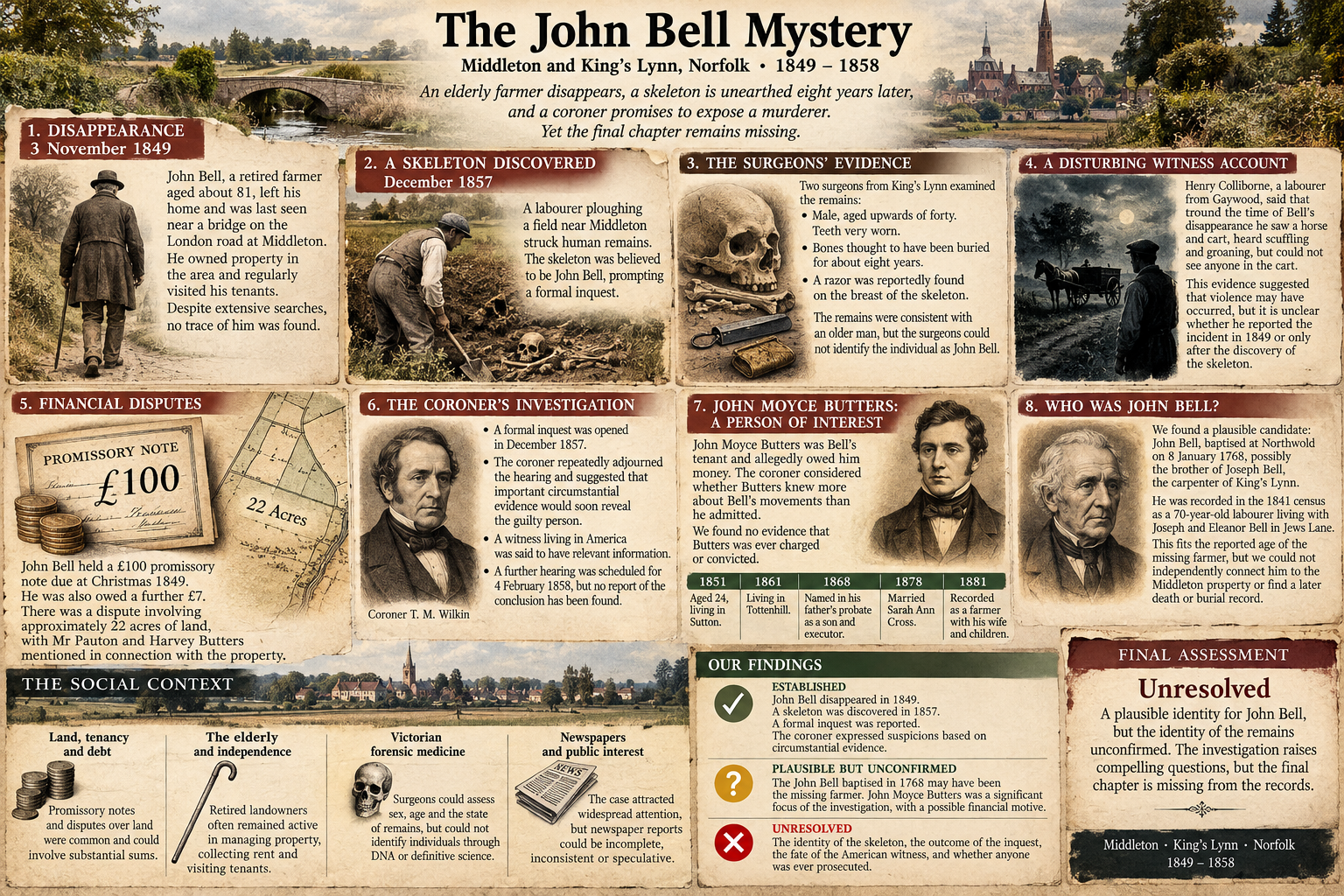
Note: All images generated by ChatGPT