This is the first of two murder cases that took were heard at the Gloucester Assizes that appeared in the Liverpool Weekly Mercury on 27 December 1873.
|
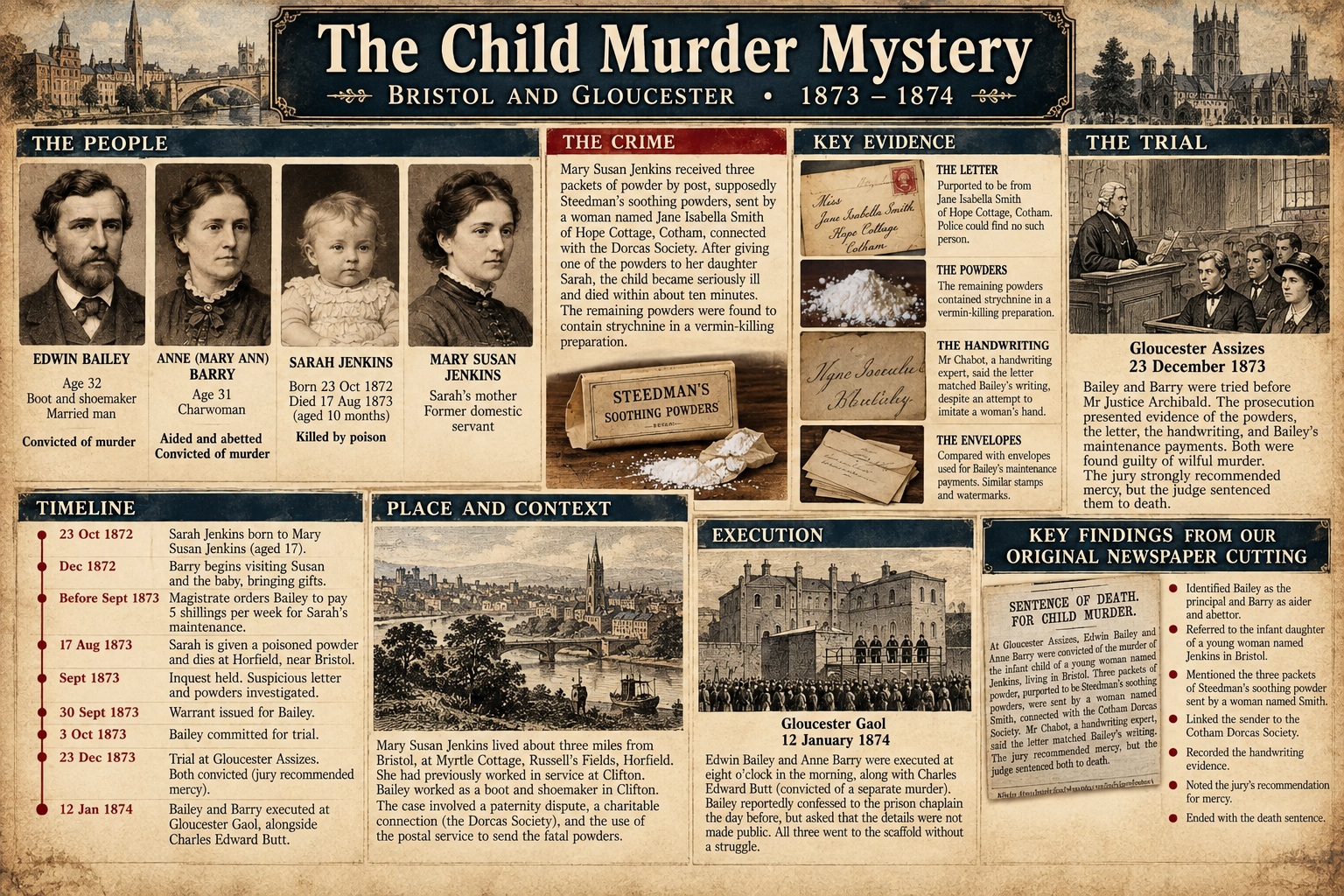
SENTENCE OF DEATH FOR CHILD MURDER. At the Gloucester Assizes on Tuesday, before Mr. Justice Archibald, Edwin Bailey and Anne Barry were tried, charged with wilful murder—the former as principal, and the latter as aider and abettor. The deceased was the infant daughter of a young woman at Bristol, named Jenkins, and Bailey had been adjudged its putative father. Barry had been in his employ, and, forming an acquaintance with the child’s mother, recommended Steedman’s soothing powder. Three powders were afterwards received by post, labelled “Steedman’s soothing powders,” and purporting to come from a lady named Smith, belonging to Cotham Dorcas Society. A day or two afterwards the child became ill, and a powder was given it. It died ten minutes afterwards, showing symptoms of poisoning, and the other two powders were found to contain strychnine. The handwriting of a letter sent with the powder, promising things for the child, was proved by Mr. Chabot to correspond with Bailey’s handwriting, and the paper used was similar to some in his house. The jury found both prisoners guilty, but strongly recommended them to mercy. His lordship passed sentence of death in the usual form. |
At first glance, this seemed to be a straightforward account of two people convicted of poisoning an infant, but what made this clipping so interesting was that it contained several research avenues beyond the murder itself: an affiliation or paternity case, a suspicious charitable connection, forensic handwriting evidence and a recommendation for mercy. We followed each of these as far as the surviving material we found would allow – mostly through reports in a variety of newspapers.
The first major breakthrough was establishing that the infant was Sarah Jenkins, daughter of 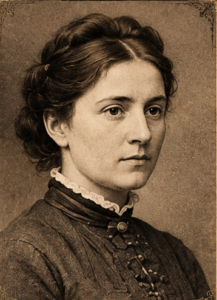 Mary Susan Jenkins, usually called Susan in the accounts. Later information gives Sarah’s birth date as 23 October 1872 and her mother’s age as 17. A September 1873 newspaper report places Susan at Myrtle Cottage, Russell’s Fields, near Bristol, about three miles from the city. She had previously worked in domestic service at Clifton.
The inquest reports also explain the relationship between Susan and Edwin Bailey. Edwin was married, but he and Susan had formed an intimate relationship which resulted in Sarah’s birth. He denied paternity, and Susan obtained a magistrate’s order requiring him to contribute five shillings a week towards the child’s maintenance. This was an important discovery because it revealed a financial and personal dispute that predated the poisoning. We must be careful, however, not to assume that the maintenance dispute alone establishes Bailey’s motive. The paternity proceedings became one of our principal research threads.
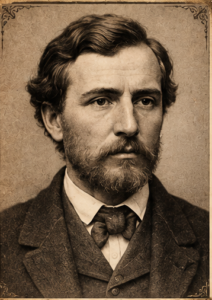 The Central Glamorgan Gazette reports of 12 and 19 September 1873 and the Gloucestershire Chronicle of 20 September all discuss Edwin’s weekly payments. The reports establish that a magistrate had made an order and that the payments were passed through a police constable to Susan.
Our most useful additional discovery came in the longer trial report in Reynolds’s Newspaper of 28 December. It names Police-constable Critchley, who produced letters in Edwin’s handwriting, including correspondence concerning an overdue maintenance payment.
Despite searching through the newspaper reports we did not establish the date or precise court of the original proceedings. This remains one of the case’s outstanding documentary questions. We have contemporary evidence that the order existed, but not the original order itself.
One of the most intriguing elements of the case was the woman who befriended Susan and Sarah. According to the September reports, a woman began visiting Susan and appeared to take a particular interest in the baby. She brought gifts and suggested that ladies associated with the Dorcas Society wished to help the child. She reportedly visited several times a week and sometimes brought cakes and other items.
The powders arrived in a letter addressed to Susan Jenkins near the Volunteer public house. The letter purported to come from Jane Isabella Smith of Hope Cottage, Cotham, described as a visitor to the Dorcas Society. Police inquiries reportedly failed to find any such person. The visitor’s own identity was uncertain. In one account she gave her name as Ann, sometimes calling herself Louise. She reportedly evaded questions about her name and was said to have expressed an interest in adopting Sarah.
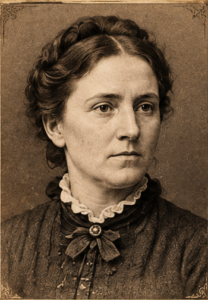 An early report in the Central Glamorgan Gazette of 3 October calls the woman in custody Emma Barry, while other reports identify her as Anne or Ann Barry, and a later account calls her Mary Ann Barry. We have not resolved this variation, although the gaol register identifies the defendant as Anne Barry.
A small but revealing detail emerged from the original cutting: the letter accompanying the powder was described as “promising things for the child”. This suggests that the parcel was presented as a benevolent gift, consistent with the supposed charitable connection. Whether the promise was deliberately intended to disguise the contents is an inference, not an independently established fact.
The Dorcas Society itself is important to the social context. Such charitable associations were associated with providing clothing and practical assistance to people in need. The supposed connection made the package plausible, but the newspaper reports say the claimed sender could not be found.
The September reports allowed us to reconstruct the events more fully than the original trial summary. Three packets arrived by post, labelled as Steedman’s soothing powders. Susan gave Sarah powder from one packet, mixed with food. The child reportedly became ill, suffered convulsions and died within about ten minutes. The two remaining powders were analysed and reportedly found to contain strychnine in a vermin-killing preparation. The fuller accounts identify Mr J. Horsley, an analytical chemist from Cheltenham, as a key witness.
The evidence was not limited to the powders. Investigators compared the envelope containing the letter and packets with envelopes used for Bailey’s maintenance payments. The September reports mention similarities in the stamps and watermarks, despite the powder envelope bearing a Clifton postmark when the supposed sender was associated with Cotham.
At trial, Mr Chabot compared the handwriting on the suspicious letter with letters attributed to Bailey. The prosecution argued that the handwriting matched, despite an apparent attempt to imitate a woman’s hand.
There is, however, a significant discrepancy in the medical reporting. One September account says the post-mortem and county analyst’s examination did not reveal irritant poison in the stomach, while another describes traces of strychnine in the stomach and intestines. The December trial report also gives a version in which no traces were found in the stomach, although the analyst believed death had resulted from poison. We cannot resolve these differences from the newspaper accounts alone. The remaining powders reportedly contained strychnine, but the exact analytical findings concerning Sarah’s body require further corroboration.
The trial took place before Mr Justice Archibald on 23 December 1873. The prosecution presented the circumstances of the poisoning, the relationship between the defendants and Susan, the maintenance correspondence, the chemical evidence and the handwriting comparisons.
The defence challenged the prosecution’s interpretation of the evidence. Bailey’s counsel questioned the handwriting evidence and the inference that Bailey had deliberately planned the murder. Barry’s counsel argued that she had been employed to investigate the child’s paternity and denied that she had participated in the poisoning.
The jury found both defendants guilty of wilful murder and strongly recommended mercy. Mr Justice Archibald nevertheless passed the death sentences.
A post-execution report in the Central Glamorgan Gazette of 16 January 1874, headed “Triple Execution at Gloucester” reports that Edwin Bailey and Ann Barry were executed alongside Charles Edward Butt at Gloucester Gaol at eight o’clock on Monday morning, 12 January 1874. Butt had been convicted of a separate murder.
The report also claims that Bailey and Barry confessed on the Sunday before their executions. Bailey reportedly made a full disclosure to the prison chaplain but asked him not to reveal the details. The newspaper attributed his crime to his atheistic beliefs, but we have not found the confession itself or independent evidence establishing that interpretation.
This investigation has uncovered several wider social historical themes.
- Illegitimacy and financial responsibility: The affiliation order demonstrates the legal route by which a mother could seek maintenance from a putative father. Susan’s case also shows that such arrangements could become entangled with personal relationships and criminal investigations.
- Domestic service and class: Susan’s employment in service and Barry’s work as a charwoman and shop cleaner help explain how people in different households came into contact.
- Charitable benevolence: The supposed Dorcas Society connection exploited the social expectation that charitable women might provide assistance to a child in need.
- Postal and forensic evidence: Handwriting, paper, stamps, watermarks and chemical analysis all featured in the prosecution. The case illustrates the importance—and limitations—of the forensic methods used in the 1870s.
- Capital punishment and mercy: Despite the jury’s strong recommendation, Bailey and Barry were executed. The subsequent reporting of confessions and religious beliefs shows how newspapers framed the final hours of condemned prisoners.
CONCLUSION
The strongest part of our findings is the convergence of contemporary newspaper reports with the Gloucester Gaol and committal records. Together, they establish a coherent account of the investigation, trial, convictions and executions.
The most valuable result is not that every mystery has been solved, but that we can now separate the established documentary trail from the claims and questions that remain open.
Bailey and Barry were executed on the same day as Charles Edward Butt, whose separate murder case appears in the next Mystery case. Their individual stories should remain distinct, but that shared date gives us a documented link between the cases.
Note: All images generated by ChatGPT