This case began with a letter in the Sunday People on 21 April 1889.
|
ANOTHER STRANGE DISAPPEARANCE. “A distressed relative” writes: In November 1888, my niece, Miss Violet Jane Donaldson, one of the young lady clerks at the British Xylonite Company’s Works, Brantham, near Manningtree, Essex, left the factory about ten o’clock a.m., and walked to Manningtree Station, where she took a ticket for Liverpool-street, and has not been heard of since. She was met on the road to the station by a coachman who knew her by sight, and he noticed she was crying. This coachman seems to be the last person who saw her. Whether she got out at Marks Tey, Colchester or Chelmsford (the only three stations the train stopped at), or went on to Liverpool-street, cannot be ascertained. One theory is that she got out at Colchester, walked along the river bank, and at some point committed suicide, but of this there is no evidence. She had no mother or father, and had but three relations in London with whom she was on intimate terms, and to none of these has she been. To these relations her mysterious disappearance, for which no reason can be discovered, has caused the greatest anxiety. The history of Miss Donaldson during the last three years is this: – In October, 1885, she came into possession of £100, and this sum, which was in Three per Cents, she sold out in June 1886, for the purpose, she said, and so it has been discovered, of sending to a friend. In August 1886 she went to live with a person named Leake and her daughter, at Stratford, the latter also being employed at the Xylonite Works, Homerton. When the manufacturing portion of the business was removed to Brantham, in 1887, Miss Donaldson went with the Leakes, lodging with them up to the time of her disappearance. Miss Donaldson left the works in her ordinary walking dress, taking neither umbrella nor waterproof. She left behind all her furniture, including a piano, also her clothes, and had, as far as can be ascertained, very little money in her possession. It is only since her disappearance that the fact of her having sold out her money in the Funds in 1886 has come to light. The matter has been in the hands of the police, but they have not succeeded in throwing any light on the mystery. Miss Donaldson is 24 years of age, about 5 ft in height, light brown hair, cut short in front and curled, grey eyes, pale complexion, freckled. |
This letter in the newspaper left readers with a troubling question: had Violet met with an accident, deliberately abandoned her former life, or disappeared for some other reason? At this stage, there was no answer.
Violet’s family background
 Violet Jane Donaldson was born on 16 November 1864 in Stepney, in east London. Her father was Thomas Henry Donaldson, whose occupation was a commercial traveller. He died in 1879 at the age of 38. Her mother was Harriet Sophia Donaldson (née Pearce).
Violet’s older sister was Jessie Harriet Donaldson, who was born in 1862. The two sisters would prove to be central to the eventual resolution of the mystery.
In the 1881 census, Jessie, age 18 and Violet, aged 16 were living at 39 Lauriston Road, South Hackney with their widowed mother, Harriet Sophia, in the home of their widowed maternal grandmother, Mary Ann Pearce, aged 75. Also there was Harriet Grix, aged 79 who was Mary’s widowed sister
 The address was confirmed by Violet’s baptism record. She was baptised at St Barnabas, Bethnal Green, on 2 May 1881, when she was about 17. No baptism record for Jessie has yet been found.
In 1882 Harriet Sophia Donaldson died at the age of 41. The two sisters were consequently left without either parent while still young adults: Jessie was about 19 and Violet about 18 when their mother died. So by the time Violet disappeared, both her parents were dead. That is important context, but it does not in itself explain why she left.
The British Xylonite Company: an unusual place of work
Violet’s employment provides an important setting for the story.
The British Xylonite Company was part of the emergence of the plastics industry in Britain. Established in 1877, it grew out of earlier experiments and businesses associated with the manufacture of xylonite, a material also known as celluloid or ivoride. These early plastics could imitate more expensive natural materials such as ivory and tortoiseshell and were used in products including combs, brushes, ornamental articles and other household goods.
The company had operations in east London, including Homerton, and expanded to Brooklands Farm at Brantham in 1887. Brantham lies on the Suffolk bank of the River Stour, opposite Manningtree in Essex. The new site offered space for industrial expansion, access to transport and the potential to develop a larger manufacturing operation.
The company’s move towards Brantham also formed part of a wider Victorian industrial story: manufacturing businesses were increasingly looking beyond crowded urban districts for sites with room to expand. In the years that followed, the company developed housing for workers in what became known as New Brantham Village. The census evidence from later decades shows that many employees and their families had connections with east London, reflecting the movement of labour associated with the company’s expansion.
This history helps explain why Violet’s working life crossed two different environments. Her employment connected her with the industrial districts of east London and with a developing factory on the Suffolk–Essex border. The railway was an important link between these places, and Manningtree station was a natural point of departure for someone travelling towards London.
It is worth being precise about the company’s history. The Brantham factory site was acquired in 1887, but the company’s finished-goods operations remained at Homerton for some years. We should therefore avoid assuming that every part of the business moved from London to Brantham at once.
Violet was not merely an anonymous figure in a newspaper appeal. She was a working woman employed in a relatively new industry at a time when the organisation of work, the use of rail travel and the opportunities available to women were changing.
The £100 and the Three per Cents
The letter in the Sunday People stated that in October 1885 Violet had come into possession of £100 (around £16,500 in today’s money). She invested it in what the report called the “Three per Cents”. In June 1886, she sold the investment, reportedly explaining that she intended to send the money to “a friend”. The article suggested that this transaction had only recently come to light.
The Three per Cents were British government securities associated with a 3 per cent annual interest payment on their nominal value. A holding with a nominal value of £100 would therefore produce £3 a year in interest, although the market price of the investment could vary. The letter does not establish the precise type of security or its market value when Violet sold it.
The date of the original £100 payment is particularly interesting. Violet’s maternal grandmother, Mary Ann Pearce, died in October 1885. Violet’s acquisition of the £100 in the very same month therefore occurred very close to or at the end of her grandmother’s life. Could the money have been connected with her grandmother’s estate? It is a reasonable possibility, but it remains unproved. We have not located a will for Mary Ann Pearce, and there is no documentary evidence yet connecting the £100 directly to her death.
The second part of the clue is equally tantalising. Violet sold the investment in June 1886, saying that she intended to send the money to a friend. We do not know who this friend was, whether the money was sent, or what relationship Violet had with the person. Nor do we know whether this transaction had any connection with her disappearance more than two years later.
The financial detail is therefore a genuine lead in the original report, but not a solution. It suggests that Violet had access to a substantial sum for a young woman, and that she had contemplated sending money to someone. The evidence does not tell us why.
The long gap in the records
After the disappearance reported in 1888, the search became a genealogical investigation. One of the difficulties was the absence of a clear census trail for Violet. There is a gap of more than two decades between her disappearance and the first strong evidence of her later life.
A possible candidate emerged in the 1901 census: a single woman named Violet Donaldson, was living alone at 28 John Campbell Road, Hackney, and recorded as a clerk, aged 29 and born in Stepney. A possible corresponding woman appeared in 1911, lodging with a Mrs York and her son in Kentish Town, also working as a clerk and born in Stepney. The two entries appear potentially to describe the same person. However, both ages are about eight years younger than the established age of Violet Jane Donaldson. That discrepancy is substantial. The birthplace, name, marital status and occupation make the candidate interesting, but they do not prove that this was Violet. The two entries must therefore remain a possible, unconfirmed lead, not a settled part of her biography.
Jessie’s records provide a more reliable trail. In 1891 she was recorded as a nurse maid. Later evidence associates her with the Civil Service and the Post Office. A pension record describes Jessie Harriet Donaldson as a second-class clerk in the Money Order Department. In 1911 Jessie was living in Essex, apparently retired from the Civil Service.
The missing census entries remain frustrating. They may reflect a name or transcription issue, a change of address or another circumstance, but we have no evidence that allows us to choose between these explanations. Nor do we have proof that Violet changed her name, left the country or deliberately concealed her identity.
A significant breakthrough came with the 1913 electoral register, which recorded Violet Jane Donaldson at 5 Torrens Road, Brixton, with a “dwelling house” qualification. The 1921 census then provided much stronger evidence. At 5 Torrens Road, Violet and Jessie were living together. Both were unmarried and born in Stepney. Violet was recorded as the head of the household, while Jessie was identified as her sister. The occupational descriptions indicate that Violet was working as a clerk and Jessie was retired from the Civil Service
This discovery changed the entire interpretation of the case. Violet had not died in 1888, as the newspaper’s speculation might have led readers to fear. She had survived and was living with her sister in London more than thirty years after the disappearance. The record does not tell us when the sisters resumed living together, or whether they had been in regular contact throughout the intervening period. It does, however, establish that their relationship endured into later life.
The 1939 Register also placed Violet and Jessie together – this time in Billericay, Essex. Their recorded dates of birth support the identities established by the earlier family research: Violet’s date was given as 16 November 1864, while Jessie’s was recorded as 3 October 1862. Violet’s occupation was recorded as that of a retired bookkeeper, and Jessie was also described as retired from the Civil Service.
The two women, once orphaned sisters from an east London household, had reached old age and were living together in Essex.
Jessie died on 2 September 1944, in Great Burstead, near Billericay, aged 81. Her probate entry named Violet Jane Donaldson, spinster, as the person to whom probate was granted. Jessie’s effects were valued at £264 15s.
Violet died in Q1 1954 in Billericay, she was 89 years old.
The woman whose disappearance had prompted fears of suicide in November 1888 therefore survived for another six decades. Did the relative who wrote the letter to the Sunday People in April 1889 ever find out what had happened to her?
Women, work and independence
Violet’s story sits within the wider social history of Victorian Britain. Women’s paid employment was often shaped by expectations about class, respectability and marriage. Domestic service, teaching, shop work, clerical employment and factory work offered different routes into earning a living, but women’s wages and opportunities were generally more restricted than men’s.
Clerical work is especially relevant here. As businesses grew, they needed people to maintain accounts, copy correspondence, manage records and undertake other office duties. Women increasingly entered such work, although the extent of their responsibilities and their prospects for advancement varied considerably.
Violet’s employment as a clerk suggests that she occupied a position within the administrative side of a modern manufacturing business. Her sister Jessie’s early description as a pupil teacher and her later association with the Civil Service point to another aspect of the changing employment landscape for women. These occupations could offer women a degree of financial independence, even when their wider choices remained constrained by social expectations.
The sisters’ circumstances also illustrate a feature of Victorian life that is easy to overlook: the vulnerability of young adults who lost their parents before they had established secure households of their own. Extended family networks could provide accommodation, practical help and financial support. Yet family relationships were not always simple, and the existence of relatives does not tell us how close or supportive those relationships were in practice.
Violet’s reported decision to send money to a friend may suggest that she had relationships and obligations beyond her immediate household. But the newspaper does not identify the friend, and we cannot safely attach a romantic or other personal interpretation to the reference.
The newspaper’s speculation about suicide is also worth treating with caution. Victorian newspapers frequently used dramatic possibilities to frame unexplained disappearances, particularly when someone had left without explanation. Such speculation can be valuable evidence of contemporary attitudes, but it is not proof of what happened.
In Violet’s case, the later records would eventually show just how misleading the assumption of death could be.
CONCLUSION
The mystery of Violet Jane Donaldson has not been solved in every detail. We still do not know what happened on the day she left work in November 1888, or what led her to disappear so completely from the records we have searched. But the investigation has achieved something important. It has overturned the most troubling possibility raised in the original newspaper cutting. Violet survived.
The original newspaper could only report an unexplained absence and speculate about a possible death. The later documents tell a different story: a woman who vanished from public view, but who eventually reappears in the records, living alongside the sister who had shared her early family history.
Violet’s case is therefore best described as a disappearance whose central fear was disproved, even though the circumstances of the disappearance remain unknown. The ending is not a complete solution, but it is a far more reassuring one than the newspaper’s speculation suggested.
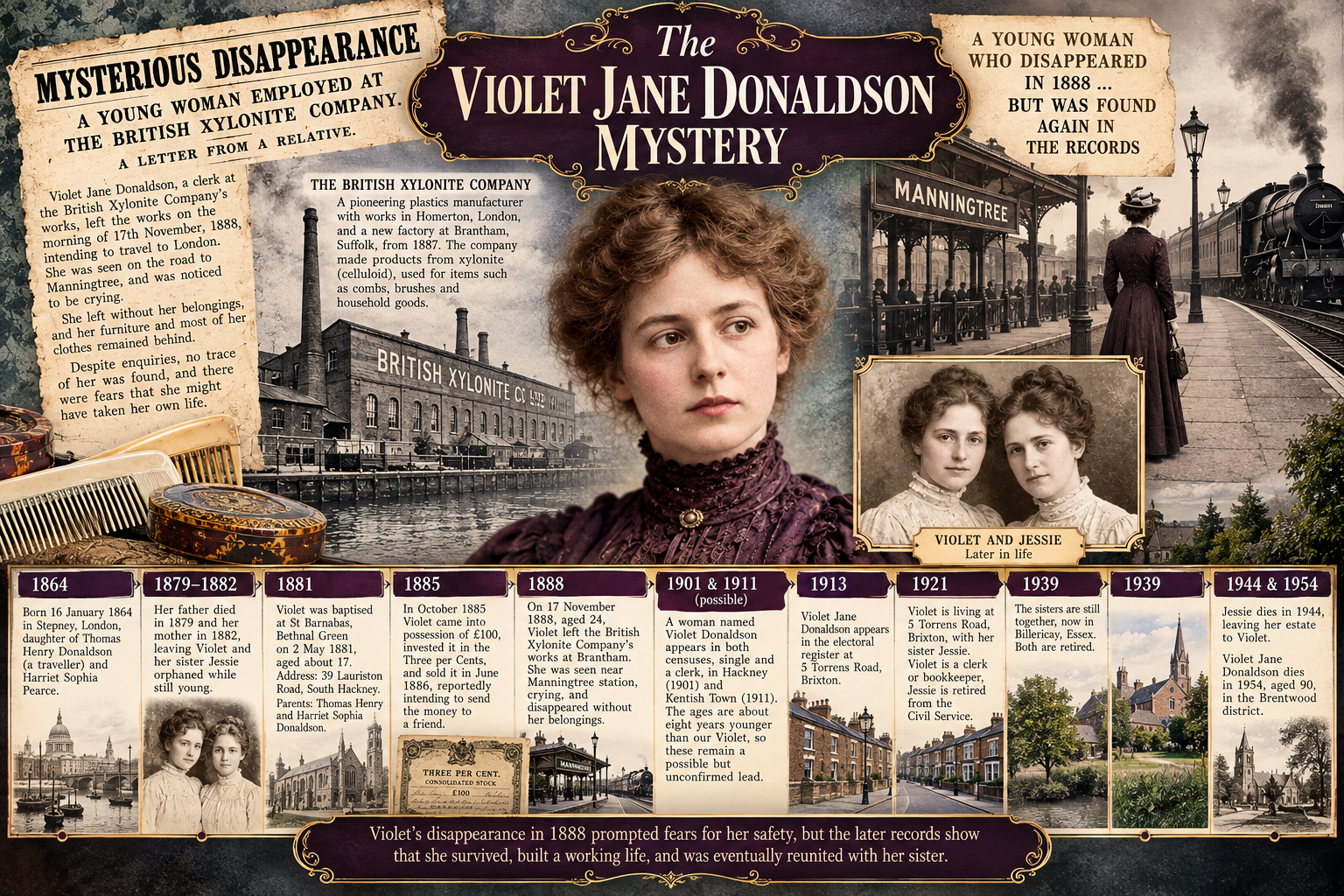
Note: All images generated by ChatGPT