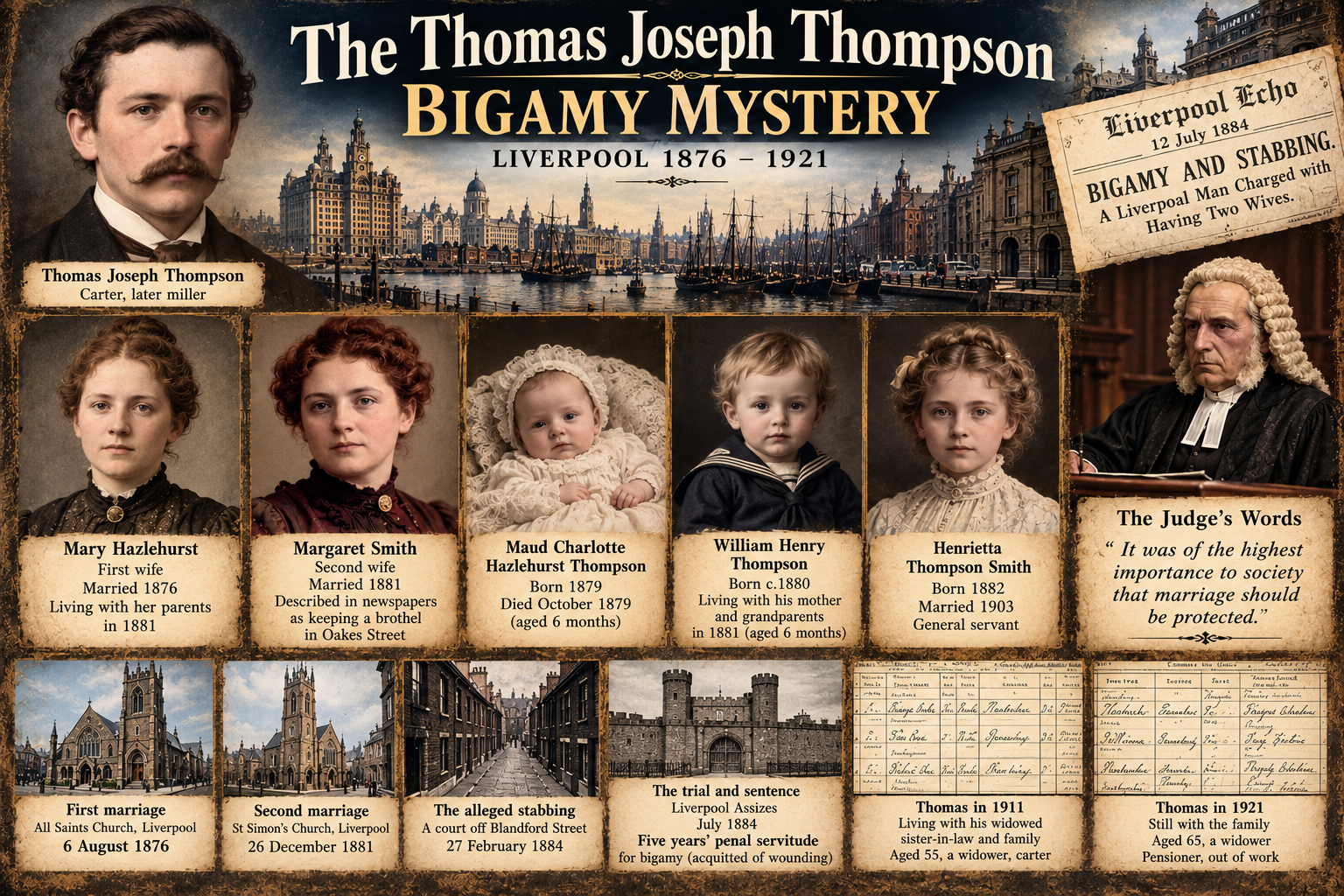
This case began with a newspaper cutting from the Liverpool Echo on Saturday, 12 July 1884.
|
ALLEGED BIGAMY. At the Liverpool Police-court, today, before Mr. T. S. Raffles, Thomas Joseph Thompson, who had the appearance of a respectable working man, was brought up, charged with having committed bigamy in this city on December 26th, 1881, and also with wounding his second wife on the 27th February last. The prisoner, according to the certificates of marriages produced, was married to Mary Hazlehurst at All Saints Church, Great Nelson-street, on the 6th August, 1876. Subsequently he left her and became acquainted with Margaret Smith, who kept a brothel in Oakes-street, and he got married to her at St. Simons Church, Gloucester-street, his first wife being then, and still, alive. On the 27th of February, the prisoner quarrelled with Smith, and stabbed her in the neck with a pocketknife in a house in a court off Blandford-street, where they had been living together. Smith then knew that the prisoner was a married man, a warrant having been out for him for the support of his first wife. Both wives appeared in court, and the prisoner stated that with regard to the second marriage that he had been taken to church while drunk and forced to marry. He was committed to trial at the assizes. |
At first glance, this appeared to be a straightforward case of bigamy complicated by an accusation of violence, yet the subsequent investigation revealed a more complicated family history. By combining contemporary newspaper accounts with original parish registers and census records, we have established the principal events and uncovered several details that illuminate marriage, family responsibility and the administration of justice in late Victorian
The first marriage
 One of our most important discoveries was the original marriage register for Thomas Joseph Thompson and Mary Hazelhurst, which established a documentary starting point for the investigation. As reported above, they married at All Saints Church, Great Nelson Street, Liverpool, on 6 August 1876. Thomas was 21 and Mary was 23. They were both living at Hawthorn Street, Liverpool.
Thomas’s father was recorded as Joseph Thompson, a tin-smith, and Mary’s father as William Hazlehurst, a watch-maker The marriage entry is valuable for several reasons; these details enabled us to distinguish him from other men with similar names and subsequently compare the first marriage with the second.
Thomas was recorded as a carter. Cartering was an important part of the urban economy: goods had to be transported between docks, warehouses, railway stations, markets, mills and shops. Liverpool’s commercial activity created continuing demand for men who could move goods by horse and cart. The marriage register therefore places Thomas within the city’s working population, rather than among the professional or mercantile classes.
 Our subsequent research identified that they had had a daughter, Maud Charlotte Hazlehurst Thompson, who was born in July 1879, but who died in October of that year; she was 4 months old.
We also found an 1881 census entry for Mary Thompson who was living with her parents and siblings at 120 Park Road, Toxteth Park. In the household was a six-month-old grandson, William H. Thompson, apparently Mary’s son.
This is an important development in the story. By early April 1881 Mary was back living with her family rather than in a household with Thomas. The census suggests that Mary’s family provided a household in which she and her baby could live. It is a reminder that the consequences of marital breakdown were often managed within the wider family, although we cannot establish the precise arrangements in this instance.
The second marriage
 The original marriage register for Thomas and Margaret was another major discovery, and, as reported above, they married at St Simon’s Church, Gloucester Street, Liverpool, on 26 December 1881. The entry records Thomas as Thomas Thompson, of full age, a bachelor, a carter, son of Joseph Thompson, a tin-smith.
Margaret Smith was recorded as a spinster, of full age, and the daughter of William Smith, a master carter. This consistency, combined with the names and dates, strongly supports the identification of the groom as the man who had married Mary in 1876.
The central contradiction is that Thomas described himself as a bachelor for this second marriage. He was not free to marry again while Mary was still alive and their marriage remained legally in force. The second marriage was therefore bigamous.
What did Margaret know? This remains one of the central unanswered questions. The register establishes that Margaret married Thomas, but it does not establish whether she knew about Mary. Nor does the fact that she was described as a spinster tell us anything about her understanding of Thomas’s previous marriage. It would be tempting to treat Margaret as either an innocent victim of deception or a knowing participant, but our evidence does not justify either conclusion.
We found evidence that Thomas and Margaret had a daughter, Henrietta, born on 28 December 1882. She was baptised at St Peter’s Church, Liverpool, on 11 February 1883.
Henrietta later married John Ellis Walsh at St Matthew’s Church, Toxteth Park, on 29 March 1903. The marriage register identifies her as Henrietta Thompson Smith, aged 20, a general servant. She named Thomas Thompson, a carter, as her father.
This 1903 marriage is valuable. It connects Henrietta’s adult identity with Thomas and Margaret and shows that she used the combined surname Thompson Smith. We cannot say why she used that surname, or where she lived during the intervening years. Nor can we establish whether Margaret raised her throughout childhood.
The two households make the consequences of the bigamy more tangible. Thomas’s first marriage had produced a daughter who died in infancy and a son whose later history remains uncertain. His second marriage produced Henrietta, who survived to adulthood. The evidence does not tell us how much the children knew about their father’s circumstances. It does, however, demonstrate that the case involved more than an abstract breach of the marriage laws. There were children whose identities and family relationships were shaped by the circumstances of their parents’ lives.
The alleged stabbing of Margaret Smith
The newspaper report (above) described an accusation that Thomas had stabbed Margaret in the neck with a pocketknife during a quarrel on 27 February 1884. As we were unable to locate the fuller assizes report, we cannot establish what provoked the quarrel, whether the marriage was a source of conflict between them, or precisely what evidence Margaret gave. Crucially, the later sentencing report tells us that Thomas was acquitted of the wounding charge.
The trial and sentence
Two later newspaper reports were essential to establishing the legal outcome. The Liverpool Mercury of Wednesday, 30 July 1884, reported the sentence imposed at the Liverpool Assizes on 26 July. The Manchester Courier and Lancashire General Advertiser, also dated 30 July 1884, supplied the important additional detail: Thomas pleaded guilty to bigamy, was sentenced to five years’ penal servitude, but was acquitted of malicious wounding.
Thomas’s guilty plea removed the need for the prosecution to prove the bigamy charge through a contested trial. The marriage records we subsequently found independently corroborate the essential facts behind that charge. The wounding charge had a different outcome. The acquittal means that the prosecution did not secure a conviction. Without the full trial report, we cannot determine why the jury acquitted him. It is important not to treat the five-year sentence as punishment for both offences. The newspaper evidence identifies it as the sentence for bigamy.
The most revealing detail in the sentencing report is the judge’s observation that it was of the highest importance to society that marriage should be protected. This is more than a passing remark. It gives us an insight into the moral and social framework within which bigamy was understood by the Victorian courts. The judge did not present the matter merely as a private disagreement between a husband and two women. His words framed the protection of marriage as a public concern.
Why was marriage regarded as so important? In Victorian Britain, marriage was closely connected with several areas of social and legal life:
- Legitimacy and family identity. Marriage provided a recognised framework for establishing family relationships and the legal status of children.
- Financial obligations. Marriage carried expectations and responsibilities between spouses, including the maintenance of a wife who might have little independent income.
- Inheritance and property. Marital status could affect succession, property rights and the legal position of family members.
- Social respectability. Marriage was widely treated as a foundation of respectable domestic life, although actual relationships often fell far short of the ideal.
- Public order and the authority of the law. A bigamous marriage undermined the legal distinction between a valid marriage and an unauthorised second union.
These considerations help explain why a bigamy case could be treated as a serious offence even when the immediate dispute between the parties was not itself the subject of a conviction. The judge’s wording reflects this broader concern: marriage was considered an institution whose legal status mattered to society as a whole.
Five years’ penal servitude was a substantial punishment. Thomas’s case therefore illustrates that bigamy could attract a severe custodial sentence in nineteenth-century England. We should be careful not to infer from the sentence alone that his case was typical, or that every bigamy conviction resulted in comparable punishment. Sentences depended on the circumstances and the law applicable at the time. Nevertheless, the case demonstrates that the courts could treat a second marriage as a serious offence against the legal and social order, even when the accused pleaded guilty and the associated wounding charge ended in acquittal.
There is also a human tension in the judge’s words. The law protected marriage as an institution, but the surviving records give us only fragments of the actual relationships. We know that Mary was living with her parents with a young baby, that Thomas married Margaret while his first marriage remained in force, and that Margaret later became involved in a dispute that led to a wounding charge. We do not know how either woman understood the situation, what support Mary received, or what Margaret knew about Thomas’s first marriage.
The judge’s statement tells us what the court considered important. It does not tell us how justice felt to the women whose lives were affected. That distinction is valuable for social history: the official record expresses the law’s concern for marriage, while the family records reveal the complicated lives that existed beneath that ideal..
Thomas after the conviction
One of the more surprising developments was the apparent discovery of Thomas decades after his trial.
We found a Thomas Joseph Thompson, aged 55, a widower, and a carter in the 1911 census, living with his widowed sister-in-law, Sarah Ann Thompson, and her family in Liverpool. The 1921 census shows him in the exact same family setting. He was once again recorded as a widower, aged 65 years and 11 months, and a pensioner.
We were unable to locate Thomas in the 1891 or 1901 censuses, or to establish exactly where he was living immediately after his conviction. Nor did we establish which woman he meant when he described himself as a widower in 1911 and 1921. The records do not prove when Mary or Margaret died, whether either remarried. These later records provide a possible endpoint for Thomas’s story, but not a complete account of his intervening years.
CONCLUSION
This case began with a striking newspaper story: a man who had married twice, a second wife described as keeping a brothel, an allegation of stabbing, and a defence that he had been drunk when taken to church.
Our investigation established the essential legal outcome. Thomas pleaded guilty to bigamy and received five years’ penal servitude, while the separate wounding charge ended in acquittal.
The case also offers a useful insight into Victorian social attitudes. The judge’s insistence that marriage must be protected reflects the importance attached to the institution by the courts. Marriage was understood not simply as a personal relationship but as a foundation of family identity, financial responsibility, inheritance and social order.
Yet the records also reveal the limitations of that formal ideal. The lives of Mary and Margaret remain only partially visible. We cannot say what either woman knew, what choices they made, or how they experienced the consequences of Thomas’s actions. That contrast is perhaps the most valuable historical lesson of the case. The court could pronounce sentence and affirm the importance of marriage, but it could not preserve the full stories of the people involved for later generations.
Not: All images generated by ChatGPT