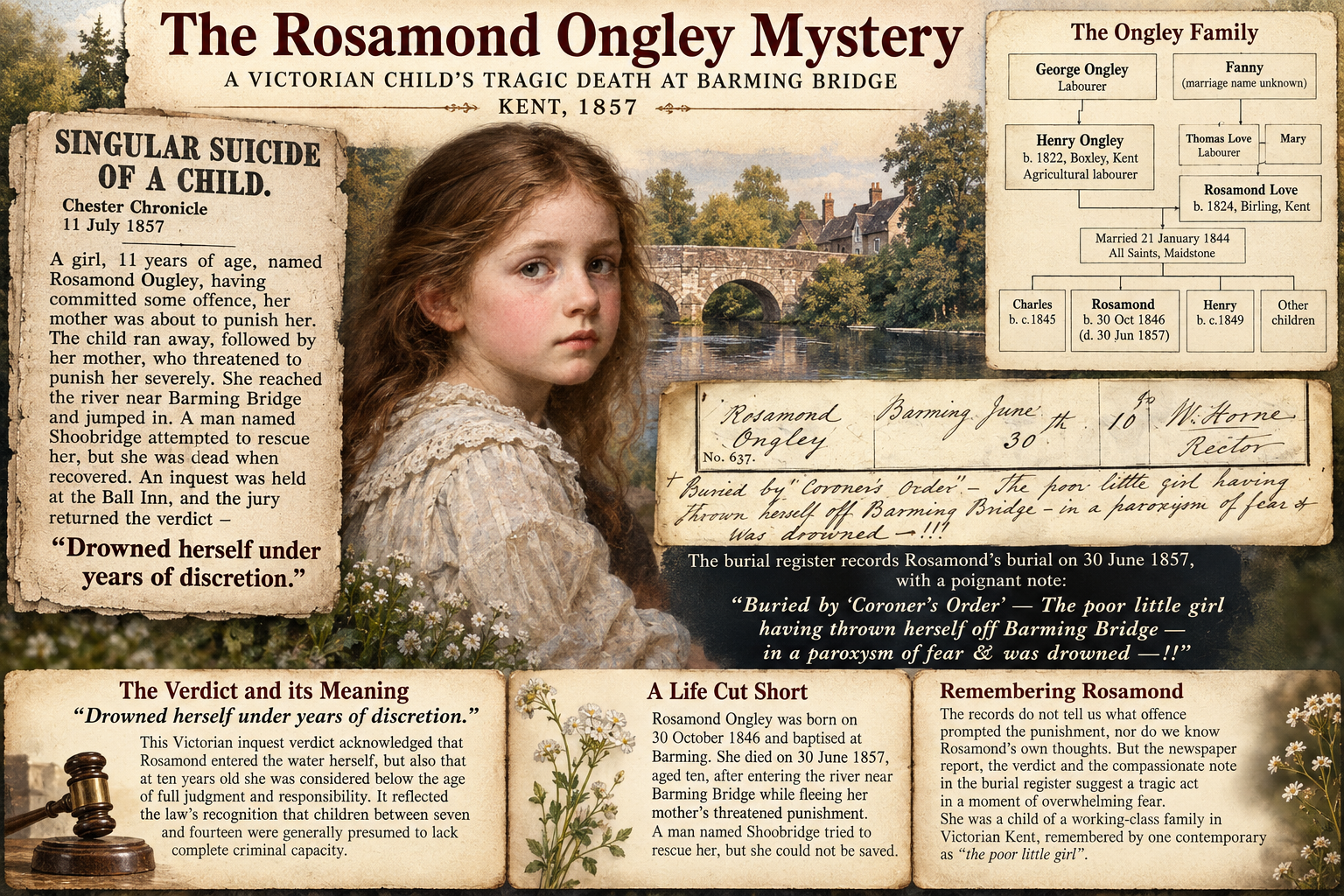
This case began with this short but tragic report in the Chester Chronicle and Cheshire and North Wales General Advertiser on 11 July 1857.
| SUICIDE OF A CHILD – On Saturday last a girl named Rosamond Ongley, aged eleven years jumped into the river near Barming-bridge, Maidstone and was drowned. It seems that she had committed some offence, and her mother was about to beat her for it, when she ran off towards the river, which is nearly half a mile distant from her parents’ house. The mother pursued her and threatened to severely punish her. At length the child reached the river bank, and was seen to jump in immediately. An alarm was given, and a man named Shoebridge endeavoured to save her, but when she was got out it was found that she was quite dead. An inquest was held the same day at the Bull Inn, and a verdict of “Drowned herself under years of discretion” was returned. |
Initially, this appeared to be a small and perhaps unpromising mystery. The newspaper supplied few details, and subsequent searches revealed no fuller account of the inquest. However, parish registers, census returns and civil registration records enabled us to identify the child, reconstruct her family and uncover a particularly poignant annotation in the burial register.
Identifying Rosamond Ongley
 Rosamond was born on 30 October 1846 and baptised on 29 November 1846 at St Margaret’s Church, Barming, Kent. Her parents were Henry Ongley and Rosamond Love.
The newspaper described Rosamond as eleven. The baptism register establishes that she was born in October 1846 and her burial entry, dated 30 June 1857, records her age as ten. The parish record therefore provides the more precise evidence for her age: she was ten years old when she died, approaching her eleventh birthday.
Rosamond’s parents married on 21 January 1844 at All Saints Church, Maidstone. Henry was a labour, and both their fathers were labourers. This establishes the family on both sides and places the couple within the rural working population of nineteenth-century Kent. Henry worked as an agricultural labourer for much of his life.
The census records allow us to follow the family before and after their daughter’s death.
In 1851 Henry and Rosamond were living with three children in Barming: Charles, Rosamond and Henry. In 1861 after the death of Rosamond they were still living there with 5 children. In fact they had a total of eleven children between 1844 and 1869.
Henry died in 1893, and Rosamond survived him until 1900.
This reconstruction does not reveal the private emotional circumstances of the family, but it does show that Henry and Rosamond continued their lives in the Barming area for decades after their daughter’s death.
The circumstances of Rosamond’s death
The newspaper report gives a simple sequence of events: Rosamond had apparently done something for which her mother intended to punish her; she ran away; her mother pursued her; and she entered the river. The account portrays her action as an immediate response to fear of punishment. Nevertheless, it is important to distinguish the newspaper’s narrative from what can be independently established.
We do not know what offence Rosamond was alleged to have committed. We have no surviving testimony from her, and the newspaper reports do not provide the full evidence heard at the inquest. We cannot establish whether the threat described was typical of her home life, whether there were other contributing circumstances, or precisely what happened in the moments before she entered the water.
The inquest verdict
The wording of the verdict is central to this case: “Drowned herself under years of discretion”
In Victorian England, a coroner’s inquest investigated the circumstances and cause of a person’s death. Where a death appeared to have resulted from a deliberate act, questions of intention and responsibility could become important.
The expression “under years of discretion” referred to a person being below the age at which they were considered capable of exercising mature judgment. It was a legal expression associated with the question of a child’s capacity and responsibility.
At common law, children under seven were generally regarded as incapable of criminal responsibility. Between seven and fourteen, there was a rebuttable presumption that a child lacked the necessary criminal capacity, although evidence could be offered to establish otherwise. These rules concerned criminal responsibility and should not be treated as a complete explanation of every coroner’s verdict.
Rosamond was ten. The verdict’s wording appears to acknowledge her youth and the distinction between a deliberate physical act and the mature understanding or responsibility that might be attributed to an adult. It should not be interpreted as evidence that she had been found mentally ill, nor does it establish that the jury knew precisely what she intended when she entered the river.
The wording is particularly significant because it does not simply describe an accidental drowning. It acknowledges that Rosamond entered the water herself while qualifying the judgment by reference to her age.
We must, however, retain a degree of caution. We have the newspaper’s abbreviated report of the verdict rather than a complete transcript of the coroner’s proceedings. The exact legal reasoning behind the jury’s wording remains unknown.
The burial register
The most revealing additional evidence emerged from the Barming parish burial register. Rosamond’s burial is recorded on 30 June 1857.
There is an asterisk by her name, and at the bottom of the register page, a handwritten annotation provides further commentary on the circumstances of her death. The readable portion states:
“Buried by ‘Coroner’s Order’ — The poor little girl having thrown herself off Barming Bridge — in a paroxysm of fear & drowned !!”
“Buried by ‘Coroner’s Order’” – This phrase explicitly connects the burial arrangements with the coroner’s involvement. It confirms that the death was being treated as a matter requiring official investigation rather than as an ordinary burial without further inquiry.
“The poor little girl” – These words convey sympathy. They are markedly different in tone from the newspaper’s terse account, which focuses on the incident and the verdict. The annotation reminds us that Rosamond was not simply a name in a newspaper report. The writer of the note – presumably the vicar – chose to describe her as a poor little girl, expressing a human response to the tragedy.
“In a paroxysm of fear” – This is the most striking phrase. A paroxysm meant a sudden and intense outburst or attack. In this context, the writer appears to have interpreted Rosamond’s actions as occurring during an overwhelming episode of fear. The phrase offers a possible contemporary understanding of what happened to her. It is consistent with the newspaper’s description of a child running away from threatened punishment, but it is more explicit about the emotional state attributed to her.
We should not mistake it for a direct quotation from Rosamond or assume that the writer witnessed the incident. It is a contemporary annotation, and its source and evidential basis are unknown. Nevertheless, it gives the case a dimension that the newspaper report alone does not provide. The register writer appears to have understood the tragedy not simply as an act of defiance, but as the desperate action of a frightened child.
Victorian childhood and family discipline
The case also provides a glimpse into the social world of a rural working-class family in mid-Victorian Kent.
Physical punishment was widely accepted as a means of disciplining children during the nineteenth century, although practices varied considerably between households. The newspaper’s account of a mother threatening to beat her daughter would not necessarily have been regarded by contemporary readers as extraordinary in itself.
What made this incident remarkable was its fatal outcome. Rosamond was ten years old, living in a household with several siblings and a father employed as an agricultural labourer. Her world would have been shaped by family authority, the practical demands of working-class life and the limited independence available to a child. We should not infer from this single incident that her parents were habitually cruel or that the household was necessarily unhappy. The records do not establish that. Equally, we should not dismiss the reported fear simply because physical punishment was commonplace.
The burial-register annotation is a reminder that the emotional experience of a child could be recognised even within the language and assumptions of Victorian society.
CONCLUSION
This case began with a few lines in a Victorian newspaper. Through the parish registers, marriage transcript, census returns and civil registration records, we have reconstructed her immediate family and followed her parents into later life.
The final discovery, the burial-register annotation, is the most poignant piece of evidence. It records not only the official circumstances of the burial but also a contemporary expression of sympathy and an interpretation of Rosamond’s actions as occurring in a paroxysm of fear.
We cannot know precisely what the child experienced or what she intended. Nor can we recover the full discussion that took place at the inquest. But the combination of the newspaper report and the burial note suggests that her death was understood by at least one contemporary observer as the tragic consequence of overwhelming fear.
The verdict acknowledged her age and the question of discretion; the burial annotation gives us a glimpse of the human sympathy that lay behind the formal record.
Rosamond lived for only ten years. Her parents continued their lives in Kent, and the surviving family grew up, worked and moved between the neighbouring communities of Barming, Teston and West Farleigh. The records allow us to restore something of that family context to a story that might otherwise have remained a brief and anonymous tragedy in the newspaper columns.
The mystery cannot be completely solved, but the surviving evidence allows us to understand more about Rosamond’s identity, her family and the way her death was recorded and interpreted in Victorian Kent.
Note: All images generated by ChatGPT