This case began with a newspaper article in the Daily News on 11 August 1894 that reported about an unusual matrimonial dispute.
|
SEQUEL TO A RUNAWAY MARRIAGE. In the Divorce Division yesterday Sir Francis Jeune had before him the case of Dore v. Dore. The petition was that of Mrs. Jane Frances Dore for restitution of conjugal rights. The respondent was Mr. Albert Dore, and he filed no answer. – Mr. Searle, who appeared for the petitioner, said that the circumstances were somewhat unusual. The families of the parties were friendly, and in September, 1883, the wife, her mother, and sister were on a visit to the respondent. Mr. Dore persuaded the petitioner to run away with him. At that time he was 21 years of age, while she was only 14. He got a licence, and they were married at the parish church, Stoke Newington, on the 14th September, 1883. They afterwards went to Blackpool for two or three days. As soon as he got there he wrote to her father, and acquainted him with the fact of the marriage. The father took the view that his daughter was too young to live with Mr. Dore, and insisted upon her going back at once. He took proceedings in the police-court against the respondent for false statements in regard to the marriage licence; but ultimately they were abandoned. Afterwards the husband seemed to have occasionally visited the house. They never cohabitated after the visit to Blackpool. There had been some negotiations, and the respondent had made his wife an allowance. On one occasion Mr. Dore contemplated a restitution suit himself, but the petitioner was never served with the citation, and the matter dropped. Now the petitioner presented her suit to “regularise” her position. It had come to her knowledge that her husband had got another establishment. She had written to him asking for restitution. He replied that he could not live with her again, that after so many years he had found other friends, and that she must not be surprised at his determination. – The petitioner was called and bore out the opening statement of counsel. – Replying to the President, she said she did not wish to go back to her husband. – Mr. Searle: In these cases wives usually do not. (Laughter.) – His Lordship: It looks to me like a case of voluntary separation. – Mrs. Dore further stated that she believed her husband was now living with someone else. If he was willing to give up his present mode of life she would be willing to go back to him. – Mr. George Thomas Ewens, father of the petitioner, of Ivy House, Kew-green, said that his daughter was born on the 23rd September, 1868. He had not the slightest idea of her engagement to the respondent, and he did not know of the marriage until afterwards. He was very indignant. His daughter was too young, and he objected to the marriage under the circumstances altogether. She returned to him, and has lived with him ever since. The 4th of January, 1884, was the last visit of the respondent to his house. He was not kept away by witness. Naturally, he was annoyed at the respondent’s conduct, and took proceedings against him in the police-court. They were adjourned two or three times, and subsequently abandoned. The respondent made the petitioner an allowance of £200 a year, under compulsion. That amount was subsequently reduced to £70. Recently witness heard that Mr. Dore had a separate establishment at Weymouth, where he kept a steam fishing-boat. In the result the learned President came to the conclusion that in all the circumstances the petitioner was justified in resorting to a demand for restitution of conjugal rights, and he would grant a decree with costs. |
At first, this appeared to be a curious story about a young woman who had married against her father’s wishes and a husband who had subsequently established a separate life, but as the investigation progressed, the discovery of original court papers transformed the case. What makes this case particularly compelling is that the surviving evidence gives us more than a dramatic courtroom story. It allows us to reconstruct the families behind the marriage, examine the legal position of an estranged Victorian couple, and follow Jane and Albert beyond the events that first brought them to public attention.
The immediate puzzle was why Jane should seek a court order requiring Albert to take her back when she apparently did not want to return under the circumstances he offered. At this stage, we had only the newspaper’s account. The discovery of the court papers would change our understanding considerably.
Jane Frances Ewens
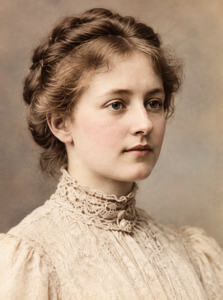 One of the most valuable discoveries was Jane’s original birth certificate that showed that Jane Frances Ewens was born on 23 September 1868 at York Cottage, New Hampton, Middlesex, and that her father was George Thomas Ewens, a merchant. The birth certificate confirms the date Jane’s father later gave in court. This is important because her age was central to the circumstances of the marriage.
Jane married Albert on 14 September 1883, just nine days before her fifteenth birthday. She was therefore fourteen at the wedding, while Albert was recorded as twenty-one. The marriage register records the marriage at the parish church of St Mary, Stoke Newington, by licence.
The 1881 census places Jane with her family at York Cottage, New Hampton, when she was twelve. Ten years later, the 1891 census records her as a married daughter, aged twenty-two, still living with her family. That later entry is especially revealing. Although Jane was legally married, she was living in her parental household rather than with Albert. It independently supports the account she and her father gave of their long separation.
The records establish a family home and a reasonably clear picture of Jane’s life before and after the marriage. They do not, however, tell us precisely what happened within the household between the 1881 census and the wedding in September 1883. We should therefore be cautious about the newspaper’s suggestion that Jane was persuaded to run away. It is the contemporary account, but the surviving documents we have examined do not independently reconstruct every conversation or decision that led to the marriage.
Albert Edward Dore
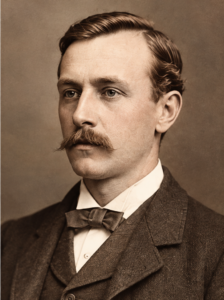 Albert’s family history has been another major part of the investigation. His background appears rather different from the impression one might initially form of a young man who kept a fishing boat and later moved between occupations.
Albert’s father was William Henry Dore, born in Corsham, Wiltshire, in August 1808 and baptised there on Christmas Day that year, the son of Lawrence and Ann Dore. William’s birthplace provides our first important link between the Dore family and Wiltshire.
In the 1861 census, William was 62 and described as a retired butcher. His wife, Jane Akers Dore, was 45. The age difference is notable, although the census alone tells us little about their marriage.
William died in 1874 and by the time of the 1881 census, his wife, Jane A. Dore, aged 55, was recorded as living on income from property in Stoke Newington, together with her son Albert. This suggests that Jane had an independent source of income after her husband’s death. We have not established whether this derived from property inherited from William, assets she already owned, or another source.
Albert wrote to his wife Jane from Broughton Gifford, Wiltshire, in December 1885, and in the 1891 census, he is recorded living there with his widowed mother.
We discovered that William’s sister Ann, baptised at Corsham in 1801, married John Humphreys and had fourteen children. Their descendants were living in the surrounding Wiltshire villages in 1881. The Wiltshire connection now makes sense.
The first surprise of this case
The case took a dramatic turn when we discovered Albert’s own petition for restitution of conjugal rights, dated February 1886 – eight years before Jane brought her petition. (It was alluded to in the Daily News article.) In his petition, Albert alleged that Jane had withdrawn from cohabitation after their marriage and had refused without just cause to resume her conjugal rights. In other words, he presented himself as the spouse seeking the restoration of the marriage.
The court papers included a letter Albert sent to Jane on 16 December 1885 from Broughton Gifford. He addressed her as “My dear Jenny” and referred to a letter she had sent to his solicitor. He said he could not believe that she genuinely intended not to live with him. Albert urged her not to be influenced by other people, referred to their earlier plans for her return and promised to do his best to make her happy. He asked her to remember her duty to him as his wife. His affidavit stated that the letter was delivered to Jane on 5 January 1886 but that he received no answer.
This is important evidence. It shows that Albert was actively asking Jane to return before filing his petition. It also establishes that Jane had written to his solicitor, although we have not found that earlier letter. That missing letter is a significant gap: it might have explained Jane’s position before Albert began his proceedings.
The court’s procedural record shows the petition being filed, followed by affidavits concerning service and the search for an appearance. The cause was subsequently set down, but an entry dated 6 November 1886 records that it was struck out of the list. We do not know from the surviving pages why it was struck out. We should not assume that the court rejected Albert’s allegations, that he withdrew the case, or that the couple reached an agreement.
Nevertheless, the discovery changes the case fundamentally. Both spouses eventually sought restitution of conjugal rights, each presenting the other as the person who refused to resume married life.
Jane’s petition in 1894
Jane’s petition was dated 21 April 1894 and filed on 23 April. The supporting affidavit confirms that she swore the statements in her petition were true and that there was no collusion between the parties to bring the case. The petition stated that the couple had not lived and cohabited together since about 17 September 1883. It asked the court to require Albert to take Jane home, receive her as his wife and restore her conjugal rights.
The most revealing documents are the letters exchanged immediately before the petition. On 12 April, Jane wrote to Albert, saying that more than ten years had passed since he last came to see her. She explained that she had been living with her father and asked Albert to take her back.
Albert replied on 13 April from Hope Cottage, Hope Bay, Weymouth. He acknowledged her request but refused to resume married life. He said that he had found other friends and could not agree to live with her again.
This exchange answers much of our original question about Jane’s motives. She did not simply go to court without first approaching Albert. She made a direct request to resume married life, and he refused. Her petition followed shortly afterwards.
The reference to his having found other friends is suggestive, especially given the newspaper’s report that he had established a separate household in Weymouth. But it does not, by itself, prove that he was living with another woman. The documents show us what each spouse said and did; they do not reveal every private motive.
The decree of restitution
On 10 August 1894, Sir Francis Jeune granted Jane a decree of restitution of conjugal rights. The decree recorded that Jane had sufficiently proved the contents of her petition. It formally declared that the couple remained lawfully married and ordered Albert to take Jane home and restore her conjugal rights within 114 days of service. This was a legal order requiring him to resume his marital obligations. It was not a divorce decree. The court’s order also required him to certify compliance, on pain of further consequences.
“Restitution of conjugal rights” was a remedy that could be used to compel a spouse to resume married life. It was not the same as ordering a couple to divorce, and it did not guarantee that a relationship could be repaired.
Jane had initially asked the court to require Albert to take her back. Yet, according to the newspaper, she did not wish to return under the circumstances he was offering. That is not necessarily a contradiction. She had asked him to resume married life, but the terms and reality of any return may have become unacceptable to her. The letters show her making the request; the newspaper reports her position at the hearing. We cannot establish precisely how her intentions evolved during the proceedings.
The final chapter of the marriage: divorce
The divorce papers reveal what happened next. Jane filed her divorce petition on 6 September 1894, less than a month after obtaining the restitution decree. The decree nisi, dated 4 February 1895, records the grounds as adultery coupled with desertion, including Albert’s failure to comply with the restitution decree. The papers indicate that Albert did not appear to defend the divorce suit.
The decree absolute was recorded on 12 August 1895.
Two separate lives after the divorce
Jane married George Richard Allan, a glove agent, in Cape Town on 8 March 1904. This was almost nine years after the final decree ending her marriage to Albert. They had two children, and lived in Ealing Middlesex, where Jane died on 8 February 1953, aged eighty-four
Albert married Catherine Alice Spackman in the third quarter of 1895, shortly after the final decree, and they had one child. Catherine’s birthplace in Broughton Gifford is intriguing because Albert had written to Jane from that village in 1885.
The 1901 census places Albert and Catherine in Weymouth, where Albert was recorded as living on his own means. In 1911, he appears as a builder, while the 1921 census describes him as a retired general dealer. These changing descriptions suggest that his working and financial circumstances evolved over time.
Albert died on 26 November 1931 at 8 Hanover Terrace, Weymouth. Probate was granted on 24 March 1932, with his estate valued at £42,476 7s 8d. That was a substantial estate. It is consistent with the earlier census description of living on his own means, but we cannot establish whether his wealth came from property, business activities, investments, inheritance or a combination of sources.
Marriage at a very young age
Jane was fourteen when she married Albert, who was twenty-one. Her father’s opposition, as reported in court, and the couple’s almost immediate separation underline the vulnerability of a young person entering marriage at such an early age. The surviving records establish the ages and the subsequent breakdown. They do not allow us to reconstruct fully the circumstances of the courtship or the extent of pressure exerted on Jane. The law could compel a formal response, not a successful marriage
Both Albert and Jane sought restitution of conjugal rights at different times. Their competing petitions show how the law could be used by spouses who claimed that the other was refusing to resume married life. But a decree could not restore affection or resolve the underlying problems between two people. In this case, the restitution proceedings were followed by divorce rather than reconciliation.
CONCLUSION
The Dore Divorce Mystery began with an unusual newspaper report: a wife asking the court to compel her estranged husband to take her back. But the central story is now clear. Jane and Albert entered a marriage that failed almost immediately, spent years living apart, each turned to the courts to seek restitution, and ultimately divorced in 1895. The surviving documents allow us to follow that process with unusual detail, while the later records restore something of the lives they built afterwards.
This is what makes the case such a rewarding Victorian Mystery: an apparently simple newspaper report has opened into a complex story of family, law, money, and two people whose lives diverged almost as soon as they married.
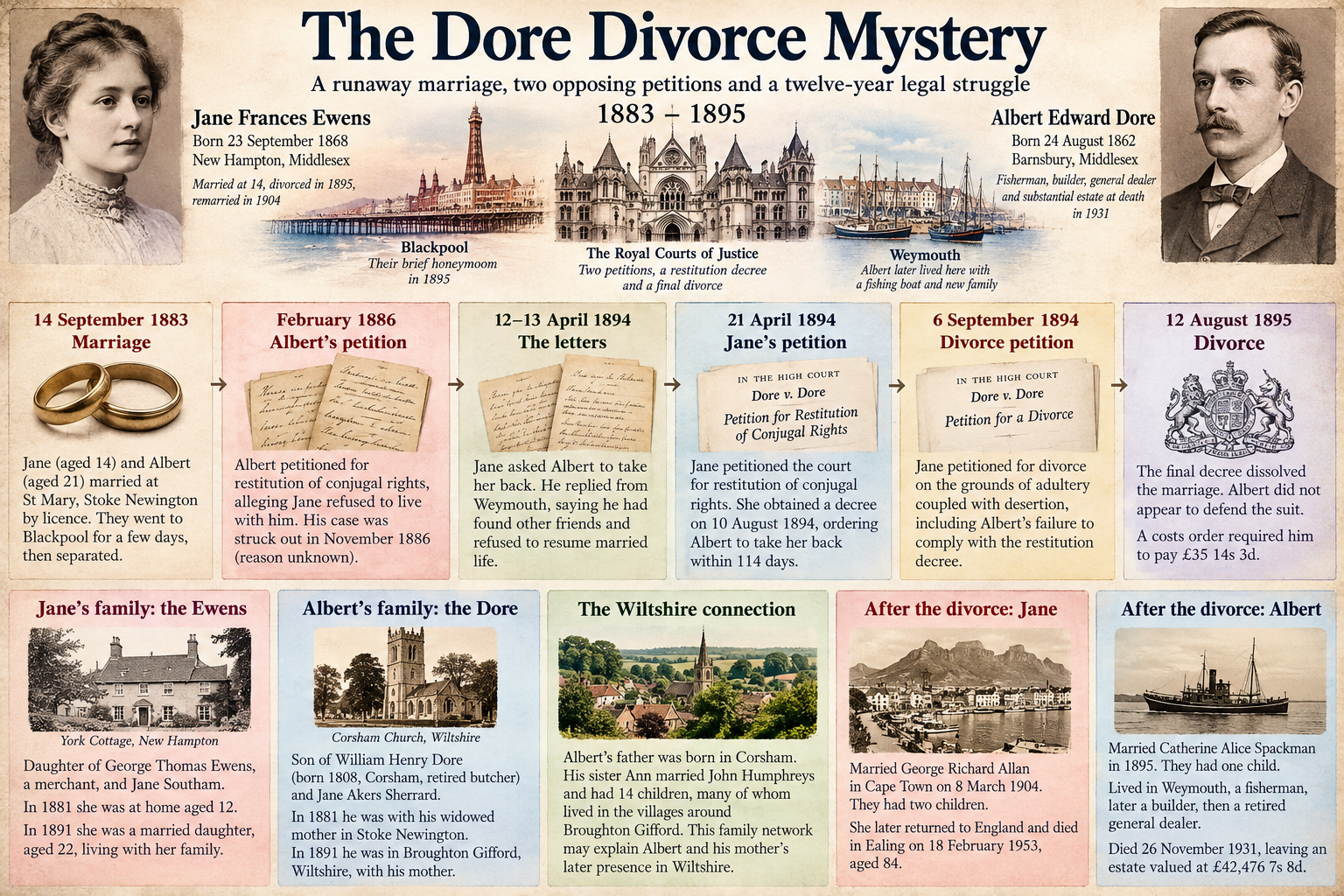
Note: All images generated by ChatGPT