This case began with a short report in the Worcester News on 27 February 1883.
|
SUPPOSED CHILD MURDER NEAR TENBURY. A servant named Ann Carter, in the employment of Mr. W. H Griffiths, having died on the night of Friday, 23rd inst., Mrs. Griffiths examined the contents of the deceased’s bedroom, when she discovered the dead body of a male infant, with a piece of calico tied around its neck. Dr. Murray says Carter had recently been delivered of a child. An inquest will be held. |
The newspaper headline immediately suggested a possible crime, but, as our investigation progressed, it became clear that the circumstances were more complicated and that the evidence did not justify assuming murder.
Ann Carter
 The census records allowed us to look beyond the sensational headline and recover something of Ann’s background.
Ann was born in April 1855 in Bockleton, Worcestershire, the daughter of Benjamin Carter, an agricultural labourer, and his wife Fanny. In the 1861 census, aged 5, she was living with her family in Bockleton, where she was the eldest of several children. The family was rooted in the local agricultural community. In 1871, Ann, aged 15, she was still at home. This gives us a picture of a young woman growing up in a rural working household.
The 1881 census records Ann, aged 25, as a servant in the household of farmer Henry W. Griffiths, his wife Elizabeth, and their 7 children at Hill Farm, Bockleton. Other servants were also present.
At the inquest, Elizabeth Griffiths said Ann had worked for the family for nine years. If that recollection was accurate, Ann had been in their service since about 1874, This was a substantial period of employment. Ann was not simply a recently arrived stranger in the household; she had spent much of her adult life working for this family.
The evidence does not tell us whether she had been happy in her position, what her wages were, or what relationships she had outside the household. Nor have we identified the father of her child.
The inquest
The subsequent inquest report, published in Berrow’s Worcester Journal on 3 March 1883, became the central document in the case. The testimony provides a chronology, although some of the details are based on recollection rather than records made at the time.
Wednesday, 24 January 1883 — the likely date of birth: A newspaper with that date was used to wrap the infant’s body. Dr Murray later estimated that the baby had been born about a month before Ann’s death. The wrapping supports a possible date of birth, but it does not prove when the infant died.
Sunday, 11 February 1883 — the doctor attends Ann: Dr William Berkeley Murray found Ann in bed. He believed she was suffering from ordinary typhoid fever and treated her accordingly. He also noticed signs suggesting that she had recently given birth, but he could not establish how recently.
Thurday, 22 February 1883 — the last reported sighting alive. Dr Murray told the inquest that he had last seen Ann alive on the 22nd.
Friday, 23 February 1882 — Ann dies: Her death certificate, as described by the doctor, attributed her death to childbirth and puerperal fever.
Sunday, 25 February 1883— Ann is buried: Mrs Griffiths said she arranged the burial because she believed Ann had died of fever.
After the burial Mrs Griffiths found the badly decomposed body of the child concealed among clothes in a recess of a table. A strip of calico was tightly tied around his neck. She informed the doctor, who examined the body.
The inquest took place on Wednesday 28 February 1883. The witnesses gave their evidence, and the jury returned a verdict that the child had been found dead, but that there was insufficient evidence to determine whether it had been stillborn or otherwise.
One point deserves emphasis. Mrs Griffiths said Ann had been ill for about a month, while Dr Murray’s account places his first attendance on 11 February. He had treated her for what he thought was typhoid fever and only later learned of the infant’s body. These are not necessarily contradictory accounts: the illness may have begun before he was called, and his initial diagnosis was made without knowing the full circumstances.
The doctor also said Ann had never told him she had given birth. He reported that she did not disclose a childbirth during his attendance, and Mrs Griffiths similarly said she knew nothing of it. We cannot know from these statements whether Ann had deliberately concealed her pregnancy, whether she had given birth alone, or whether anyone had helped her. The evidence simply does not answer those questions.
The infant’s death and the verdict
The post-mortem examination was central to the inquest. Dr Murray stated that the infant had not breathed and believed it had been born about a month before Ann’s death. Yet the jury did not return a finding that the child had been murdered. Its verdict was explicit:
“That the child was found dead, but whether still-born or otherwise there is not sufficient evidence to say.”
That wording leaves the central question unresolved.
The calico around the neck was a disturbing discovery, but it did not, by itself, prove that the child had been born alive or that the strip had caused death. The body was already greatly decomposed, making the medical investigation more difficult.
The original newspaper’s phrase “Supposed Child Murder” therefore reflects the suspicion surrounding the discovery, not a verdict of murder.
Ann’s own death was also tragic, but it was medically distinct from the unresolved question of the infant’s death. The doctor attributed her death to childbirth and puerperal fever. His evidence gives us a plausible account of the illness that killed her, even though we cannot retrospectively verify the diagnosis from the newspaper alone.
Ann’s story is also a reminder that childbirth in the nineteenth century was not simply a private family event. It could be a major medical danger, and the social consequences of pregnancy outside marriage could be severe.
Pregnancy outside marriage
For an unmarried woman in domestic service, a pregnancy could threaten both her livelihood and her position in society. Servants generally depended on their employers for wages and accommodation, and a pregnancy could place their employment at risk.
The evidence does not establish whether Ann was unmarried at the time of her death, although the census records list her as a daughter in her parents’ household and subsequently as a servant. Nor do we know whether the father of her child knew about the pregnancy or offered any support. We should therefore avoid assuming that Ann was abandoned, that she feared dismissal, or that these circumstances explain the concealment of the baby. Those are possibilities within the broader social context, not established facts about her life.
Nevertheless, her situation illustrates how a woman could face childbirth in circumstances where she might be reluctant or unable to seek help. Pregnancy was not always easy to conceal, but a woman living and working in another household might find it particularly difficult to discuss it openly.
Childbirth at home
In rural communities such as Bockleton, births commonly took place at home, often attended by a midwife or experienced local woman, with a doctor called when complications arose. Access to help depended on local circumstances, money, distance and the perceived seriousness of the situation. There were skilled and experienced practitioners, but there was no modern maternity service with routine antenatal care, laboratory testing, blood transfusion, antibiotics and specialist obstetric support.
Childbirth could result in several potentially fatal complications, including haemorrhage, obstructed labour and infection after delivery. A woman might survive the birth itself only to become seriously ill in the days that followed.
We do not know where Ann delivered her child or whether anyone attended her. The inquest did not establish these details. The fact that Dr Murray was called later in her illness suggests that medical care was available to her at that stage, but it could not necessarily reverse the underlying disease.
Puerperal fever
The doctor’s evidence makes puerperal fever the most important medical aspect of this case. Puerperal fever, also known as childbed fever, was a potentially fatal illness following childbirth. What was historically grouped under this name included serious postpartum infections, many of which would now be understood as forms of sepsis. Streptococcal infection was responsible for many such deaths.
After childbirth, the uterus and birth canal were vulnerable to infection. Bacteria could enter damaged tissue and, in severe cases, spread through the body, causing systemic illness and death. Symptoms could include fever, pain, weakness and rapid deterioration. In the nineteenth century, however, doctors did not always understand the cause of the illness or agree on how it spread. The term puerperal fever was itself a broad historical category rather than a precise modern diagnosis.
A particularly important figure in this history was the Hungarian physician Ignaz Semmelweis. In 1847, while working in Vienna, Semmelweis observed that women attended by doctors and medical students in one maternity clinic died of childbed fever at much higher rates than women in a neighbouring clinic staffed by midwives. He connected the difference with doctors moving between post-mortem examinations and maternity patients, and introduced handwashing with a chlorine solution. Death rates fell sharply. His findings were not immediately accepted everywhere. For much of the nineteenth century, the causes of puerperal fever remained contested.
By the 1880s, however, medical practice was changing. Joseph Lister’s work on antiseptic surgery, developed from the late 1860s, helped encourage the use of antiseptic precautions in obstetrics. During the 1870s and 1880s, such measures became increasingly influential, although adoption was uneven and rural practice could lag behind developments in major hospitals.
This matters for Ann’s case. Her death occurred in 1883, when the importance of antisepsis was becoming better understood but before modern antibiotics were available. We cannot establish what infection Ann actually had, or whether any particular infection-control measure would have saved her. But her case occurred at a pivotal point in the history of medicine: doctors were beginning to understand how some postpartum infections could be prevented, while their ability to treat an established, severe infection remained very limited.
If Dr Murray had recognised puerperal fever, could he have saved Ann? This is perhaps the most poignant question raised by the inquest. The answer is that recognising the illness might have helped, but it would not necessarily have saved her. The distinction is between recognising a disease and having an effective treatment for it.
What might have been different?
Dr Murray first saw Ann on 11 February. He believed she had ordinary typhoid fever and treated her on that basis. At the inquest, he said he had noticed that she had had a child, but he could not tell how recently. We cannot know whether he could have diagnosed puerperal infection at that first visit. The report does not give us Ann’s full symptoms, temperature readings, pulse, abdominal examination or other clinical details. It would be unfair to judge his diagnosis solely with the benefit of modern medical knowledge.
Had he suspected a postpartum infection, he might have considered different nursing, hygiene and antiseptic measures, closer observation, or other interventions available to a doctor in 1883. By then, antiseptic practice was increasingly understood, and prevention of infection could make a substantial difference. But once a serious infection had become established, the outlook could be grim.
Antibiotics were not available to treat bacterial infections in the way we use them today. Penicillin was discovered in 1928, and its widespread therapeutic use came much later, during the 1940s. A modern patient with postpartum sepsis can receive urgent antibiotics, intravenous fluids, close monitoring and, where necessary, surgery or other treatment to control the source of infection. These options can be lifesaving, although even modern medicine cannot guarantee survival.
In 1883 a doctor had no comparable antibiotic treatment to eradicate the bacteria responsible for severe puerperal infection.
It is therefore possible that earlier recognition might have improved Ann’s chances, especially if prevention or early intervention could have interrupted the infection. But we cannot say that a different diagnosis would have saved her. She may already have been seriously ill by the time Dr Murray was called, and the report does not give us enough clinical evidence to know how advanced the disease was.
There is another important distinction: the inquest report says the doctor initially thought Ann had typhoid fever, but that does not mean he failed to recognise that she was gravely ill. He attended her over a period of days and treated what he believed was the disease. The tragedy was that the medical knowledge and treatments available to him were limited.
CONCLUSION
This case began with a sensational newspaper headline and the discovery of an infant’s body. It could easily have become a story about suspected infanticide, with Ann judged through the suspicions of the time. The inquest gave us a more complicated picture.
Ann had grown up in Bockleton and spent years working in the Griffiths household. In February 1883, she died after childbirth, with Dr Murray attributing her death to puerperal fever. Her infant son’s body was found after her burial, concealed among clothes and wrapped in a newspaper. We cannot explain the concealment, identify the father, or reconstruct the birth itself. We should not fill those gaps with assumptions about Ann’s motives or conduct.
What we can do is place her story in its historical setting. An unmarried or unsupported woman facing childbirth could be socially vulnerable; childbirth itself could be dangerous; and puerperal fever remained a major cause of maternal death even as the medical understanding of infection was improving. Ann’s death occurred at a time when prevention was becoming better understood, but effective antibiotic treatment lay decades in the future.
We have no proof that Ann Carter murdered her child. We have evidence of a concealed birth, an unexplained infant death, and a young woman who died following childbirth in an era when medicine could not reliably prevent or cure the infections that claimed so many mothers’ lives.
The newspaper headline gave the case its mystery. The inquest gave it its limits. And the census records helped us recover something of the woman behind the headline.
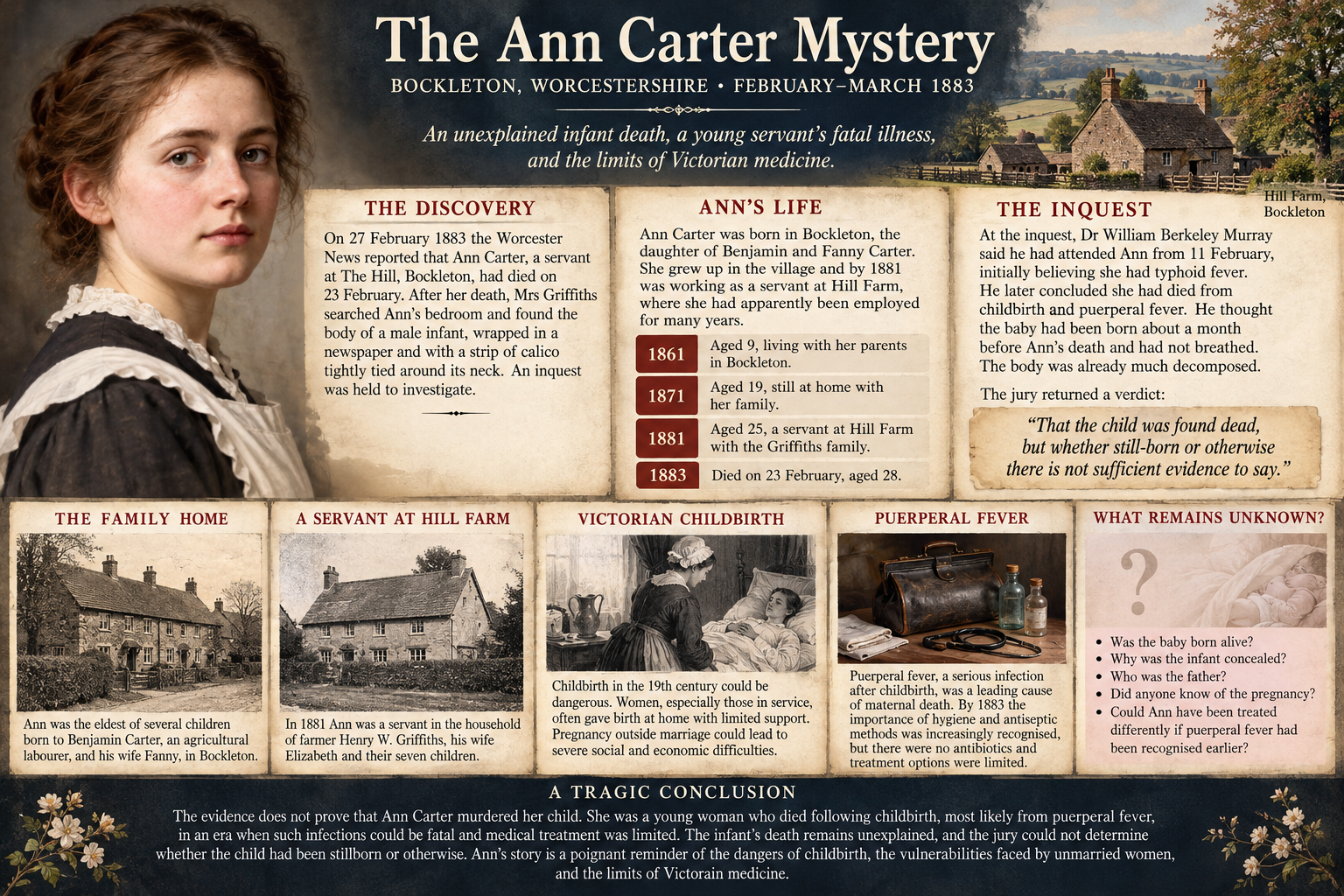
Note: All images generated by ChatGPT