This case started with the following article in the Liverpool Mercury (copied from the Cheltenham Examiner) on 1 January 1850.
| A LADY BURNT TO DEATH – We have to record this week a shocking accident, which occurred to Lady Pynn, a well-known resident of this town, and by which her Ladyship suffered so severely as to cause her death in a few hours. The deceased lady was the daughter of the late Mrs. Bruce Jackson – one of the leaders of the fashionable world in Cheltenham twenty years ago, and had been for many years married to Sir Henry Pynn, who, at the time of the accident, was in Paris. It appears that, on Thursday se’nnight*, Lady Pynn had met with an accident while walking up the Promenade. Her foot having slipped, she fell down and sustained a fracture of one of the bones of the arm, and was conveyed to her residence in the Promenade, and was still under surgical treatment for the fracture when the more serious event occurred which caused her death. On Monday last, being Christmas Eve, the deceased was in her private sitting-room and at about three o’clock she partook of lunch, being habited at the time in a morning dress of light muslin. Her servant had only left the room for a few moments when her Ladyship threw up the window to change the air of the apartment, and it is supposed that the draught of air from the window drew her dress into the fire; for in a moment afterwards, the most piercing screams were heard to issue from her apartment, and, on one of the men servants running upstairs to ascertain the cause, the unfortunate lady was found enveloped in flames. The man, with great promptitude, took off his coat and wrapped it around her, by which means the fire was speedily extinguished; but it was once evident that her Ladyship had sustained very serious injuries. She remained perfectly conscious of what had taken place up to a late hour in the evening, and had again a brief interval of reason on the following morning, but, shortly afterwards, nature gave way under the intensity of the injuries, and at about nine o’clock the unfortunate sufferer breathed her last. – Cheltenham Examiner |
* se’nnight is an archaic English noun meaning a week (a space of seven nights and days)
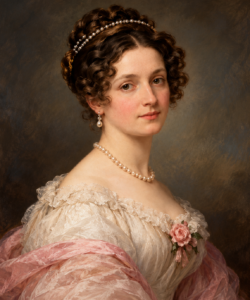 On Monday, 24 December 1849, Lady Charlotte Cecilia Pynn, the wife of Sir Henry Pynn, suffered terrible burns when her light muslin dressing gown caught fire at the Queen’s Hotel in Cheltenham. She died the following morning, Tuesday, 25 December, shortly after 9.15 a.m.
The incident was reported in several contemporary newspapers, including the Liverpool Mercury (above) and Berrow’s Worcester Journal. A detailed account from the Cheltenham Chronicle provides particularly valuable evidence because it records the testimony given at the subsequent inquest.
Lady Pynn had been staying at the Queen’s Hotel for some considerable time. One report says nine weeks, while another gives approximately three months. She was a familiar visitor to Cheltenham, where she regularly spent time during the season.
At the time of the accident, she was recovering from a serious fracture of her arm. She had reportedly fallen about ten days earlier. The same arm had been fractured approximately three years before, during a stay in Brighton, and the earlier injury was said never to have united properly. Her continuing frailty may have made the consequences of the accident particularly severe.
The most detailed newspaper account records the testimony of Lady Pynn’s maid, Ann Woodman, who had served her for ten years. Lady Pynn had been sitting in her drawing room after lunch. Her maid left her in her chair and went to her own bedroom. About ten minutes later, the maid heard a loud scream. When she returned, she found Lady Pynn surrounded by flames.
A servant in the household of Mrs Mytton, named Arnold, came promptly to her assistance. He removed his coat and wrapped it around Lady Pynn to extinguish the flames, exposing himself to considerable danger. Lady Pynn’s own servant and other members of the hotel household also helped.
According to the maid, Lady Pynn explained that her dressing gown had caught fire when she rose from her chair. The window was open, and the maid thought a draught might have blown the light fabric towards the fire.
Another newspaper account describes Lady Pynn going near an open window to change the air before her clothing caught fire. The surviving reports do not agree in every detail, so it is impossible to reconstruct her precise movements with complete certainty. Nevertheless, the essential facts are consistent: her light clothing came into contact with the fire, the flames spread rapidly, and those nearby attempted to save her.
Mr Charles Fowler and Mr Dalton attended Lady Pynn after the accident. The newspaper account records the use of lint, cotton wool and a liquid preparation in treating her burns. Mr Dalton considered the shock to her system more severe and dangerous than the burns themselves. Lady Pynn suffered considerable pain but remained conscious until a few minutes before her death.
The doctors’ comments are important. Severe burns can cause profound shock, fluid loss and systemic injury, and the consequences may be fatal even when a patient initially remains conscious. The doctors’ observation that shock was especially dangerous is consistent with the medical understanding of serious burns, although we cannot determine her precise physiological cause of death from the surviving newspaper account.
In 1849, medicine had nothing comparable to modern burn units, intravenous fluid replacement, intensive monitoring or antibiotics. Treatment was largely supportive, and the capacity to prevent the complications of extensive burns was extremely limited. Even with modern care, severe burns can be life-threatening; in Lady Pynn’s time, the outlook was considerably worse.
The inquest was held at the Queen’s Hotel on 26 December 1849, before the deputy coroner, S. Mayer. The jury returned a verdict of accidental death through burning. The report also records that the jury agreed to the customary fee being paid to Cheltenham Hospital. This small detail offers a glimpse of the local arrangements surrounding an inquest and the practical institutions of Victorian public life.
Lady Pynn’s husband, Sir Henry Pynn, was not in Cheltenham when the accident occurred. The contemporary report states that he was in Paris. Sir Henry’s biographical notice describes a distinguished military career. He had served in the British Army and in the Portuguese service, including during the Peninsular War. He was knighted by the Prince Regent in 1816 and later held the rank of major-general in the Portuguese service.
Sir Henry Pynn, knight, bachelor, married Cecilia Charlotte Jackson, spinster, in Cheltenham on 1 March 1821. The order of her names differs from the form used in some later records, which call her Charlotte Cecilia Pynn. Such variation in the ordering of given names is not, by itself, evidence that two different women are involved.
There is however, an unresolved question of her birth. We found a baptism entry dated 12 November 1794 for Cecilia Charlotte Jackson, daughter of James Jackson, Esq., and Rebecca Bruce Jackson. The entry gives her birth date as 2 August 1794. This was a promising record because the child’s name matches the marriage entry and the parents correspond with the family information in Sir Henry’s biographical notice. That notice identifies his wife’s father as James Jackson of Petersham. The Liverpool Mercury newspaper account (above) also refers to her as the daughter of the late Mrs Bruce Jackson, which is compatible with the name Rebecca Bruce Jackson.
However, the age evidence is not straightforward. The civil death registration gives Charlotte Cecilia Pynn’s age as 50. Her maid estimated that she was “about fifty”, while admitting that she did not know her exact age. A contemporary newspaper described her as being, it believed, in her fiftieth year. The 1794 baptism would make her 55 at the time of her death in December 1849.
However, the burial register image appears to say she died aged 64, and a later memorial gives a birth date of 18 June 1785, and names Robert and Charlotte Jackson as her parents. The National Portrait Gallery (which holds a portrait of her) also gives dates of 1785–1849. A 1785 birth date therefore appears in more than one source, but the family details attached to that date conflict with the names of the parents found in the 1794 baptism and with the biographical information about Sir Henry’s wife.
We examined the 1785 baptism entry for Charlotte Jackson, the daughter of Robert and Charlotte. It is possible that this entry relates to the woman described in the later memorial, but we have not established that she was Sir Henry’s wife.
Our conclusion must therefore remain cautious. The 1794 baptism is a strong candidate because the name and parental details fit several independent pieces of evidence. Yet the reported age at death and the later 1785 identification remain significant contradictions. We cannot confidently declare either birth year proven.
In the context of Victorian life, Lady Pynn’s death illustrates a familiar domestic danger of the nineteenth century: the combination of an open fire and highly flammable clothing. Light muslin and other delicate fabrics could catch fire quickly. Loose gowns and dressing garments could come into contact with flames, particularly when someone rose from a chair or moved close to a fireplace. A draught might also have moved fabric towards the fire, although the precise mechanism in Lady Pynn’s case is uncertain.
The accident also reminds us that social status did not protect a person from the physical dangers of domestic life. Lady Pynn was the wife of a baronet with an impressive military background, staying in a hotel frequented by visitors to Cheltenham. Yet when her clothing caught fire, her survival depended on the immediate efforts of those nearby and the limited medical resources of the period.
CONCLUSION
The evidence allows us to provide a coherent account of Lady Pynn’s final days. She was recovering from a serious arm injury when her clothing caught fire at the Queen’s Hotel in Cheltenham on Christmas Eve 1849, and despite the efforts of those who came to her aid and the attendance of doctors, she died the following morning.
We have also established her marriage to Sir Henry Pynn in 1821 and found substantial evidence linking her to James Jackson and Rebecca Bruce Jackson, but her exact birth date remains unresolved.
Lady Pynn’s case can therefore be considered as a well-documented fatal accident with an unresolved identity question. If a new primary source emerges in the future, it can be assessed against the evidence we have already assembled.
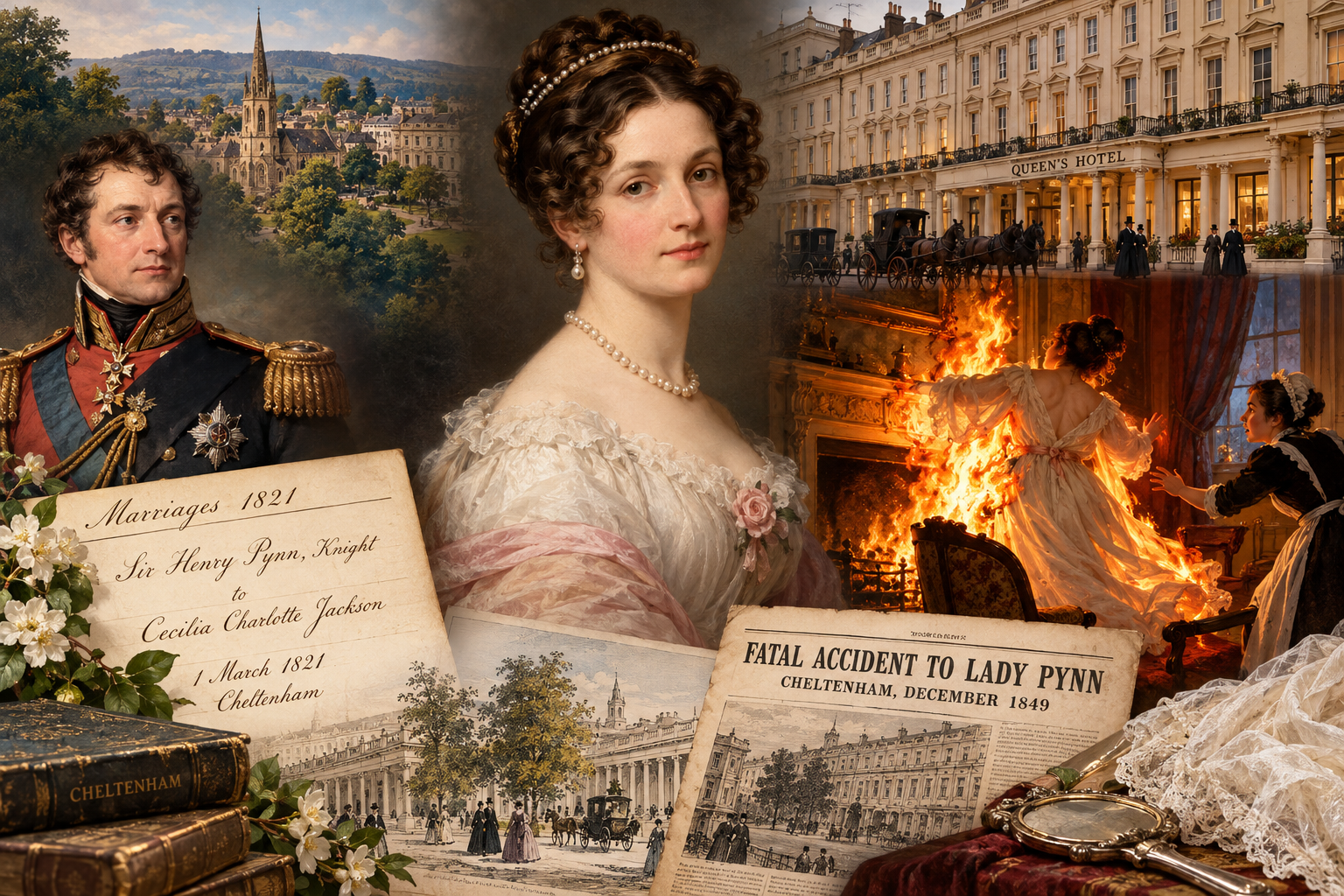
Note: All images generated by ChatGPT