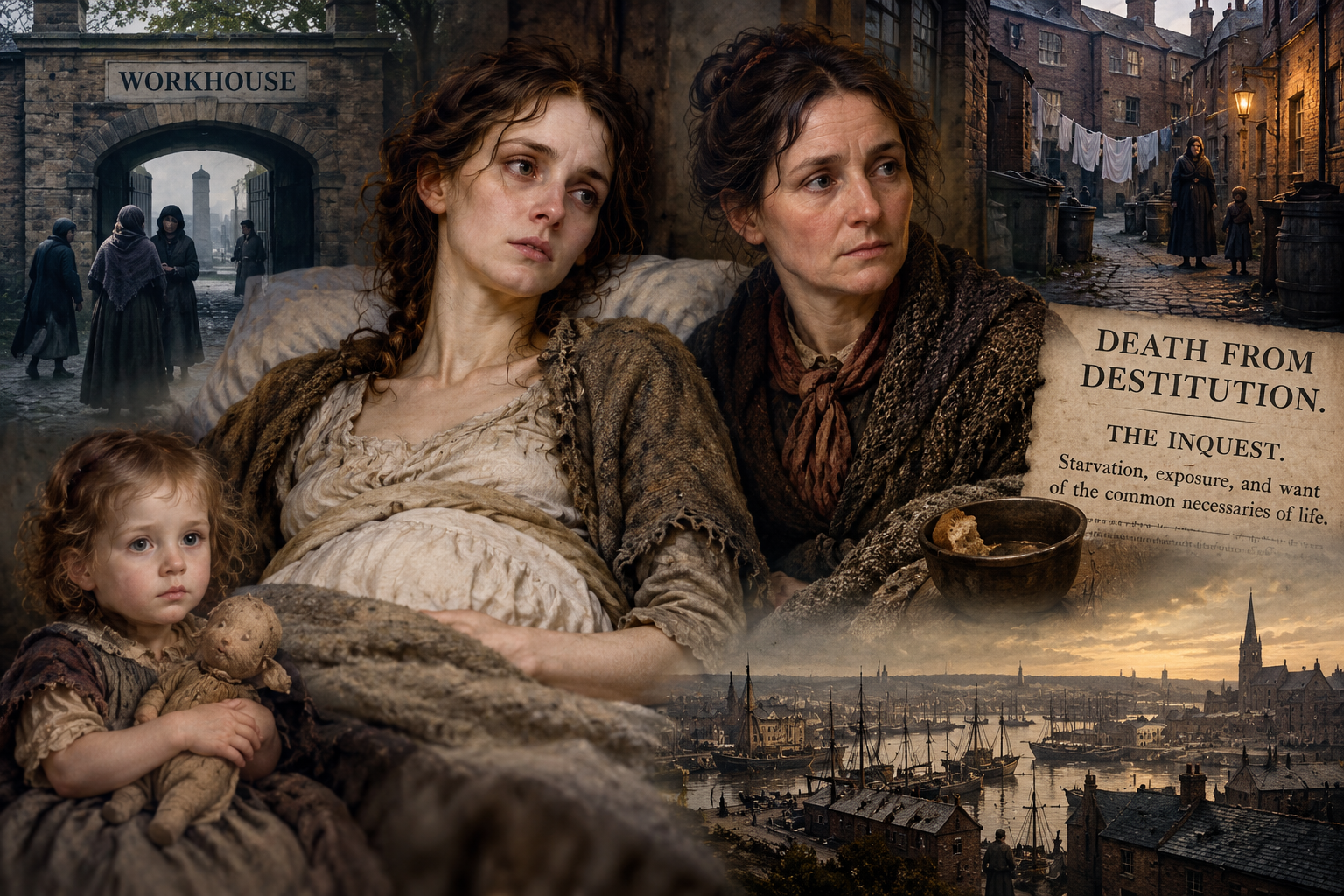
This mystery began with a tragic newspaper account of a pregnant woman who died from starvation and exposure, but became an investigation into Victorian poverty, the failures of the Poor Law, two sisters bound by hardship, the uncertain fate of a young child, and a family history that remained elusive despite extensive research.
THE NEWSPAPER ARTICLE
Morning Post, 1 January 1850
| DEATH FROM DESTITUTION. – Considerable sensation has been caused in Southampton, in consequence of a poor unmarried woman named Elizabeth Biggs, in the last stage of pregnancy, having been literally starved to death, in consequence, it is alleged, of the inhumanity of the parish officers. The officers have all been dismissed, and the matter has been submitted to the Government by the coroner. An inquest has been held on the body, and the following verdict returned:- “We find that the deceased died from starvation and exposure to the cold, and the want of human necessities of life; and that there has been great and culpable neglect on the part of some of the officers connected with the administration of the Poor Laws at Southampton, in not receiving the deceased into the workhouse, and providing proper lodging and nourishment on the nights of Friday and Saturday of last week; but no sufficient evidence doth appear to the said jury as to who are the parties actually blameable.” |
THE FACTS
A more detailed account in The Times on the same date allowed us to reconstruct more of the circumstances surrounding the death of Elizabeth Biggs on 27 December 1849 aged 23.
 She was unmarried, had a young child, and was about eight months pregnant. She was desperately poor and needed somewhere warm to stay and sufficient food to sustain herself. The evidence reported at the inquest described attempts to obtain assistance through Southampton’s Poor Law authorities.
Elizabeth had received parish relief, and surgeon Mr Cooper had directed her towards the workhouse for food and shelter. She was admitted to the tramp-house, the accommodation intended for casual applicants, but the conditions were inadequate for someone in her condition. The reported provision included straw and a single quilt. She found the cold intolerable and left.
The subsequent efforts to find her suitable accommodation involved her sister Ann. Elizabeth was found in the street with her young child, and Ann tried to secure a bed for her. The newspaper testimony suggests that Elizabeth was already gravely ill when Ann was seeking help.
The precise sequence of every event is not entirely clear from the reports, but the broad picture is unmistakable: a heavily pregnant woman in extreme poverty was unable to secure the shelter and nourishment she needed.
The post-mortem examination was conducted by Mr Cooper. According to the newspaper account, Elizabeth’s stomach was distended with gas and contained approximately three to four ounces of bloody fluid, together with a few crumbs of bread described as undigested. The surgeon attributed her death to want of food.
The examination also revealed a male child in Elizabeth’s womb. The report described the child as healthy, but we cannot establish from the evidence we have whether the baby was born alive, stillborn, or died before delivery. We found no birth registration that could confidently be identified as his. This is one of the saddest unanswered questions in the case. We know that Elizabeth was pregnant with a boy, but the surviving evidence we found does not tell us what happened to him.
The inquest is the central document in this mystery because it records not only the cause of death but also the jury’s judgement on the conduct of the Poor Law authorities. The verdict reported by the Morning Post showed that the the jury did not simply record a natural death caused by illness. It explicitly found that Elizabeth died from starvation, exposure and want, and that there had been serious and culpable neglect by some officers responsible for administering relief. At the same time, the jury could not identify the individuals who were actually blameworthy. That distinction left the case with a damning institutional finding but no clearly identified individual held responsible by the verdict.
The Morning Post also reported that officers had been dismissed and that the coroner submitted the matter to the Government. Those details show that the case attracted attention beyond the immediate inquest. We should not claim that the verdict proved a particular officer deliberately caused Elizabeth’s death. It did, however, establish that the jury considered the failure to provide adequate relief a serious matter. The case therefore exposes a difficult distinction in Victorian administration: a system could be found culpably negligent in its treatment of a vulnerable person, while the evidence remained insufficient to assign responsibility to particular individuals.
To understand Elizabeth’s predicament, we need to consider the system through which poor people were expected to obtain help.
The Poor Law Amendment Act of 1834 had sought to reform relief for the poor. Its philosophy encouraged the use of workhouses and the principle of less eligibility: conditions for those receiving relief inside the workhouse were intended not to be more attractive than the circumstances of the lowest-paid independent labourer. In practice, relief was administered locally, and the experience of a poor person depended on the decisions of local officials, the facilities available and the rules applied to their particular circumstances.
Poor relief was not a single, straightforward service. Indoor relief meant accommodation and maintenance in the workhouse. Outdoor relief meant assistance provided to people living outside it, which might include money, food or other support. Casual accommodation was intended for people needing temporary shelter, including travellers and those moving from place to place.
The distinction matters in Elizabeth’s case. She was not simply refused all assistance from the outset: the reports indicate that she had received parish relief and had been directed towards the workhouse. The critical issue was the adequacy of the accommodation and the failure to ensure she had suitable shelter and nourishment when she needed them.
The tramp-house was not equivalent to a comfortable place of refuge. Casual accommodation was generally basic and subject to rules, and its suitability for someone who was ill, pregnant and caring for a young child was questionable. We should not infer that every workhouse or casual ward operated in the same way. Elizabeth’s case is evidence of the particular failures reported in Southampton, rather than proof that every institution treated every applicant identically.
Elizabeth’s circumstances placed her at the intersection of several disadvantages. She was unmarried, pregnant, responsible for a young child and desperately poor. She needed food and warmth at a time when her physical demands were increasing, and she was approaching childbirth without the security of a settled home. Her case shows how difficult it could be for a woman in such circumstances to navigate a system governed by local rules and official decisions. Even when a person sought help and was directed towards an institution, that did not guarantee that the assistance provided would be adequate. The jury’s verdict makes the issue unusually clear: it specifically criticised the failure to provide proper lodging and nourishment.
Our investigation into the Biggs family led us to Simnel Street, Castle Lane and Castle Court. These place names help situate the family within the older, poorer parts of Southampton.
 Elizabeth’s sister Ann died aged 30 on 12 August 1851 and her death certificate records she was living at 5 Castle Court, Southampton. It also gives the cause ofher death as inflammation of the windpipe – that historical wording may indicate inflammation of the trachea, but the certificate does not allow us to make a more precise modern diagnosis.
Ann’s burial record gives her residence as Simnel Street. The 1851 census records households under Castle Court, Simnel Street, without house numbers that allow us to identify No. 5 confidently. Charlotte Moore (who was the informant of Ann’s death appears in one of those households, but we cannot use the census sequence to place Ann in that household. Although Charlotte’s presence at Ann’s death is a firm fact, whether she was a friend, neighbour or someone who had taken an active role in helping Ann remains unknown.
Nevetheless, the address Castle Court, Simnel Street is important because it explains the kinds of hardship poor Southampton residents could face. Simnel Street was an area containing common lodging houses whose occupants included some of the poorest and most notorious men and women in the town. The wider historical evidence supports the conclusion that Southampton had serious housing and sanitation problems in this period. William Ranger’s 1850 sanitary investigation described overcrowding, inadequate drainage, poor water supplies and badly ventilated courts and alleys. Common lodging houses could accommodate people in very cramped conditions, sometimes with several people sharing a bed. These circumstances help us understand the environment in which poor people sought accommodation.
Ann Biggs is an important figure in this story because her testimony connects the family history directly to Elizabeth’s final days. At the inquest, Ann identified Elizabeth as her sister. She described efforts to find Elizabeth a bed and obtain help for her. Her evidence places her alongside Elizabeth at a moment of extreme distress. There is something poignant in the record, that Ann, who had tried to help Elizabeth, died less than two years later, and another woman was present at her own death.
One of the most significant discoveries outside the newspaper reports was the baptism of Eliza Biggs, in Shirley, Southampton, on 25 April 1848, recorded as the illegitimate daughter of Elizabeth Biggs. The date fits the inquest account of Elizabeth having a young child. By the time Elizabeth died in December 1849, Eliza would have been around a year and eight months old.
We then found a burial record for Eliza Biggs, at St Michael’s, Southampton, on 10 December 1850, aged three, with Castle Lane recorded as her residence. The baptism and burial provide a plausible outline of Eliza’s short life.
So, did Ann care for Eliza after Elizabeth died? This is a reasonable hypothesis, but it remains unproven. Ann was Elizabeth’s sister, she was involved in trying to help Elizabeth, and Eliza’s burial record gives an address in the same general part of Southampton associated with Ann. It is possible that Ann took the child in after her mother’s death.
We spent considerable time trying to identify the parents of Elizabeth and Ann and to locate a possible brother named George but it did not produce a family group that could be established confidently.
We did, however, find an Ann Biggs, aged 20, and described as a dressmaker, in the 1841 census for a Hampshire House of Correction. Her age and name make her a possible candidate for the Ann who later died in Southampton. But we have not found an admission register or other record that securely connects the two women.
Pregnancy, childbirth and the dangers Elizabeth faced
Elizabeth’s pregnancy is central to the case. She was reported to be about eight months pregnant when she died, and she was already in a profoundly precarious situation. Pregnancy places additional nutritional and physical demands on the body. A person experiencing severe food deprivation, cold exposure and serious illness would be particularly vulnerable. Elizabeth’s circumstances would have made the approach of childbirth still more dangerous.
Victorian medicine was also limited in its ability to treat many serious complications. There were no antibiotics, and the understanding and management of infection were far less developed than today. Maternal and infant mortality remained significant concerns.
We should not, however, claim that Elizabeth died from a particular pregnancy complication. The reported post-mortem and the surgeon’s opinion attributed her death to want of food. The jury’s verdict emphasised starvation, exposure and the lack of life’s necessities. Nor can we confidently reconstruct what would have happened to the baby had Elizabeth survived. The medical evidence identifies a male child in the womb, but we have not established the circumstances of his death or birth. What we can say is that Elizabeth faced childbirth while suffering extreme deprivation, without the reliable shelter, nourishment and support that she needed. Her case illustrates the danger of leaving a pregnant woman in such circumstances without adequate assistance.
CONCLUSION
The Biggs mystery began as a family history question, but the surviving evidence has made it much more than that. It reveals a moment when local government, public health, poverty and women’s vulnerability intersected. Elizabeth was not simply an anonymous person found dead in the street: the inquest brought her circumstances into public view and recorded a jury’s conclusion that serious neglect had occurred.
The case also shows how limited the surviving record can be for poor women. We have a newspaper report, an inquest account, a handful of parish records and death certificates. These sources preserve some essential facts but leave enormous gaps about family relationships, accommodation and everyday life.
For women like Elizabeth and Ann, those gaps are particularly difficult. They may have moved between parishes, lived in informal accommodation, worked irregularly or relied on family and neighbours whose relationships were never formally recorded. Their lives can be difficult to reconstruct precisely because the records are fragmentary.
The fact that we could not identify their parents does not make the investigation pointless. We have established a great deal about the circumstances of Elizabeth’s death and the efforts of her sister to help her. We have also recovered the existence of Eliza, whose short life might otherwise have remained unnoticed in the parish registers.
Elizabeth, Ann and Eliza deserve to be remembered as people whose lives were shaped by poverty and vulnerability, not merely as names in a newspaper cutting or entries in a register. The mystery remains partly unsolved, but the investigation has recovered a meaningful account of their lives and the circumstances surrounding them.
THE SUMMARY IMAGE