This is the cutting from the Birmingham Daily Post on 1 January 1878 that started this case.
|
THE REMARKABLE CASE OF ATTEMPTNG TO POISON At the Birmingham Police-court, yesterday, before Messrs. Kynnersley (Stipendary) and Ellis, Reuben Liveley (42), labourer, Arthur Street, was charged, on remand, with attempting to poison two men but putting a quantity of “vermin killer” into a pot of beer. – George Henry Currall, brother-in-law of the prisoner, said he and his wife, went to live near the prisoner’s house a fortnight ago. There was some quarrelling in the house between prisoner and George Hodges, who wanted to marry the prisoner’s sister, to which the prisoner objected. The woman had had two children by her brother. On Saturday night, the 22nd inst., witness and the prisoner and the man Hodges went into the Price Arthur beerhouse in Arthur Street. They had one quart of beer, and a second was called for, and witness had a glass out of it. The prisoner then put his hand over the jug, and witness saw in his hand a paper parcel labelled “Poison”. The prisoner’s sister, snatched the parcel out of his hand and said, “Reuben, do you mean to poison us all?” She said she would give him into custody, and he said ,”You can give me seven years, and be -.” Witness then went for a policeman, and the prisoner was given into custody. George Hodges, a labourer, residing at Bordersley Green, said on Saturday, the 22nd, he met the prisoner by appointment, and went into the Price Arthur to discuss witness’s proposal to marry witness’s sister. The prisoner wanted witness, if he married his sister, to allow him (prisoner) to live in the same house. Witness refused to accept this condition, and the prisoner then said, “No man shall have her except myself; I’ll settle her first”. After that the prisoner became more “sociable”, and asked witness to go into his house and have a “drop of beer” quietly, but witness refused to go. While his back was turned witness heard the prisoner’s sister say “Good God Reuben! Do you mean to murder us all?” – Mary Ann Lively, the prisoner’s sister, deposed that Hodges had wanted to marry her, and prisoner had refused to give his consent. Prisoner had threatened to bury the hatchet in Hodges’s head if ever he caught him in the house. On Saturday night, witness, her sister, the prisoner, Currall and Hodges went to the Prince Arthur, and while there prisoner threatened to murder witness and Hodges if he caught them together. While witness was talking to her married sister, the prisoner said to hers, “Look here, Polly, what I’ve brought to do away with myself”. She then took a packet from him, and seeing that it was labelled “poison”she said, “Good God, Reuben! Do you mean to poison us!” She could not say whether the packet was opened while it was in the prisoner’s hand, but after she read the label, she herself ripped the packet open a little way. She gave the packet to a police-officer, she and her sister drank the beer that was left in the jug after the prisoner was locked up. – Police-constable Bird proved taking the prisoner into custody. On the way to the police station prisoner said he brought the poison to destroy himself. Hodges was walking behind, and prisoner said he “would be the death of him before he had done with him”. – Dr. Bostock Hill, who had analysed the contents of the packet, said they contained 18 or 20 per cent, of strychnine, and the rest of starch and some colouring matter. The quantity of the powder was about nine drachms, and the proportion of strychnine was rather more than a drachm and a half. A quarter of a grain had been known to poison a man. The prisoner was committed for trial at the Assizes. |
Note: 1½ drachms of powder is equal to 5.83 grams (or 90 grains)
A later report, published in the Birmingham Post on 30 January 1878, gave a fuller account of the trial. Reuben was charged in connection with George Henry Currall, George Hodges and Mary Ann Lively. His defence argued that the evidence did not establish an intention to poison anyone and suggested that his conduct might have been bravado or connected with his stated intention to harm himself. The jury nevertheless found him guilty, and he was sentenced to five years’ penal servitude.
One important qualification remains: the newspaper evidence does not establish that poison was actually put into the beer. Mary Ann reportedly did not see Reuben do anything with the packet. The conviction establishes the legal outcome, but we should not turn every allegation in the newspaper narrative into an independently proven fact.
Our investigation of Reuben Lively has taken us a considerable distance beyond the original newspaper cutting. What began as a sensational report of an alleged attempt to poison two men has become a much fuller account of a family dispute, a criminal trial, and the Victorian penal system that received Reuben after his conviction.
The Lively family and the dispute
 Reuben Lively was baptised on 25 October 1835 in Ashton under Lyne, Lancashire, the son of William Lively and Ann Goodman. He was the 4th child of a large family, possibly numbering twelve or thirteen children.
Harriet Lively, Reuben’s younger sister, was born in 1840. She married George Currall in 1863.
Mary Ann Lively, Reuben’s unmarried sister, was born in 1846, she was at the centre of the dispute with George Hodges.
Reuben had married Elizabeth King in 1853. She died in 1858, and we have not found evidence of any children from that marriage.
Newspaper reports alleged that Mary Ann had one or two children for whom Reuben was the reputed father. This is a claim made in the reporting, not something we have independently verified.
This case was therefore not simply a stranger-on-stranger crime. It emerged from a family and courtship dispute, with accusations and relationships that may have been complicated by domestic tensions.
Reuben before the trial
Reuben appears in a military record associated with the Crimean War and the 63rd Regiment of Foot, with service dates listed as 1854–1855. This is an important clue to his earlier life, although the precise details of his service still need confirmation from a full military record.
We have been unable to locate Reuben or Mary Ann in the 1871 census, but an 1876 trades directory lists Reuben Lively, lodging-house keeper, at 1 Northgate Street, Warwick. This is a valuable clue because it gives him an occupation and an address shortly before the poisoning case. The 1871 census shows Reuben’s mother, Ann, living at that address in Northgate Street area. .
The newspaper reports, meanwhile, place Reuben in Devonshire Street, Birmingham, at the time of the case. These records may indicate a move between 1876 and 1877, or they may reflect different arrangements for residence and work.
Reuben after the trial
Warwick Assizes register places Reuben in the Winter Assizes in January 1878 and confirms the conviction and sentence reported in the newspaper. Reuben was tried in connection with the poisoning allegation. He was found guilty. He received a sentence of five years’ penal servitude.
We found Reuben in prison records identifying him as born in Ashton-under-Lyne in 1835. The physical description is unusually detailed: he was about 5 feet 5½ inches tall and of slender build, with moles and scars recorded at several locations. The register also notes crossed swords tattooed on his right forearm.
A further register shows that Reuben was transferred to Pentonville and then onto Wormwood Scrubs in March 1878, and the 1881 census independently confirms his presence at Wormwood Scrubs.
We wondered whether transfers through prisons such as Pentonville and Wormwood Scrubs indicated that Reuben was considered especially dangerous. We have found no evidence to support that conclusion. Transfers could form part of the ordinary administration of a convict’s sentence, including the movement of prisoners between establishments serving different purposes. A transfer by itself does not establish a special security classification, a disciplinary problem or an unusually dangerous reputation.
This distinction matters: prison registers can tell us where a man was held, but we should not infer a particular assessment of his character unless the records actually say so.
What did five years’ penal servitude mean?
This is an important part of Reuben’s story. In the 1870s, penal servitude was a distinct and serious punishment, generally used for longer sentences. It had replaced transportation as the principal punishment for many serious offences, although transportation to certain destinations continued until 1868.
Reuben was not simply sent to a local gaol for five years. Convicts sentenced to penal servitude could pass through a sequence of establishments and different forms of confinement and labour.
This what a Victorian convict would likely experience:
Separate confinement: Prisoners could spend an initial period isolated in individual cells, with restricted contact with others. The system was intended to encourage reflection and repentance, but also imposed considerable psychological strain.
Labour and discipline: Convicts could be required to undertake hard, repetitive work under strict rules. The penal philosophy of the period placed considerable emphasis on deterrence, obedience and discipline.
Centralised prison administration: The Prison Act of 1877 brought local prisons in England and Wales under central government administration. The Prison Commission took over in 1878, the year Reuben began serving his sentence. The system was becoming more standardised and centrally controlled.
These were features of the wider system, not a complete description of Reuben’s individual treatment. We do not have a daily prison diary or a detailed conduct report showing precisely what labour he performed, how he behaved, or how much time he spent under each regime.
Reuben’s discharge
The most revealing prison document we found records Reuben’s discharge from Wormwood Scrubs on 30 December 1881.
The register gives his destination as “R.S.A.D.P., London”—the Royal Society for the Assistance of Discharged Prisoners. This organisation offered assistance to people leaving prison, including help intended to support their return to society.
That entry is significant. It suggests that Reuben’s discharge involved a recognised channel of post-prison assistance rather than simply recording that he walked out of the prison gates. It does not tell us whether he accepted help, found employment or remained in contact with the organisation.
Was Reuben released on a ticket-of-leave? This was one of our principal questions. A ticket-of-leave, more formally a convict licence, allowed a prisoner to be released before the end of the nominal sentence, subject to conditions. Good conduct was an important part of the licensing system. Reuben’s dates make this possibility worth considering.
His discharge came roughly four years after conviction, rather than five. That is consistent with the possibility of early release, but it does not prove that he received a ticket-of-leave. Nor can we assume that he served exactly three-quarters of his sentence: the calculation and applicable rules need to be established from the relevant records.
We investigated the National Archives’ guidance on convict licences and identified the relevant record series butwWe have not located a specific licence for Reuben in the material examined. The fact that we have not found it does not establish that no licence existed. For now, the careful conclusion is that early licensed release remains a plausible explanation, not a proven fact.
What happened to Reuben after prison?
This is where our trail currently ends. We have not established a reliable post-discharge census entry, a confirmed death record, or another document that securely identifies Reuben after December 1881.
Several possibilities remain open. He might have returned to Warwick or Ashton-under-Lyne, remained in London, moved elsewhere for work, or used a different form of his name in later records. These are research possibilities, not conclusions.
His discharge to the assistance society may eventually provide a route forward, but we should not assume that its records survive or that Reuben necessarily received sustained support from it.
We have also not been about to find his sister Mary Ann in the 1881 census. These gaps limit our ability to reconstruct their movements and domestic circumstances.
The wider Victorian context
There are three wider historical points that make this case especially interesting.
First, the balance between punishment and rehabilitation was contested. Victorian prison policy was not simply a single, consistent programme of reform. During the middle decades of the nineteenth century, policy increasingly emphasised deterrence, separation, silence and hard labour. Later reforms placed greater emphasis on rehabilitation, with important changes around the end of the century.
Second, release did not necessarily mean freedom from the consequences of conviction. A person leaving prison could face the practical problems of finding work, securing accommodation and rebuilding relationships. The existence of organisations assisting discharged prisoners shows that contemporaries recognised at least some of these difficulties. In Reuben’s case, the referral to the Royal Society makes this social dimension particularly relevant, even though we do not know what happened next.
Third, the prison records preserve details that ordinary records may not. Reuben’s physical description, scars and tattoo are unusually personal evidence. They offer a glimpse of the individual behind the newspaper headline and may help distinguish him from namesakes in other records. They also show how closely the convict system documented and classified the people it held.
CONCLUSION
This case is a good example of how a short newspaper report can open up a much larger historical investigation. We began with a sensational accusation. We have since reconstructed important family relationships, identified a likely military connection, confirmed the conviction through an Assizes record, and followed Reuben into the Victorian convict system.
Perhaps the most valuable discovery is the discharge record. It takes us beyond the trial and shows that Reuben survived his years in prison and was released into a world in which his next steps are, for now, hidden from us.
We cannot say whether he was reformed, whether he remained estranged from his family, or whether he ever returned to ordinary working life. Nor can we say that he received a ticket-of-leave without locating the relevant evidence. But we can now describe the main course of his known life with considerably greater confidence than the original cutting allowed.
The case is therefore substantially reconstructed, although not completely solved. The final chapter of Reuben Lively’s life remains unknown—and it is better to leave that question open than to fill the gap with an attractive but unproven story.
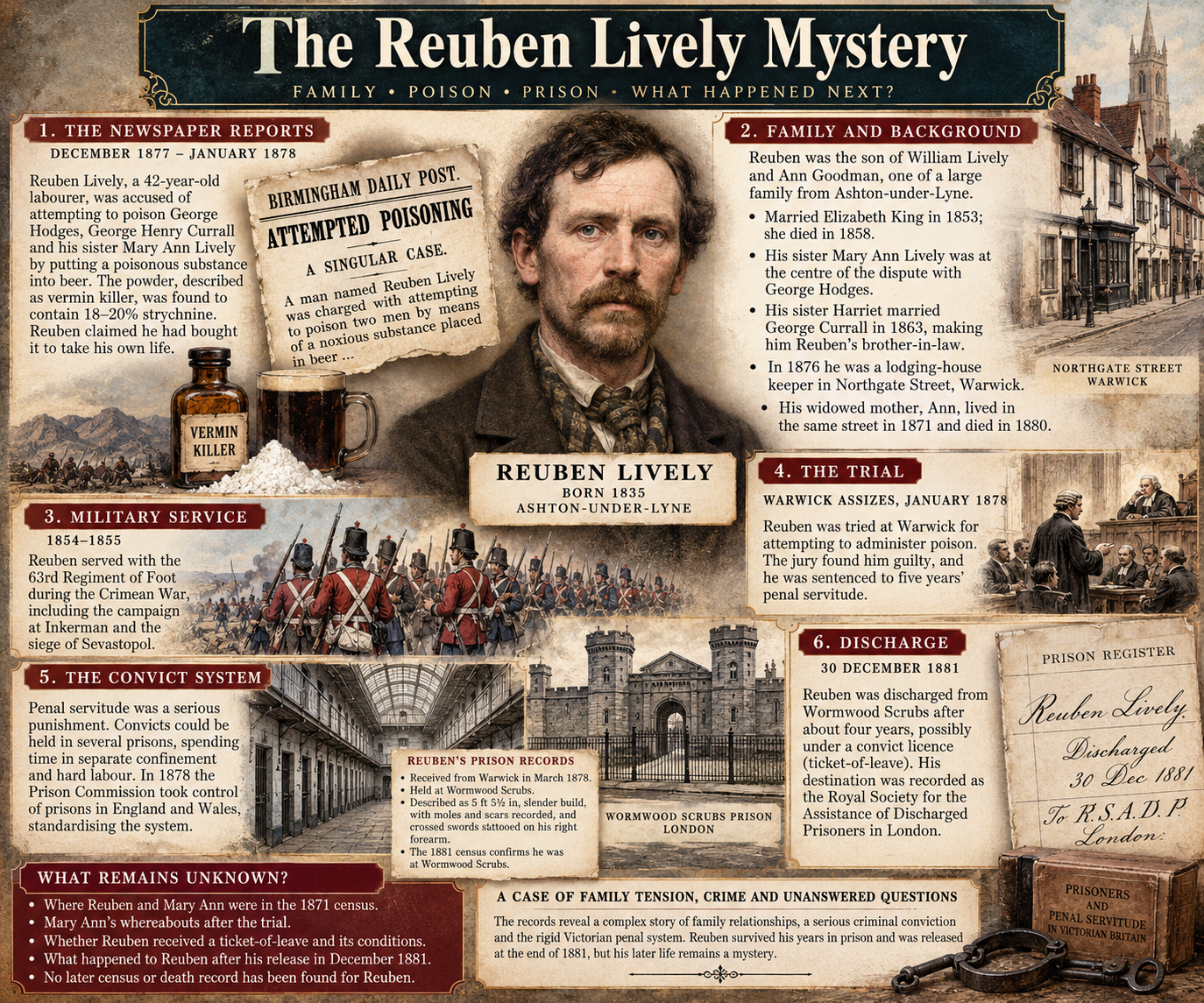
Note: All images generated by ChatGPT