THE NEWSPAPER ARTICLE
This case started with this newspaper report in the Shepton Mallet Journal on 1 September 1899.
| MARRYING A MAN WITH 14 CHILDREN
Alice Chard, aged 23, living at Silvio Street, Fulham, was charged with attempting to commit suicide by taking carbolic oil. She looked very ill, and was allowed to be seated. After she made the attempt on her life she was removed to the west London Hospital, where the house surgeon administered restoratives, with the result that she recovered consciousness. Sergeant Ready, the chief warrant officer of the court, gave an account of the woman’s antecedents. She was, he said, induced to marry an omnibus driver, whom she understood to be a bachelor, but found out to her dismay that he was a widower with 14 young children. The man, after a short illness, died, and his large family was thrown entirely on her hands. Kind friends assisted her and relieved her of a portion of her burden, but she still had a great difficulty to make ends meet. She desired to re-enter domestic service, but the landlady of the house where she lodged, detained her clothes for rent, and in this way prevented her. She was ordered to be remanded, and directions were given for her to be conveyed in a cab to Holloway Gaol. |
THE FACTS
Alice Chard, aged 23, had attempted to take her own life by swallowing carbolic oil. When she appeared before the West London Police Court, the circumstances behind her distress emerged: she had married an omnibus driver believing him to be a bachelor, only to discover that he was a widower with a large family. He had since died, leaving her in difficult circumstances.
Her husband, Henry Albert Chard was born in 1852. By 1891, he was living at 10 Bayonne Road, Fulham, and working as an omnibus coachman. The census records him with his wife, Jane Sarah Mayes, whom he had married in Kensington in 1877, and five children: William Albert, Henry Alfred, Walter John,
Flora Bertha and Laura Maud.
Further research has identified three more children from Henry and Jane’s marriage: Arthur Ernest, born in 1891; May Elizabeth, born in 1893, who died in 1894; and Horace Edwin, born in 1895. The records so far establish at least eight births to Henry and Jane, although the number of children alive at any particular date needs to be distinguished from the number born.
Henry’s wife, Jane Sarah Chard died in Fulham in Q1 1897, aged 40. Henry was left a widower with a number of dependent children. Later that year, he married Alice Beatrice Terry in Fulham.
On 2 March 1899 their son, Edward Albert Chard, was born and baptised on 9 April at St Andrew’s, Fulham.
Henry died in Q2 1899, aged 46.
The newspaper reports of the court case provide our most vivid glimpse of Alice’s circumstances. They do not, however, tell us exactly what support Alice had received from Henry, what she knew about his first family before their marriage, or whether she had relatives who could help her.
The Shepton Mallet Journal of 1 September 1899 (above) reported that Alice had been remanded, whilst a report in the Fulham and Hammersmith Chronicle, also dated 1 September, says she was subsequently discharged after promising not to repeat the act.
The reports differ over the size of Henry’s family. One says he had fourteen children; another says seven. Alice reportedly interjected, “The others are dead.” This is an important clue, but it does not settle the total number of children born to Henry, nor does it tell us exactly which children had died.
The Worcestershire Advertiser of 2 September 1899 offered a more sympathetic account. It described Alice as a young widow left with fourteen children and reported that a gentleman signing himself “R.P.” sent her £1. She was also offered a “situation” — in this context, most likely employment in domestic service.
That small detail is revealing. The proposed remedy for Alice’s hardship was not a continuing income or a modern form of social security, but a job. Domestic service offered many working-class women a way to earn a living, sometimes with accommodation included. But a young woman who had recently given birth, lost her husband and then her infant son would have faced considerable practical and emotional difficulties in securing and keeping employment.
The newspaper also reported that her landlady had retained Alice’s clothes over unpaid rent. Without her clothes, Alice could not readily return to domestic service. This illustrates how poverty could become a trap: a woman needed suitable clothing to obtain work, but needed money to recover her clothing, and needed work to obtain money.
The newspapers do not tell us everything; they give a compressed account of Alice’s life, shaped by the conventions of court reporting and the public interest in a distressing story. Nevertheless, the reports are consistent in portraying a young woman who had become desperately vulnerable.
Alice’s predicament becomes easier to understand when placed in the context of late Victorian society. The Victorian Poor Law system was designed not simply to relieve hardship but also to distinguish between people considered deserving of assistance and those thought responsible for their own poverty. Under the system established by the Poor Law Amendment Act of 1834, relief for able-bodied people was deliberately restrictive in many areas, with the workhouse intended to be less attractive than earning a living. Although attitudes gradually changed during the century, stigma attached to seeking public assistance remained powerful.
This did not mean that all Victorians were indifferent to suffering. Churches, charities, philanthropists and social reformers provided assistance, and the newspaper report about the £1 donation shows that private generosity could make a difference. But help was often discretionary and temporary, depending on the willingness of an individual benefactor or charitable organisation to intervene.
Alice’s case captures that contrast. She attracted sympathy and received an offer of employment and a small donation, yet the assistance described in the reports did not amount to a secure means of supporting herself.
A married working-class woman might contribute to the household through paid work, but marriage and motherhood could make continuous employment difficult. Domestic service was a major source of work for women, but it required employers to regard an applicant as suitable and dependable. A woman without suitable clothes, a settled address or references could struggle to obtain a position.
Widowhood could be especially precarious when the husband was the main wage earner. There was no universal state pension for widows and no modern welfare safety net. Some women could rely on parents, siblings, neighbours, churches or charitable organisations; others faced the workhouse or the difficult process of trying to support themselves.
The newspapers suggest that she had little money and was struggling to recover her clothes from her landlady. We cannot know whether she had other relatives willing or able to assist her.
An attempted suicide could bring a person before the courts, since suicide and attempted suicide were treated within the criminal law framework of the period. Alice’s appearance before the magistrates therefore placed her private distress into a public setting. The report that she was discharged after promising not to repeat the act suggests a relatively sympathetic outcome in this instance.
The newspaper’s presentation of Alice as a young widow in distress also invited readers to feel sympathy. Her circumstances were framed as a misfortune, rather than simply as evidence of wrongdoing. The donation and offer of a job suggest that at least some readers responded with practical assistance. We should not, however, assume that the public response was universally compassionate. Victorian attitudes combined charity and pity with anxieties about dependence, respectability and personal responsibility. Alice’s story fell into a category that could evoke sympathy: a young woman apparently abandoned by circumstances, rather than someone portrayed as deliberately avoiding work.
What happened after the court case?
The most significant event was the death of Alice’s son Edward, in Q4 1899. Thus, within a short period, Alice had lost both her husband and her infant son.
But, one of the most poignant parts of the case is what happened to the Chard children after the deaths of both their parents. By 1901, the children were no longer living together as one family. Census records show that several had entered institutional care or training establishments. This was not unusual for children whose families could no longer support them, although each child’s precise route into care remains to be established.
Flora — recorded as Florence — was at Kensington Training School for Girls, where she was listed as a “laundry maid”. The establishment was associated with training girls for work and domestic service. This suggests that she was being prepared for employment, although the census alone does not tell us how she came to be admitted or how she felt about her circumstances. Laura, aged about 12, was recorded at the same Kensington institution, under the designation “scholar.” Her presence there suggests that she was receiving education or training rather than living independently. The institution’s emphasis on preparation for respectable employment reflects the Victorian belief that training in domestic skills could help poor girls achieve self-support.
Arthur Ernest and Horace Edwin were at the West London Poor Law Schools at Ashford, near Staines in Middlesex. These were institutional schools for children under Poor Law care. Such establishments provided accommodation and schooling, with an emphasis on discipline and preparation for adult working life. Their presence there is strong evidence that the family could no longer maintain them in an ordinary household.
It is important not to assume that every institution was identical, or that every child experienced it in the same way. Some institutions offered schooling, food, accommodation and vocational training that children might not otherwise have received. Others imposed strict discipline and separated children from family life, sometimes for long periods.
Historians have shown that Poor Law authorities often saw institutions as a means of preventing children from growing up in poverty and becoming dependent on public relief. The system aimed to turn them into industrious, self-supporting adults, but it could also reduce parental control and make family reunification difficult.
The children were not necessarily placed in care because they were orphaned in the strict sense. It is possible that the children entered care because there was no relative able to support them, because Alice could not do so, or because other circumstances intervened. We do not yet have the admission records that would explain the decisions.
As for the older boys, William Albert, Henry Alfred and Walter John, they were lodging in different places elsewhere, probably as apprentices.
Who was Alice Chard?
No birth record could be found for an Alice Beatrice Terry, nor a subsequent marriage or death – or even a census entry – for an Alice Beatrice Chard. However, our research has uncovered a possible lead, but not a confirmed answer.
An Alice Beatrice Thair was born in July 1876 in Hackney. In the 1891 census (aged 15) she is living with her parents, George and Mary Ann Thair in Hackney, and she is also with them in the 1901 census (aged 25). Alice Thair died in January 1902 aged 25. Her age is therefore compatible with the age reported for Alice Chard in 1899. So if this is her, then she returned to her own family and died shortly thereafter.
The difficulty, clearly, is the surname, but it is possible that Alice’s maiden surname, recorded in documents as Terry, was a mis-hearing of Thair. Henry and Alice’s 1897 marriage certificate is therefore the most important outstanding document. It should provide Alice’s age, residence, marital status, father’s name and occupation. Those details may enable us to confirm or reject the Thair theory and identify Alice’s family before her marriage.
There is another unanswered question, however: the newspaper says Alice was induced to marry Henry believing him to be a bachelor. Did Henry deliberately mislead her, or did she misunderstand his circumstances? The phrase suggests that she was persuaded into the marriage, but it does not establish precisely what was said between them. Until we have more evidence, we must leave that question open.
CONCLUSION
The Chard family’s history illustrates how quickly a working-class household could become vulnerable to death, poverty and institutional intervention. Henry’s first marriage produced a large family, and after his first wife died in 1897, he married Alice later the same year. Henry and his infant son Edward both died in 1899. Within only a few years, the family had lost several members and the surviving children were scattered between different households and institutions.
For Alice, the combination of widowhood, bereavement, unpaid rent and difficulty finding work seems to have created a crisis from which she struggled to recover. The newspapers offer glimpses of both the harshness of her situation and the kindness of strangers. Yet the help reported was limited: a small donation, an offer of employment and a promise to the magistrates.
For the children, institutional care may have offered security, education and a route into employment, but it also meant separation from siblings and the loss of an ordinary family home. Their experiences remind us that Victorian welfare was not simply a story of neglect or cruelty, nor simply one of benevolence. It combined genuine charitable concern with strong expectations of discipline, self-reliance and respectable behaviour.
THE SUMMARY IMAGE
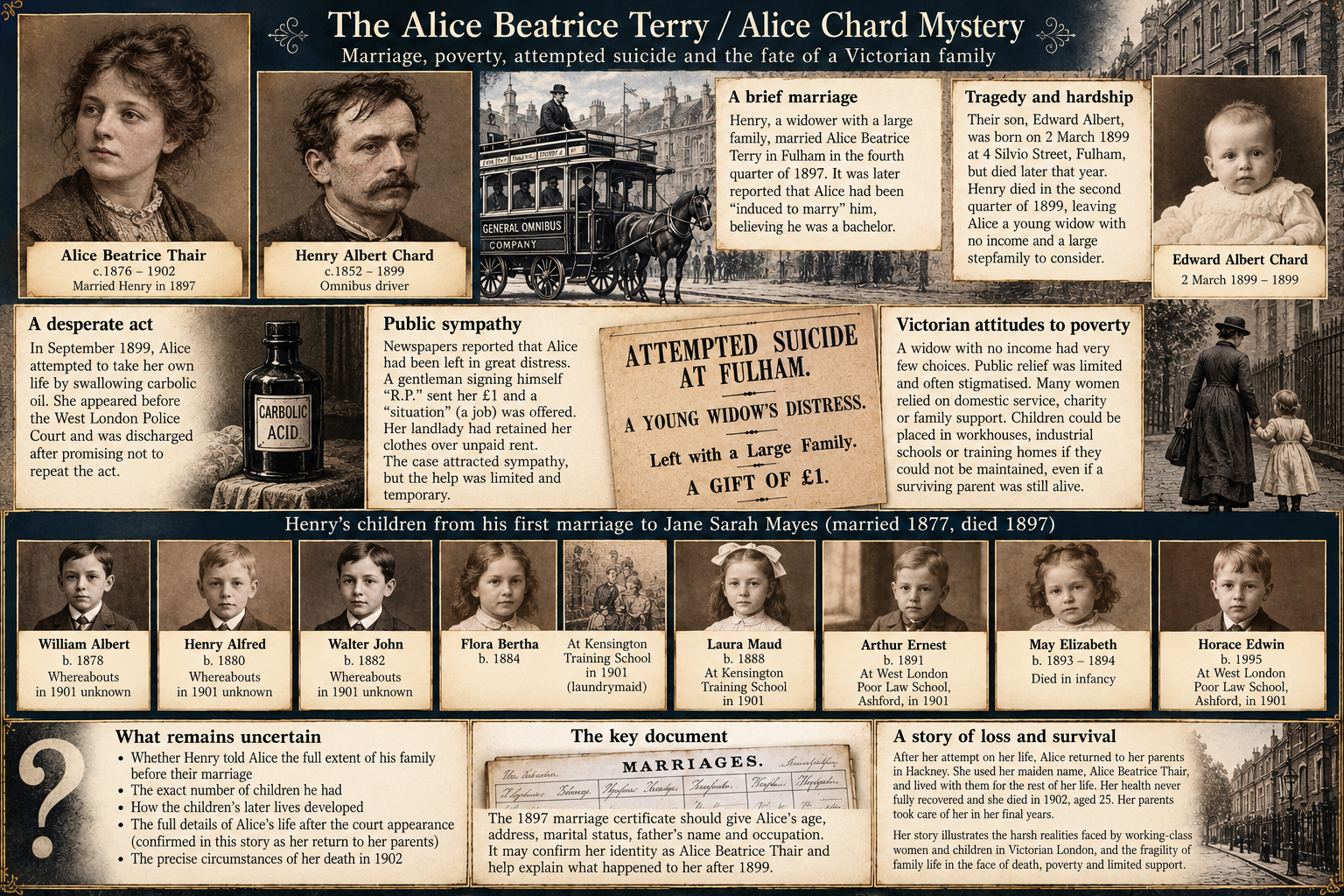
THE IMAGINED STORY
The Widow of Silvio Street
A fictional story, created by ChatGPT, inspired by the Alice Chard mystery.
Chapter One: The Man Who Said He Was a Bachelor
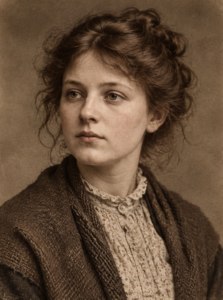 In the spring of 1897, Alice Beatrice Thair was twenty years old and tired of living a life measured in pennies.
Her parents, George and Mary Ann Thair, kept a modest home in Hackney. Her father worked when he could find employment, and her mother managed their small household with the determination of a woman accustomed to making too little go too far. Alice loved them, but she longed for a home of her own, somewhere she might be more than a daughter waiting for the next week’s wages.
Then she met Henry Albert Chard.
Henry was an omnibus driver, a broad-shouldered man with a neat moustache and a confident manner. He knew London well and spoke about its streets and crowds as though he belonged to something important. To Alice, who had seen little beyond the neighbourhoods in which she had grown up, he seemed worldly and capable.
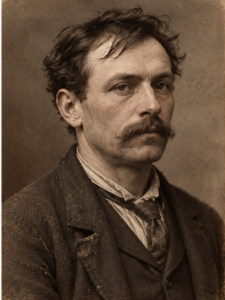 He was attentive, too. He walked with her on Sundays, brought her small gifts when he could afford them, and spoke of marriage as a partnership in which two people might make a better life together.
When Alice asked about his past, Henry was careful with his answers. He had known disappointment, he said, and wanted to put it behind him. He did not tell her that he had been married to Jane Sarah Mayes, nor that Jane had died earlier that year. He certainly did not tell her that he had a large family of children.
Alice believed him to be a bachelor.
Perhaps Henry feared that no young woman would willingly marry a man already burdened with so many dependants. Perhaps he was ashamed of his circumstances, or simply unwilling to risk losing Alice by telling her the truth. Whatever his reasons, he allowed her to believe that she was entering a first marriage with a man free to build a future with her.
They married in Fulham in the final quarter of 1897.
Alice left her parents’ home with a small trunk, a few dresses and the hope that she had finally found security. She did not know that the man she had married had already lived an entire family life before her.
Chapter Two: The Family She Had Never Agreed to Join
Alice discovered the truth after the wedding.
Henry’s home was not the modest household she had imagined. It was a family already shaped by years of marriage, hardship and bereavement. Children needed feeding, clothes needed mending, and every penny seemed to have been promised before it arrived.
Henry explained that his first wife, Jane Sarah, had died and that he had been left to manage the children alone. He spoke of his difficulties as though Alice should understand and accept them. Perhaps he believed that marriage would make the burden lighter.
For Alice, the revelation was devastating.
It was not simply that Henry had children. It was that he had denied her the choice of deciding whether she wished to marry a widower with a large family. She had consented to one life and found herself living another.
At first she considered leaving him. But where could she go? She had married him in good faith, and returning to her parents so soon after the wedding would mean admitting that the future she had promised them had collapsed.
She tried to make the best of things.
Some of the children were suspicious of her; others were too young to understand why their father’s new wife had appeared in their home. Alice did not blame them. Their mother had died, and she was a stranger occupying a place that belonged, in their memories, to someone else.
Henry’s wages as an omnibus driver were not enough to make the household comfortable. He was often tired when he returned home, and Alice began to suspect that he had married her not only because he wanted companionship, but because he needed help.
“I thought things would be easier,” he said one evening.
“So did I,” Alice replied.
Neither of them said what they both understood: that their marriage had begun with a lie, and no amount of hard work could make that lie disappear.
Chapter Three: Edward Albert
In March 1899, Alice gave birth to a son. They named him Edward Albert.
For a time, the baby gave Alice something to look forward to. She loved him with a fierce tenderness, and when she held him she could imagine a future that belonged to the two of them, even if the rest of her marriage had become a disappointment.
Henry was proud of his son. He held Edward carefully and watched him sleep. Alice sometimes wondered whether he felt guilty for having brought her into a household she had never knowingly agreed to join. If he did, he did not know how to say so.
But the happiness surrounding Edward could not erase the strain within the household. Henry’s health was failing, and by July 1899 he was dead, aged forty-six.
Alice was suddenly a widow with an infant son and a large stepfamily whose future was uncertain. She had little money of her own and no secure means of maintaining the household. The children needed care, but she could not simply replace their father or take responsibility for them all.
She was also trying to understand what Henry’s death meant for her. The man who had deceived her was gone, leaving behind the consequences of his deception. She had lost not only a husband, but the possibility of ever obtaining an explanation from him.
Yet Edward remained. When the days seemed unbearable, she held him close and reminded herself that she still had someone to live for.
She could not know how soon that fragile comfort would be threatened.
Chapter Four: Carbolic Oil
The rent fell into arrears.
Alice’s landlady grew impatient and eventually retained her clothes against the unpaid money. It was a small matter to the landlady, perhaps, but for Alice it became a trap. She needed a situation in domestic service, where she might earn wages and perhaps receive accommodation. But she needed suitable clothes to present herself to an employer. To recover the clothes, she needed money; to earn money, she needed work.
Each solution depended on another she could not reach.
She thought of her parents in Hackney. Her mother would have made room for her, she was sure, but Alice was ashamed to return. She had left home as a bride, believing Henry to be a bachelor and imagining a secure future. Now she was a widow struggling to provide for a baby, unable even to recover her own possessions.
Grief, debt and humiliation pressed upon her until she could see no way forward.
In September 1899, Alice swallowed carbolic oil in an attempt to take her own life.
She survived and was brought before the West London Police Court. The newspaper reports described her as a young widow who had been induced to marry an omnibus driver whom she understood to be a bachelor, only to discover that he had a large family. They reported her poverty and the landlady who had retained her clothes.
Alice was discharged from the court – alive, but not restored. A £1 donation of from a well-wisher might help her for a little while, and the offer of work gave her a possible route out of poverty, but neither could give her back the life she had imagined.
For the moment, she returned to her rooms in Fulham. Edward was still alive, and she tried to believe that, with him beside her, she might yet find the strength to begin again.
Chapter Five: The Last Straw
The weeks after the court appearance were difficult. Alice tried to make arrangements for work and to settle her debts, but the future remained uncertain. She had to think about food, rent and the practical needs of a baby, while also recovering from the crisis that had brought her before the magistrates.
Edward was her comfort. She watched him sleep and imagined him growing into a little boy who would never have to know how his father had deceived his mother. She would work for him, she told herself. She would find a way.
Then, in the November 1899, Edward became ill and, despite Alice’s anxious care, he could not be saved.
She had already lost her husband. Now she had lost the child who had given her a reason to endure the hardship.
For days she could barely speak. The rooms that had once seemed crowded with children and the noise of family life now felt unbearably empty. She looked at the little things she had kept for Edward and could not bear to touch them.
The court had told her to promise that she would not try to end her life again. She had made that promise, and she did not break it. But she could no longer imagine rebuilding her life in Fulham. Every street reminded her of Henry, every room of the future she had hoped for, and every small object of the child she had buried.
At last, she admitted what she had been too proud to say before: she could not manage alone.
She would go home.
Chapter Six: The Journey to Hackney
George Thair opened the door when Alice arrived. For a moment he stared at her, taking in her tired face and the small bundle she carried.
Then he stepped aside.
Mary Ann drew her daughter into the house and held her without asking a single question. That evening she made tea and put bread on the table. Alice tried to speak, but the words came out as sobs.
At last she told them everything: Henry’s claim to be a bachelor, the children he had concealed, his death, the court appearance and Edward’s death afterwards.
Her father listened in silence.
When she had finished, he said, “You should never have been put in that position.”
It was the first time anyone had said the words plainly.
Alice had expected reproach, perhaps even anger that she had married without seeing through Henry. Instead, her parents made a place for her. Her mother helped her find suitable clothes, and her father accompanied her to Fulham to recover the few possessions she had left.
There were still Henry’s children to consider. They could not all be accommodated in the Thairs’ modest home. Some were old enough to work or find other arrangements, while the younger ones came under the care of Poor Law authorities.
Alice worried about them. They had lost their mother, then their father, and now the family had been scattered. Although she had never knowingly agreed to become their stepmother, she could not forget them.
She wondered whether they blamed her. She hoped that the institutions would give them food, schooling and the chance to learn a trade, even if they could not replace a family home.
But Alice had no means of keeping them together. She had barely been able to keep herself and Edward.
In Hackney, her parents did what they could. Her mother sat beside her when grief overwhelmed her, and her father found small tasks she could manage. They did not ask her to justify her marriage or her despair. They were simply grateful that she had come home alive.
Chapter Seven: Alice Beatrice Thair
In the years that followed, Alice slowly rebuilt a quiet existence with her parents.
She did not speak often about Henry. When she did, she no longer defended him or made excuses for him. She had loved the man he had presented himself to be, but she had never been given the chance to decide whether she wished to marry the man he really was.
That distinction mattered.
She helped her mother with the house and took small jobs when she was able. Her father grew older, and the household remained poor, but it was no longer a place where she had to hide her sorrow. Sometimes she sat by the window and watched children playing in the street, wondering what Edward might have become.
By 1902, Alice’s own health had begun to fail. She grew thin and tired, and her mother increasingly stayed beside her.
One evening, Alice asked her mother to bring out the small bundle of papers she had kept since her marriage. Among them was the certificate recording her union with Henry Chard.
“Do you think I was foolish?” she asked.
Her mother held her hand.
“No, Alice. You believed a man who asked you to trust him. That was his responsibility, not your shame.”
Alice turned her face towards the pillow. It was a kindness she had waited years to hear.
She died in 1902, aged twenty-five, in the home of her parents.
George and Mary Ann buried their daughter and kept her papers. They remembered her not as the woman who had stood before the magistrates, but as the girl who had wanted a home of her own, and the daughter who had returned when the world had become too much for her to bear alone.
Epilogue: The Widow of Silvio Street
The children of Henry Chard grew up in different places, their childhoods divided by the deaths of their parents and the poverty that followed. Some received institutional education and training; the later histories of the older boys remain to be discovered.
The newspapers remembered Alice as the young widow who had attempted suicide. They did not record the death of her infant son later that year as the final blow that drove her from Fulham, nor the quiet years she spent with her parents in Hackney.
Alice Beatrice Thair’s story ends not with the court or the newspaper headlines, but with her return to the people who had known her before she became Mrs Chard.
Henry’s deception had taken away her chance to choose her future freely. His death left her with responsibilities she had never knowingly accepted. Edward’s death removed the last fragile tie that had kept her in Fulham.
Only then did Alice allow herself to go home.
Her life was brief, and much of it was marked by loss. But in the end, she was no longer alone. She was Alice again: a daughter, loved and sheltered by the people who had never asked her to pretend that she was stronger than she was.