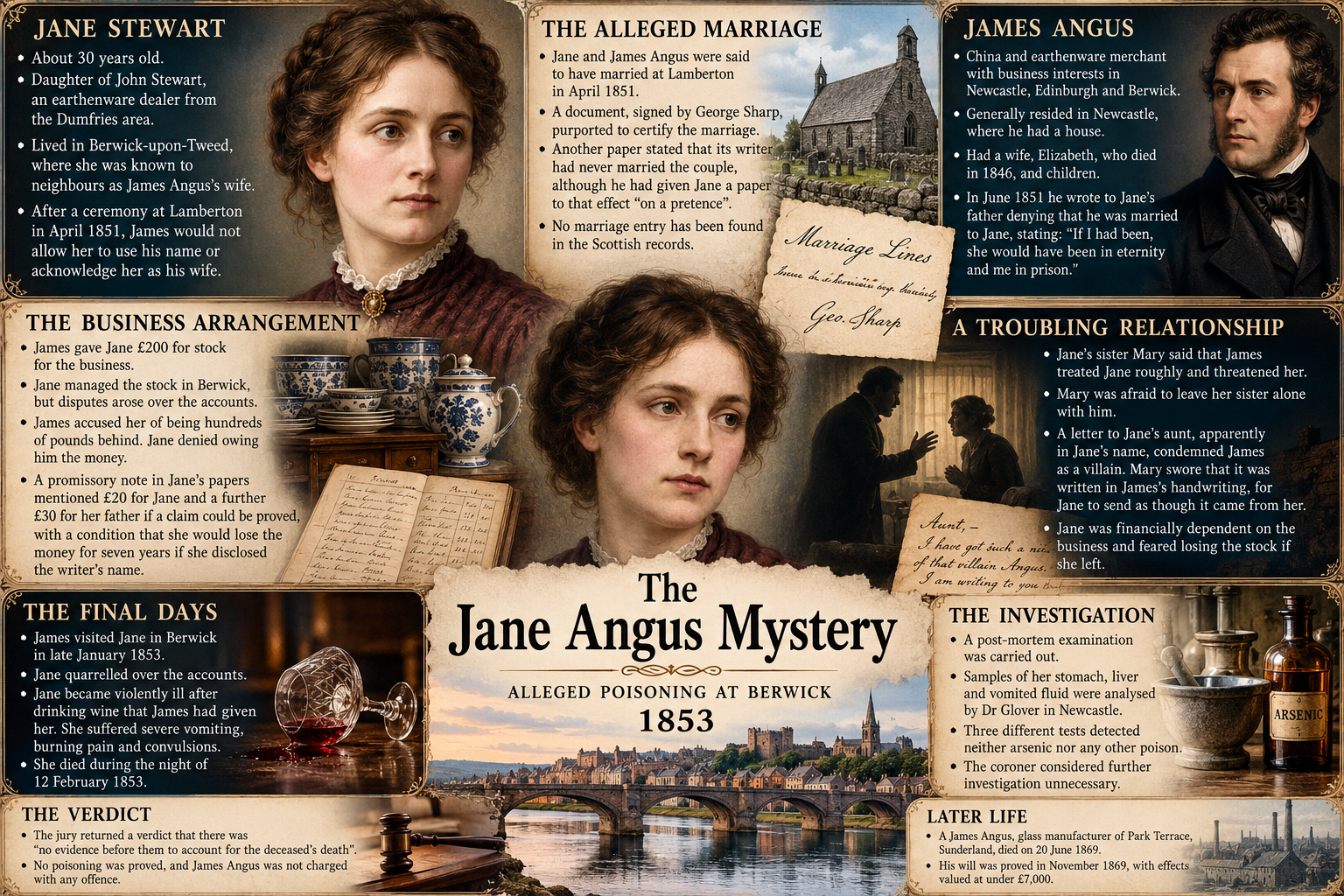
This mystery began with a newspaper account of a suspicious death but became a troubling investigation into a disputed marriage, financial entanglements, alleged abuse, a woman’s fear of losing her livelihood, and an unexplained death that remained unresolved despite a medical investigation.
THE NEWSPAPER ARTICLE
Hampshire Advertiser, 19February 1853
| ALLEGED POISONING AT BERWICK.
On Thursday se’nnight an inquest was opened at Berwick, on the body of Jane Angus, wife of James Angus, china merchant (supposed to be the same person who kept a china shop at the corner of Taylor’s-passage, High-street, Southampton, about two years ago, and left the town disreputably), who had died on the preceding day under suspicious circumstances. Mary Stewart, sister of the deceased, was examined at some length, and from her evidence it appeared that the deceased and her husband had not been upon good terms, and that Angus had ill-used her and threatened to do her injury. Mr. Angus had shops in Newcastle, Berwick, and Glasgow, residing in the first-named town, and on the 27th ult. he had gone to Berwick for the purpose of examining the books of the deceased, and had charged her with being behind in the money. A quarrel took place on Sunday, when he handled her roughly, and she became unwell, and died on the Wednesday following. Witness had sent for wine on Tuesday evening, and was going upstairs to give it to the deceased, when she met Angus, who said, “he had given her wine, and it was all right.” Deceased vomited very much afterwards, and expired in the course of the night. The inquest was then adjourned to Tuesday, when Mary Stewart, sister of the deceased, was again sworn. She identified some papers produced as having been in the possession of her sister. One of these was a certificate of marriage with Angus, at Lamberton Toll, on the 6th of April 1851, signed by George Sharp. Another paper, not signed, set forth that the writer had never married the parties, although he had given her a paper to that effect on a pretence. Another was a promissory note to pay deceased £20 and a further £30 to her father on his proving a claim to it; but that, if she took the writer’s name, she should lose all claim to it for seven years. Dr. Kirkwood was next called, and detailed the symptoms shown by the deceased on her taking ill. Deceased complained of violent vomitings, with a burning pain at the pit of her stomach. Her voice was very hoarse, and she was frequently in convulsive fits. The fits were not of an ordinary character, and he asked deceased if she had taken anything deleterious. She replied that she had been unable to take anything for some days. Witness had never seen a case of poisoning by arsenic. He had made a post-mortem examination of the body, but found nothing which would account for the death, either by natural causes or otherwise. He had not examined the vomiting. From appearances previous to death, he imagined arsenic had been taken, and that suspicion was neither confirmed nor removed by the examination. The coroner said he proposed sending the contents of the deceased’s stomach to Dr. Glover ,of Newcastle, for a more minute analysis; and the inquest was accordingly adjourned to Monday, the 21st instant. The following letter, written by Angus to deceased’s father, was given in evidence at the first sitting. The letter was without a date, but the postmark was “Edinburgh, June 6 1951”:- “Dear Sir, – Don’t alarm yourself about me, being married to your daughter Jane. I never was or never will be, as you stated to me child. If I had been, she would have been in eternity and me in prison. I wish you well. I also wish her from my heart well. I could explain all – no credit to her, no easement to you. And it only makes me blood boil to hear and look back on her conduct.” Meet me – reason with me – condemn me if you can. I am your wisher, JAMES ANGUS” |
THE FACTS
 The newspaper report described the sudden death of Jane Angus, a woman living in Berwick-upon-Tweed, whose relationship with the china and earthenware merchant James Angus had apparently been marked by quarrels, financial disputes and fear. Jane died after a severe illness involving vomiting, intense pain and convulsions.
At the inquest, Jane’s sister Mary Stewart said that Jane was about thirty years old and had married James Angus at Lamberton in April 1851. According to Mary’s testimony, Jane was known to the neighbours in Berwick as his wife.
The coroner produced a copy of the purported “marriage lines”, signed by George Sharp, who was said to have performed the ceremony. The document named John Renwick and his wife as witnesses.
Lamberton Toll, just north of Berwick-upon-Tweed on the Scottish side of the border, was known for irregular border marriages. Such ceremonies could create uncertainty about a couple’s legal status, particularly when surviving documentation was incomplete or disputed.
In this case, there was reason to question what had actually happened. Among Jane’s papers was another document stating that its writer had never married the parties, although he had given Jane a paper to that effect “on a pretence”. The surviving report does not establish who wrote this statement or settle the legal status of the alleged marriage.
More revealing was Mary’s evidence that James would not allow Jane to use his surname and would never acknowledge her as his wife. This appears to have left Jane in a painful and precarious position: she was regarded locally as his wife, yet the man himself apparently refused to recognise her publicly.
The letter James had written to Jane’s father, John Stewart, in June 1851 was even more disturbing. In it, James denied being married to Jane and wrote: “If I had been, she would have been in eternity and me in prison.” The remark is chilling, but it is not proof that he had planned or carried out any harm.
 James Angus was a china and earthenware merchant with business interests in Newcastle, Edinburgh and Berwick. He generally resided in Newcastle, where he kept a house, while Jane lived in Berwick.
The evidence suggests that their relationship was closely tied to a commercial arrangement. The surviving papers referred to money promised to Jane and her father, including a promissory note mentioning £20 for Jane and a further £30 for her father if a claim could be proved. It also contained a condition concerning the use of James’s name and the loss of a claim for seven years. The precise meaning and purpose of these terms remain unclear.
The wider evidence discussed in the newspaper reports also points to a substantial sum—apparently £200—associated with stock for the business. The surviving accounts, however, do not give us enough information to reconstruct the entire agreement with confidence.
When James visited Jane in January 1853, he inspected her books and accounts and accused her of being behind with money. Jane disputed this and complained that he did not send enough funds for the business. According to the testimony, James claimed that she was hundreds of pounds in arrears, while Jane denied owing him such a sum.
The quarrel was not merely about bookkeeping. Mary described James ill-using Jane and threatening her. She feared for her sister’s safety. The reports also suggest that Jane was frightened of losing the stock or the money invested in it if she left the arrangement.
One particularly troubling detail concerned a letter to Jane’s aunt, apparently signed in Jane’s name and condemning James as a villain. Mary told the inquest that the handwriting was James’s and that he had written the letter for Jane to send as though it came from her. If Mary’s account was accurate, it suggests that James may have manipulated the written evidence of the dispute as well as controlling the business. But this, too, remains testimony rather than independently established fact.
Taken together, these details suggest a relationship in which Jane’s livelihood may have depended upon a man who disputed her account of their finances and refused to recognise her as his wife. Whether the original arrangement was entered into willingly, under pressure, or with expectations that James later frustrated is not known.
Mary described a confrontation during which James handled Jane roughly. Jane subsequently became unwell. On the Tuesday evening before her death, Mary took wine upstairs for her sister and encountered James, who said that he had already given Jane wine and that everything was all right. Jane suffered severe vomiting and died during the night.
Dr Kirkwood, who attended her, described violent vomiting, burning pain in the region of the stomach, hoarseness and convulsive fits. These symptoms prompted suspicion of poisoning, particularly arsenic, although the initial post-mortem examination did not reveal an obvious cause of death. The timing of Jane’s illness, the recent quarrel and the account of the wine made the circumstances deeply suspicious. But suspicion alone could not establish what had happened.
The coroner arranged for Jane’s liver, stomach and some of the vomited fluid to be sent to Dr Glover of Newcastle for analysis. His findings were reported in The Journal on 12 March 1853. After conducting three different tests, Dr Glover could detect neither arsenic nor any other poison.
The coroner considered further investigation unnecessary. The jury returned a verdict that there was “no evidence before them to account for the deceased’s death”.
This was not a finding that James had murdered Jane, nor was it a definitive explanation of her death. No poisoning was proved, and the evidence did not establish a cause of death. James Angus was not shown in the reports we have examined to have been convicted of any offence in connection with Jane’s death.
Perhaps the most haunting aspect of the case, however, is not the unanswered question of poison, but Jane’s apparent vulnerability. She seems to have been involved in a business arrangement on which her financial security depended, while the man at its centre denied her the status she believed—or was said to believe—she possessed. If Mary’s testimony was accurate, Jane endured quarrels, threats and treatment that frightened those around her. She may have feared that leaving would cost her the stock or money that represented her means of support.
We cannot know exactly what Jane thought, what promises she was given, or what choices she believed were available to her. Nor can we know whether James was responsible for her death.
As for what happened to James after the inquest, census records and later probate evidence provide some background for him. The 1841 census (12 years before this event) records him working as a china dealer in Newcastle with a wife named Elizabeth and children. In March 1851 (a few weeks prior to his “marriage” to Jane) he was living in Newcastle-upon-Tyne with children in the household but no wife present. In fact, his first wife, Elizabeth Angus, had died in 1846. In the 1861 census he was recorded as a widower and a glass merchant in the Sunderland area. A probate record states that James Angus, described as a glass manufacturer of Park Terrace, Sunderland, died on 20 June 1869, and his will was proved in November of that year, and his effects were valued at under £7,000. He had not re-married.
CONCLUSION
The inquest ended without an explanation. Jane Angus died in circumstances that aroused grave suspicion, but the evidence fell short of proving poisoning. Her story remains a Victorian mystery in the truest sense: a life marked by troubling uncertainties, an unexplained death, and a final verdict that left the central questions unanswered.
THE SUMMARY IMAGE