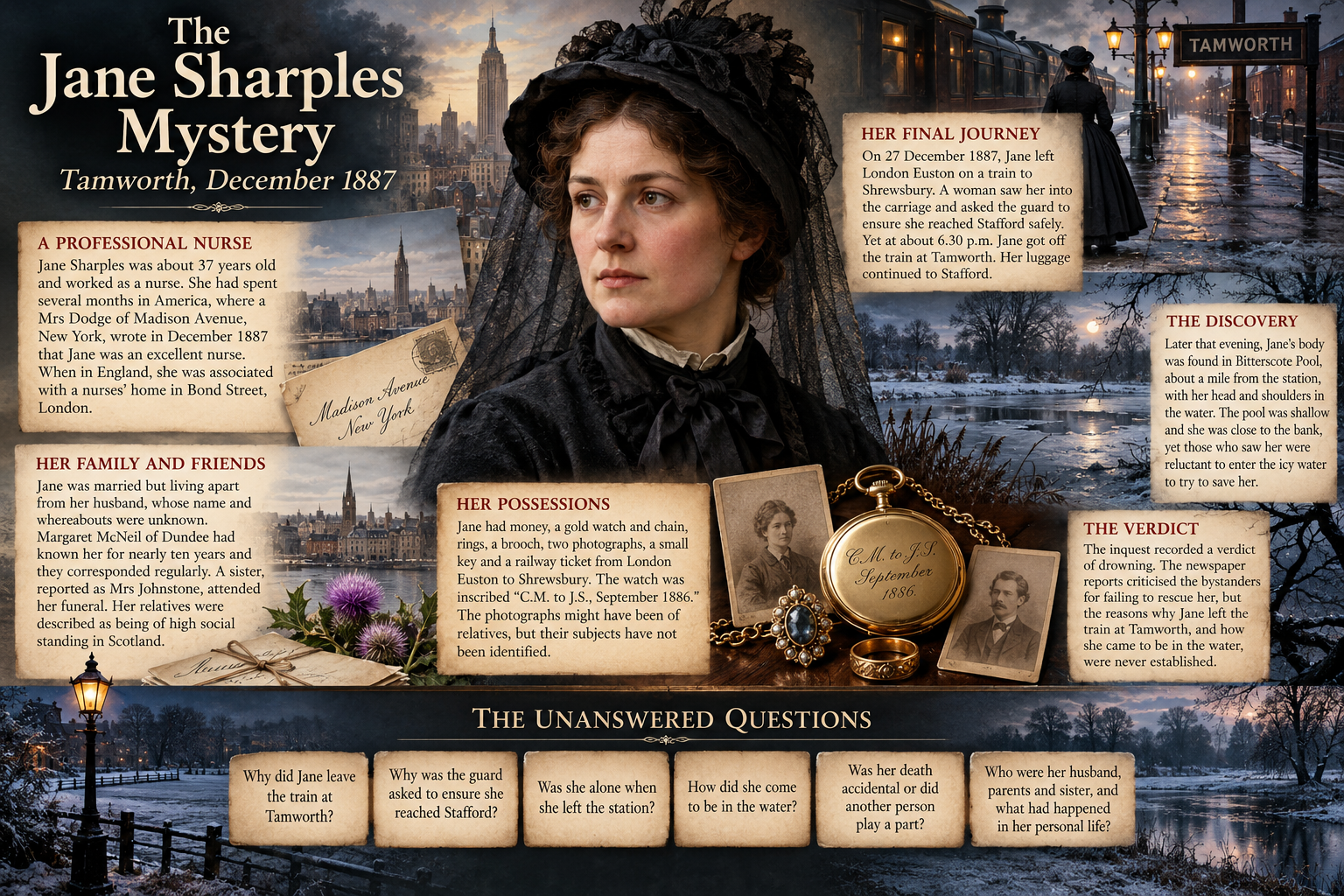
This mystery began with the discovery of a nurse drowned in a frozen pool but became an investigation into a woman’s elusive identity, her nursing career in America, an estranged marriage, a baffling interruption to a railway journey, and the unanswered questions surrounding a death officially recorded as drowning.
THE NEWSPAPER ARTICLE
Birmingham Post, 31 December 1887
|
THE MYSTERIOUS DEATH AT TAMWORTH Mr. E. Hooper, coroner, held an inquest yesterday, at the Jolly Sailor Inn, Tamworth on the body of Mrs. Jane Sharples, the lady who was found drowned under such mysterious circumstances on Tuesday evening. It appeared that deceased left Euston Station , on Tuesday afternoon, at four o’clock, her luggage being labelled for Shrewsbury. The train arrived at Tamworth at 6.30 p.m., and deceased for some reason or other got out at Tamworth, but allowed her luggage to remain in the railway-carriage, and it was put out at Stafford. – The body was identified by Miss Margaret McNeill, of Dundee, a lady with whom deceased had arranged to spend a short vacation. She stated that deceased intended breaking her journey at Shrewsbury, so as to pay a visit to a friend, the matron of the Eye Hospital there. Last April, Mrs. Sharples went to New York, where she became connected with the Nurses’ Home, and a fortnight since she returned in the s.s. Etruria. – From the evidence of a boy named Westbury it appeared that whilst skating on Biddescote pond on Tuesday evening he heard a sound as of ice breaking, and together with a man named Pearson, who was near, went in the direction from whence the sound came. Lying on the slope of the bank, with her head in the water, was a lady, but neither of them made any effort to get her out, for fear, as they said, of falling in themselves and getting drowned, although at this spot the water is not deep. Pearson remained there while Westbury went for a police-officer, and about half an hour afterwards Police-constable George Willis arrived. With the aid of some bystanders he got deceased out, and conveyed her to the Jolly Sailor Inn. – The Coroner denounced as abhorrent the conduct of Pearson and Westbury, remarking that he was disgusted with the unmanly way in which they had behaved. – The jury returned a verdict of “Found drowned,” and at their request the Coroner called Pearson and Westbury before him, and, addressing them, said the jury desired him to express their thorough disgust at the manner in which they had behaved. The jury believed that had they done as they ought to have done – had they acted with the courage of Englishmen – this unfortunate lady might not have lost her life. The jury regretted – and he (the coroner) shared their regret – that it was not possible to punish both Pearson and Westbury for their neglect and unmanly conduct; but to show his disgust at their conduct he would disallow their expenses for attending the inquest. |
THE FACTS
 On 27 December 1887, the body of Jane Sharples, a 37-year-old nurse, was recovered from Bitterscote Pool near Tamworth. She had apparently fallen through the ice into shallow water. Her death attracted considerable attention in the contemporary press, which described it as a mysterious death and questioned the conduct of those who witnessed her predicament.
Despite the newspaper coverage, and extensive subsequent research, we have been unable to establish Jane’s birth identity, identify her husband or confidently connect her to a particular family. She remains a woman whose final journey was reported in considerable detail, but whose earlier life is still frustratingly obscure.
The inquest reports describe Jane as a professional nurse. When in England, she was associated with a nurses’ home in Bond Street, London. Unfortunately, we have found no surviving record that establishes precisely which establishment this was, and she has not been identified in the 1881 census.
Jane had spent several months (if not longer) in America. The Tamworth Herald reported that a letter dated 10 December 1887 from Mrs Dodge of Madison Avenue, New York, recommending Jane as an excellent nurse, had been found in her possession. This is valuable evidence of her professional life, although we have not identified Mrs Dodge or established the precise institution in which Jane worked.
An 1880 United States census entry for a Jane Sharples, aged 28, born in Scotland, married and working as a nurse in New York, is a possible lead.
Jane reportedly returned to England aboard the Etruria shortly before her death in December. We have examined the available passenger-list leads without finding a Jane Sharples who can be identified as the deceased.
The newspapers stated that Jane was married but was not living with her husband. His name and whereabouts were not established in the reports known to us. We have not found a marriage record that can confidently be attributed to Jane. Her maiden name, parents, birthplace and husband therefore remain unknown.
Margaret McNeill, who had known Jane for nearly ten years, told the inquest that they had corresponded regularly and that Jane’s friends were expecting her to visit Dundee. Margaret described her as cheerful, happy-natured and strictly sober. Jane’s sister, reported as Mrs Johnstone, attended her funeral at Tamworth alongside Margaret McNeil. The press described Jane’s relatives as being of high social standing in Scotland. These details suggest that Jane had personal connections in Scotland and that at least some of her family or friends remained in contact with her. However, neither Margaret’s identity nor that of Mrs Johnstone has been established beyond reasonable doubt. The commonness of the surnames and the absence of further identifying information have prevented a secure genealogical connection.
The inquest reports recorded a number of personal possessions. These included money, a gold watch and chain, rings, a brooch, two photographs, a small key and a railway ticket from London Euston to Shrewsbury. The watch bore the inscription: “C.M. to J.S., September 1886.” This appears consistent with a personal gift to Jane Sharples, but the initials C.M. do not allow us to identify the giver.
The photographs might have depicted relatives or acquaintances, but their subjects have not been identified. They cannot safely be assumed to show Jane’s family. The possessions offer tantalising glimpses of Jane’s personal relationships, but none has yet provided the link needed to establish her identity.
One of the most puzzling aspects of the case is Jane’s journey on 27 December 1887. She left London Euston on a train shortly after 4 p.m., carrying a third-class ticket to Shrewsbury. Her luggage was labelled for the onward journey and continued beyond Tamworth, reaching Stafford, where railway staff discovered that Jane had left the train earlier than expected. The reports state that a woman at Euston had seen Jane into the carriage and asked the guard to ensure that she reached Stafford safely. Why Stafford was singled out in this request is unclear, particularly when Jane’s ticket was for Shrewsbury.
Jane alighted at Tamworth at approximately 6.30 p.m. Her body was subsequently found at Bitterscote Pool, about a mile from the station. No convincing explanation was established for her leaving the train there, and the reports identify no friend or acquaintance whom she was known to be visiting locally. This unexplained change of plan is the central mystery of the case.
It is possible that Jane left the train voluntarily for a reason that was never discovered. It is also reasonable to consider whether something happened during the journey that caused her to leave, or whether she was influenced or compelled to do so. But the evidence does not establish any of these possibilities. The fact that her luggage continued to Stafford proves that her journey and her luggage became separated. It does not, by itself, prove that she was prevented from taking her luggage with her.
Ernest Westbury, aged 17, reported seeing Jane walking alone beside the pool at about 7 p.m. He said she walked up and down for a period before he heard the ice crack. He and others found her with her head and shoulders in the water, while the remainder of her body lay on or near the ice. Another witness, Thomas Riley, aged 12, also reported hearing the ice crack and a groan.
The position in which Jane was found is striking. Her feet were reportedly within about 18 inches of the bank, and the water was said to be less than three feet deep. Yet those present were reluctant to enter the water to attempt a rescue, fearing that they too might fall through the ice. Constable George Willis eventually recovered Jane’s body, but she was already dead.
The reports criticised the conduct of the bystanders, and the coroner expressed the view that Jane’s life might have been saved had assistance been given sooner. The controversy surrounding the rescue became a significant feature of the newspaper coverage.
However, the awkward position of the body does not establish how Jane entered the water. It might be consistent with an accidental fall through the ice, an attempt to regain the bank, or other circumstances that the witnesses did not observe. The position alone cannot establish that she was pushed or deliberately drowned.
The inquest examined the discovery of the body, witness accounts, Jane’s identity and possessions, and the circumstances of her journey. It exposed important unanswered questions, particularly why she had left the train at Tamworth. The newspaper accounts differ in some details of the proceedings and their description of the verdict. The verdict is reported as “found drowned” in the accounts available to us. Without the original inquest record, we should not claim more certainty about its precise wording or implications than the reports permit.
The contemporary coverage focused heavily on the failure of bystanders to rescue Jane. That issue was immediate, visible and contentious. The reports available to us do not demonstrate that the police pursued a sustained investigation into the possibility of assault or foul play. This absence of reported investigation is not proof that no further enquiries took place. Nor does it establish that the authorities believed her death suspicious. It means that we cannot reconstruct the full extent of any police investigation from the surviving newspaper evidence we have examined.
CONCLUSION
The mystery of Jane Sharples is not simply that a woman drowned in a pool on a winter evening. It is that she was travelling towards a known destination, carrying a ticket and luggage for that journey, yet left the train unexpectedly and died within a short time. The evidence gathered at the inquest did not explain why.
Her professional life, marriage and family remain largely hidden from us. The contemporary reports preserve fragments of her story but do not join them into a complete biography.
The fairest conclusion is therefore that Jane’s death was recorded as drowning, while the circumstances leading to it remain unresolved. We cannot responsibly declare it a murder, but we cannot explain the decisive events that brought her to the pool either.
For now, the case must remain open in the historical sense: not because we have proved foul play, but because the surviving evidence does not allow us to reconstruct Jane’s final journey with confidence.
THE SUMMARY IMAGE