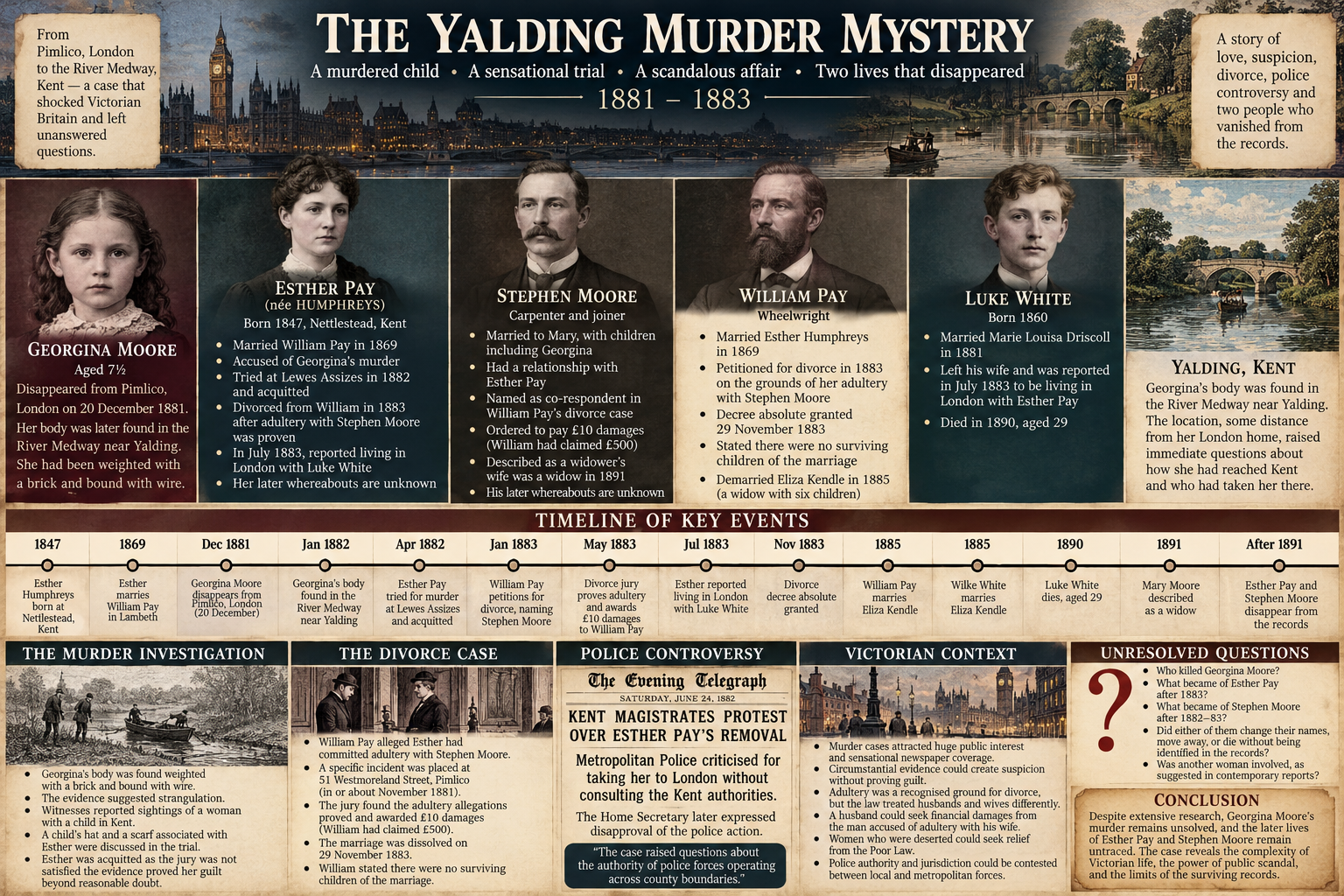
This mystery began with the a newspaper account of a murdered child but became a far-reaching investigation into a Victorian family, a suspected murder, an adulterous relationship, a contested police procedure, and a divorce that continued to attract attention long after the criminal trial had ended.
THE NEWSPAPER ARTICLE
The Citizen, 1 February 1882
|
CHARGE OF CHILD MURDER. At the Westminster Police-court today, Esther Pay, 35, a married woman, was charged on suspicion with having caused the death of Georgina Moore, aged seven and a half years, at Yalding, in Kent. Prisoner appeared quite unconcerned. The police evidence showed that when charged the prisoner denied knowing anything of the child. In her possession was found a letter addressed to the deceased’s father, commencing “Darling”. On her way to London after being arrested the prisoner said to the police officer who had her in charge, “Don’t feel surprised if the child’s father bolts, and then you will find the most guilty party has gone.” Prisoner further said the child had been killed out of spite by some woman whom Moore had served as badly as he had her. Subsequently at the Police-station Moore said he thought the prisoner was guilty. The case was remanded for a week. |
THE FACTS
Numerous newspapers reported on the murder of this little girl, and the facts of the case were revealed as follows.
 Georgina was living in Pimlico with her family when she disappeared on 20 December 1881. Her father, Stephen Moore, was a carpenter and joiner. The family included Stephen’s wife, Mary Elizabeth and a son, Harry.
The child’s body was recovered from the River Medway near Yalding, Kent, in January 1882. The circumstances were disturbing. Georgina had been bound with wire and weighted with a brick. The post-mortem evidence was reported as consistent with strangulation, and the child had apparently eaten relatively recently before her death.
The body’s location, some distance from her London home, raised immediate questions about how she had reached Kent, who had taken her there, and whether more than one person was involved.
The investigation developed through a combination of witness sightings, physical clues, and the examination of people connected with the Moore family. The newspapers reported sightings of a woman with a child in Kent, the discovery of a child’s hat, and discussion of a scarf associated with Esther Pay. But the identifications were not consistently certain, and the evidence did not ultimately persuade the jury that Esther was guilty beyond reasonable doubt. She was acquitted of murder.
 Esther was born Esther Humphreys at Nettlestead, Kent, in March 1847. She was the youngest of seven daughters in the Humphrey family, which also included a younger son, William. Her father, William Humphrey, was a farm bailiff in Nettlestead.
This family background is important because it anchors Esther in a real community before she became the subject of sensational newspaper coverage. Her sisters’ marriages and later households have also provided some of the most useful clues in our search for her.
On 12 August 1869, Esther Humphreys married William Pay at St Mary’s Church, Lambeth. William was a wheelwright, but by 1881 Esther had became intimately involved with Stephen Moore, Georgina’s father
The prosecution at Esther’s murder trial suggested that Stephen had ended his relationship with Esther in 1881 and that jealousy or revenge might have supplied a motive for murder. Yet a motive, even if plausible, is not proof of guilt. The trial evidence depended on sightings, circumstantial clues and witness identifications that the jury did not find sufficient to convict her.
Esther was arrested after the discovery of Georgina’s body and brought into the criminal proceedings. The case generated a separate controversy over the Metropolitan Police’s decision to take her from Kent to London for the preliminary hearing.
The Evening Telegraph of 24 June 1882 reported that Kent magistrates protested to the Home Secretary. They objected that a Metropolitan Police inspector had taken Esther from Yalding without consulting the chief of the Kent County Constabulary. The officer’s superior reportedly maintained that Esther had been invited to accompany the inspector rather than formally arrested. A later report in the Whitstable Times of 28 October 1882 described the Home Secretary’s disapproval of the police action and instructions to prevent a recurrence.
This controversy matters because it shows that the case raised questions not only about guilt but also about the proper authority of police forces operating across county boundaries. It does not, however, establish that the police acted unlawfully or that the procedural dispute affected the verdict.
Esther was tried at Lewes Assizes in April 1882. On 1 May 1882 the Guardian reported her acquittal and the judge’s warning that suspicious circumstances were not enough: the jury had to be satisfied that the evidence justified the conclusion of guilt. The report also mentioned the possibility that another woman might have committed the murder to direct suspicion towards Esther. This was speculation, not an established alternative solution.
What happened to Esther after the trial?
One of the most significant developments in our research has been the discovery and examination of William Pay’s divorce papers. William petitioned for divorce in January 1883, alleging that Esther had repeatedly committed adultery with Stephen Moore. He specifically placed an act of adultery at 51 Westmoreland Street, Pimlico, in or about November 1881.
In fact, the Tunbridge Wells Courier reported that William had come home one afternoon and found Esther and Stephen kissing on a sofa, and that he had given Stephen a thrashing.
On 5 May 1883 the divorce case was heard before a jury. On 6 May 1883 the decree nisi was granted, and on 29 November 1883, the decree absolute dissolved the marriage. The jury found the adultery allegations proved and assessed damages of £10 against Stephen Moore, although William had originally requested £500.
The divorce proceedings establish that the court accepted the adultery allegations for the purposes of dissolving William and Esther’s marriage. They do not establish that either Esther or Stephen had anything to do with Georgina’s murder.
The case is particularly revealing when placed in its Victorian legal context. Before the Matrimonial Causes Act 1857, a full divorce permitting remarriage generally required a private Act of Parliament, making it prohibitively expensive for most people. The 1857 Act created a civil divorce court, but adultery remained central to the grounds for divorce, and the law treated husbands and wives differently. A husband could petition on the ground of his wife’s adultery alone, whereas a wife generally had to establish adultery together with an additional qualifying circumstance, such as cruelty or desertion. William’s petition therefore reflects an unequal legal system in which a wife’s sexual conduct could become the central issue in a husband’s attempt to dissolve a marriage. Stephen was named as the co-respondent because he was alleged to have committed adultery with Esther.
For a time, it seemed that Esther might simply have returned to her family in Kent. A note on a family tree claimed that after her acquittal she went to live with a sister whose husband ran the Huntsman Beerhouse in Maidstone. We investigated this lead and established that the Huntsman was at 21 Astley Street, Maidstone, and was run in 1881 by John Collins, husband of Esther’s sister Harriet Humphrey. But Esther does not appear in their household in either the 1881 or 1891 census. A temporary stay remains possible, but it has not been confirmed.
A more concrete lead emerged from the Sevenoaks Chronicle and Kentish Advertiser of 13 July 1883. The newspaper reported that Luke White, a young man charged with deserting his wife, had left Maidstone and was living in London with Esther Pay. His wife had sought assistance from the Maidstone Union.
This report is our strongest contemporary evidence of Esther’s life after the trial. It places her with Luke in London, while he was still married to his wife, Marie Louisa. Luke later married (bigamously) Catherine Florence Maloney in 1887, so Esther’s relationship with him was not long-standing.
We traced Esther’s sisters in order to establish her family background and identify possible places where she might have stayed, but the only intriguing fact that has emerged concerns Esther’s sister, Fanny.
She married Henry Saunders in 1863 and had five children with him. However, on 7 June 1882 she was admitted to the Kent Lunatic Asylum, and died there on 27 October 1886. Fanny Saunders’ asylum admission occurred only weeks after Esther’s acquittal. We have no evidence that the two events were connected, and the timing should not be used to imply a causal relationship.
So, despite extensive searches, Esther has not been found in the later census households of her sisters, nor have we identified a subsequent marriage or death registration that can confidently be assigned to her. The family network has therefore helped us understand her origins, but has not solved the question of where she went after 1883.
What happened to Stephen Moore after the trial?
 Stephen’s later life has proved just as difficult to trace as Esther’s.
The 1881 census shows him living with his wife Mary and their two children, Harry and Georgana. He was a carpenter and joiner. But by the 1891 census, Mary was living alone with their son Harry and describing herself as a widow.
This is a significant clue, but it does not conclusively prove that Stephen had died. We have not found a death registration that can confidently be assigned to him.
The fact that Esther and Stephen both become difficult to trace after 1882–83 is intriguing, especially given the publicity surrounding the murder and divorce. But it would be unsafe to conclude that they deliberately disappeared because of the case. We simply do not know.
Several aspects of the case help explain why it became so prominent in contemporary newspapers.
Sensational reporting and the power of circumstantial evidence
A child’s body found in a river, weighted with a brick and bound with wire, provided the ingredients for a sensational crime story. Newspapers reported sightings, questioned witnesses’ credibility and discussed the relationships between the adults involved. The press could make an allegation familiar to readers long before a court reached a verdict.
This case illustrates the difference between public suspicion and legal proof. The prosecution built a circumstantial case against Esther, but the jury acquitted her. The acquittal did not solve the murder; it established that the prosecution had not persuaded the jury to convict her on the evidence presented.
The alternative theory mentioned by the Guardian — that another woman might have committed the crime to cast suspicion on Esther — is an example of how the press and the courtroom could generate competing narratives. It should not be elevated into a solution without supporting evidence.
Family respectability and sexual reputation
The case also exposed the importance attached to marriage and sexual respectability in Victorian society. Esther’s relationship with Stephen was relevant to the prosecution’s suggested motive, and it later became the explicit ground for William’s divorce petition.
The divorce papers show how private relationships could be drawn into public view through legal proceedings. Allegations of adultery were not confined to the couple concerned: the alleged partner could be named in the proceedings, damages could be sought, and the case could be reported in newspapers.
For Esther, the consequences of this publicity may have been considerable, but we cannot establish how she experienced it or whether it influenced her later decisions. We should not assume that she changed her name or left her former life because of public hostility, although such possibilities can remain open.
Police authority and local jurisdiction
The dispute between the Metropolitan Police and Kent magistrates demonstrates that criminal investigations could involve tensions between different police authorities and local jurisdictions. The complaint about Esther’s removal to London shows that the procedure itself became a public issue.
This is an important reminder that a high-profile case was not just about evidence and verdicts. It could also expose disagreements over who had authority to investigate, where a preliminary hearing should take place, and how suspects should be brought before magistrates.
CONCLUSION
The investigation has established a substantial amount about the people surrounding Georgina Moore’s death. We have reconstructed Esther’s family background, documented her marriage and divorce, followed the evidence about her relationship with Stephen, examined the controversy over police procedure, and found a contemporary report placing her with Luke White in 1883.
But the central crime remains unresolved. Esther was acquitted, and no alternative perpetrator has been established by the records examined. Stephen’s later whereabouts are also uncertain, while Esther disappears from the records we have been able to identify after her association with Luke White.
It is tempting to imagine that the notoriety of the case drove Esther and Stephen to change their names and begin again elsewhere. That is possible, but it remains speculation. Equally, either may have died, moved away, or become difficult to distinguish from others with similar names.
The responsible conclusion is therefore that Georgina Moore’s murder remains unsolved in the evidence reviewed, and Esther Pay’s and Stephen Moore’s later lives remain untraced.
This is not a failure of the research. The investigation has uncovered the social and legal world surrounding the case and shown how far a single newspaper cutting can lead. It has also established the limits of the surviving evidence — an important part of any serious historical mystery.
THE SUMMARY IMAGE