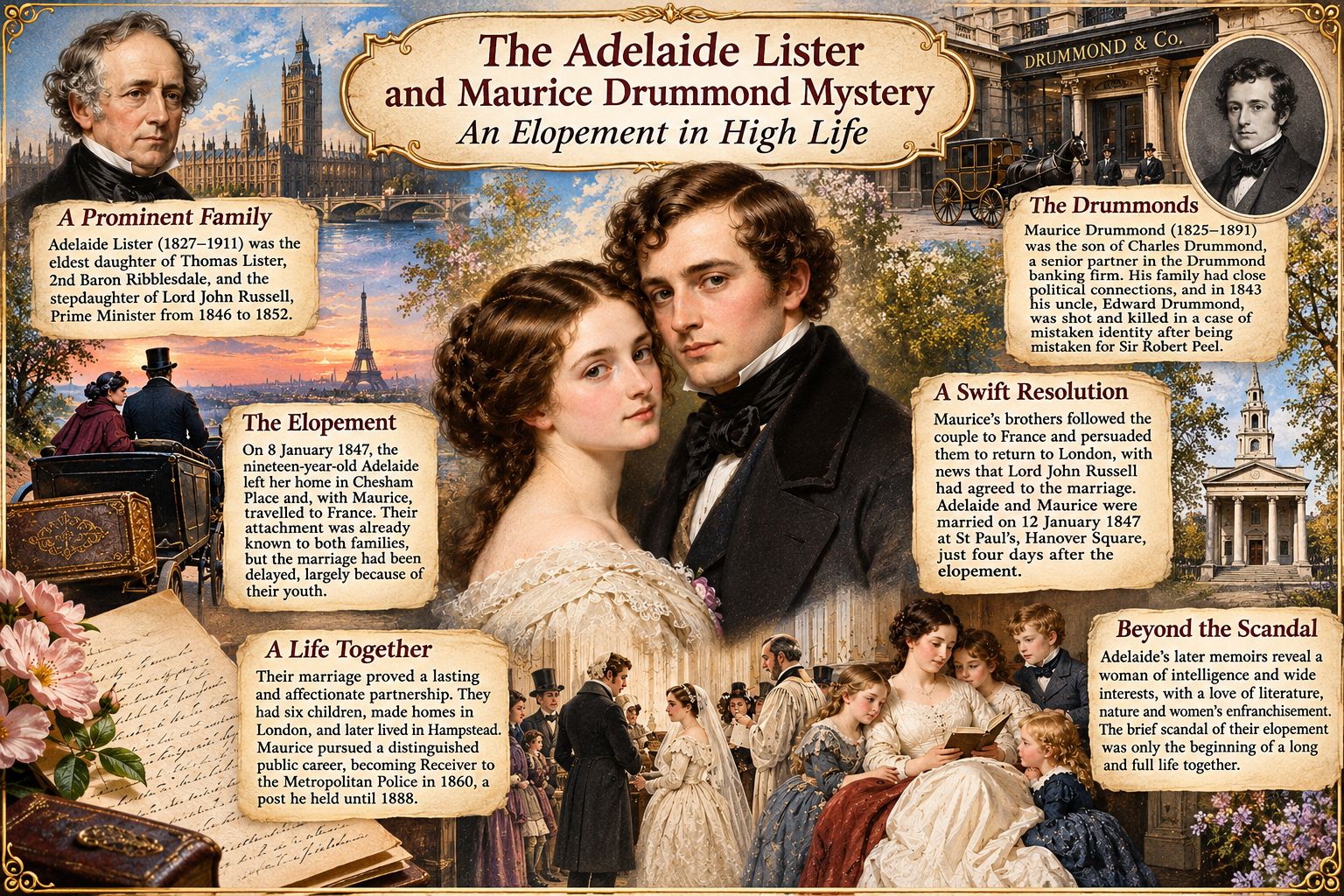
This mystery began with a dramatic newspaper story about an aristocratic young woman who eloped with her suitor to France, only to be brought back by his brothers. But as the investigation developed, it became much more than a romantic escapade. It opened a window onto two influential families, the political world surrounding the Prime Minister, the Drummond banking dynasty, and the marriage that followed the scandal.
THE NEWSPAPER ARTICLE
The Star of Freedom, 16 January 1847
| ELOPEMENT IN HIGH LIFE.
An elopement took place last week which caused considerable sensation in “high society”. The youthful parties were the Hon. Miss Lister, eldest daughter of the late Lord Ribblesdale and the late Lady John Russell, and consequently step-daughter of the Premier, and Mr. Maurice Drummond, third son of Mr. Charles Drummond the opulent banker. It was known to both families that a warm attachment existed as far back as two years ago. Lord John Russell, on learning that fact, we hear, did not positively discourage the addresses of the suitor, but most properly advised a more mature consideration, and mentioned the youth of both the parties as the only obstacle. On Friday last, shortly before six o’clock, the Hon. Miss Lister clandestinely left the roof of her affectionate guardian, and her absence was not positively noticed until just before dinner time, when inquiries among the domestics proved fruitless, as the youthful lady had departed unobserved by any of the establishment. The Earl and Countess Grey were with a small circle, dining with Lord and Lady John Russell; but the Noble Lord was so much affected, that the party broke up shortly after they had assembled. The fugatives bent their course to the Continent, and not to Gretna, the usual rendezvous for runaway lovers; and a satisfactory clue having been obtained to their route, the Messrs. Robert and Charles Drummond, brothers of Mr. M. Drummond, without the least possible delay, proceeded in quest of the parties. They were discovered in France, and were immediately brought back to this country by their friends, and reached London on Sunday afternoon. The Hon. Miss Lister was instantly taken to the residence of her step-father. On Tuesday morning the “runaways” were married at St. Paul’s Church, Knightsbridge. The ceremony was conducted with strictest privacy. The Hon. Miss Lister is in her twentieth year, and Mr. Maurice Drummond is within a few months two years her senior. He is, we understand, a clerk in the Treasury. |
Adelaide Lister: a young woman in a remarkable family
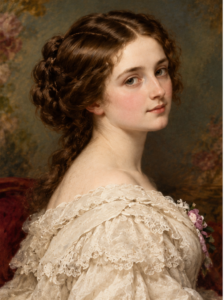 Adelaide Lister was born on 14 May 1827, the eldest daughter of Thomas Lister, 2nd Baron Ribblesdale and Adelaide Lister (who were 2nd cousins). Her father died in 1832 when she was 5, and in 1835 her mother married Lord John Russell, at which point her life became connected to the political establishment. Her mother died in 1838 shortly after the birth of her second daughter with Lord John Russell, and her step-father married again in 1841 to Frances (Fanny) Elliot and they had 8 more children together. She called Lord John “papa” and Fanny “mama”, showing a close attachment to them both.
In June 1846 Lord Russell became Prime Minister. It is therefore important to understand the attention that Adelaide’s elopement would have attracted in 1847. She was not simply a young woman from a wealthy family: she was the stepdaughter of the head of the government. Her actions had the potential to embarrass a prominent political household at a moment when Lord John Russell was occupied with the demands of office.
Yet it would be a mistake to see Adelaide only through her relationship to powerful men. The elopement suggests a young woman determined to pursue a marriage she wanted, even when the circumstances were difficult. How much she planned in advance, and what she intended to achieve by leaving, remain questions rather than established facts.
Maurice Drummond and the family banking dynasty
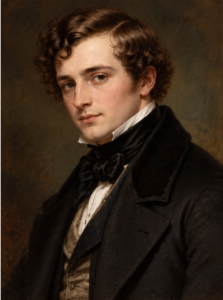 Maurice Drummond was born on 9 July 1825, the son of Charles Drummond, a senior partner in the Drummond banking firm, and the Hon. Mary Dulcibella Eden, daughter of the 1st Lord Auckland.
The Drummonds were an established banking family. Their London business had originated with Andrew Drummond, who began as a goldsmith at Charing Cross around 1712 and was conducting banking business by 1717. Over subsequent generations, the firm developed a clientele that included aristocrats, landowners, military figures and other influential customers.
The family’s importance extended beyond money. Banking, political patronage, public service and aristocratic connections were closely intertwined in the world in which Maurice grew up. His own future would take him into government rather than into the family bank, but he belonged to a network in which personal connections could have considerable influence.
The family’s history also provides an important backdrop to the events of 1843. Maurice’s uncle Edward Drummond was the private secretary to Sir Robert Peel. On 20 January 1843, Edward was shot by Daniel Macnaghten, who mistakenly believed him to be Peel. Edward died five days later, and Macnaghten was acquitted on grounds of insanity.
Contemporary newspaper reports provide vivid details of the attack. A report in The Hampshire Advertiser on 21 January records that Edward had visited his brother Charles’s banking house at Charing Cross shortly before he was shot. The Times report of the same date provides further details of the attack, Edward’s treatment and the family’s response. These reports connect the banking business directly to the family tragedy. The bank was not merely an institution bearing the family name: it was part of the family’s immediate world.
Adelaide’s memoir states that Maurice obtained a Treasury clerkship at seventeen, shortly after Edward’s death. According to her recollection, the family believed the appointment was a form of compensation for their loss.
Maurice subsequently became private secretary to Sir George Cornewall Lewis in 1856, briefly served under Disraeli, and then under Lord Derby from 1858 to 1859. In 1860 he became Receiver to the Metropolitan Police, a post he held until 1888. He died in 1891.
His career is a reminder that Maurice’s identity was not defined by the elopement. He went on to hold a substantial public appointment and lived a long life of public service.
The elopement of January 1847
The central episode began with a relationship that, according to newspaper reports, was already well established. This is an important detail. The contemporary account does not describe a relationship that had been entirely secret or a sudden infatuation. Instead, it suggests that the attachment was known, but that the couple had encountered resistance or delay over the timing of their marriage.
On the evening of Friday, 8 January 1847, Adelaide left her guardian’s home in Chesham Place at about six o’clock. Her absence was reportedly not noticed until shortly before dinner.
Adelaide and Maurice went to the Continent, and Maurice’s brothers Robert and Charles followed them to France, found them and brought them back to England.
The reports say that it was understood there would be no further objection to the marriage, and the couple married on Tuesday, 12 January 1847. The marriage register records Maurice as a 21-year-old bachelor, living in Stratton Street, and Adelaide as a 19-year-old spinster, living in Chesham Place.
The marriage took place just four days after the elopement.
What might the elopement mean? This is where the case becomes particularly compelling. We know the broad sequence of events, but we do not know exactly what the couple intended or what passed between the families.
One plausible interpretation is that the elopement was a deliberate attempt to bring a long-standing disagreement to a conclusion. If Adelaide and Maurice had been attached for two years, and if the principal objection was their youth, they may have concluded that leaving together would force the families to make a decision.
They both came from wealthy, well-connected families. They were not necessarily attempting to disappear permanently. Their return and rapid marriage suggest that the journey may have been a means of securing the union rather than abandoning their former lives.
It is also possible that Adelaide understood the public implications of her actions as the Prime Minister’s stepdaughter. An elopement was bound to attract attention, and the newspapers certainly treated it as a story of social significance. Whether she consciously intended to force Lord John Russell’s hand, however, remains unproven.
We do not know precisely where in France the couple went. Paris is a plausible possibility, but there is no evidence establishing it. Nor have we found evidence that Maurice used banking contacts to arrange accommodation. These are possibilities for an imaginative reconstruction, not facts to be included as established history.
What the evidence does support is a story of a known attachment, a reported objection based on youth, a dramatic departure, the intervention of Maurice’s brothers, and a marriage that followed very quickly.
The elopement occurred at a significant moment in Lord John Russell’s political career. He had become Prime Minister in June 1846 and remained in office until February 1852. In January 1847, his government was also confronting the crisis in Ireland, including the introduction of the Irish Coercion Bill on 10 January – two days before Adelaide and Maurice married.
There is no evidence that the political situation caused Lord John’s reaction to the elopement. Nevertheless, it provides useful context. The head of the government was managing major public responsibilities while a private family affair involving his stepdaughter became a subject of newspaper attention.
Married life: from scandal to domesticity
One of the most rewarding discoveries in this case is that Adelaide’s memoir allows us to follow the couple well beyond their brief moment of notoriety.
Her recollections, written between 1906 and 1909 and published by her son-in-law Basil Champneys in 1915, describe a marriage that developed into a long shared life. Champneys had known Adelaide for nearly fifty years and was closely acquainted with her for about thirty-five. He selected and arranged her reminiscences, broadly chronologically but sometimes retaining material in its original topical order.
The memoir is not a diary of the elopement, and it does not give us a detailed retrospective account of the scandal. Its value lies elsewhere: it shows us something of the household and interests that followed.
After marrying, Adelaide and Maurice initially lodged at 20 Half Moon Street before moving to a small cottage in Brompton. Adelaide remembered the cottage’s garden and a fine Marie Louise pear tree. She also recalled that they paid little attention to the stream below the bedroom window and attributed the unpleasant smells to nearby stables. These domestic details are strikingly different from the world of aristocratic headlines and political dinners. They suggest the texture of ordinary married life: homes, gardens, practical inconveniences and the creation of a household.
Adelaide and Maurice had six children, and motherhood was central to Adelaide’s life and outlook. In her memoir, she reflects on the happiness to be found in children, an appreciation of nature, hobbies and intellectual pursuits. Her comments reveal a woman who valued the domestic sphere but also maintained interests and ideas of her own.
She gradually withdrew from some aspects of society, living relatively quietly in Hampstead and devoting herself to her family, writing and other pursuits. Champneys describes her involvement in literary circles and moderate women’s enfranchisement, although her health later restricted her social life.
This is a more complex picture than that of a young woman whose life was defined by a single romantic adventure. Adelaide developed her own interests and convictions over many decades.
The memoir also gives glimpses of Maurice’s humour and eccentricity. One anecdote describes him showing a piece of tanned skin said to have belonged to John Bellingham, the assassin of Spencer Perceval, to Perceval’s son while entertaining him, apparently forgetting the connection. The episode captures an awkwardly comic side of Maurice’s personality.
Adelaide also recalls his parodies and the humour shared within the family. Her cousin Lena Eden admired his talents, although Adelaide observed that his circumstances had not yet provided much opportunity for those talents to develop.
These recollections offer a glimpse of a marriage in which family life, intellectual interests and humour had a place. They do not provide a direct declaration of romantic feeling about Maurice, but the absence of such a declaration should not be read as evidence of an unhappy marriage. The memoir was a selection of reminiscences, not an intimate account of every aspect of their relationship.
CONCLUSION
This mystery began with a sensational report about a young couple who left England for France and returned to marry within days. The newspapers gave us the drama; the marriage register confirmed the union; and Adelaide’s memoir revealed the quieter decades that followed.
The elopement itself remains open to interpretation. Perhaps it was an impulsive act of youthful defiance. Perhaps it was a determined effort by two people who had already waited long enough. The evidence permits the latter as a compelling working hypothesis, but it does not establish it as fact.
What makes the case so rich is that Adelaide was not merely a Prime Minister’s stepdaughter at the centre of a scandal, nor Maurice merely the banker’s son who ran away with her. They were two people embedded in influential families, making a decision that briefly brought their private lives into public view. They then went on to build a household, raise children and pursue interests that the headlines could never have captured.
The mystery is therefore not simply why they eloped, but what that dramatic decision reveals about their agency, their families and the lives they chose to build afterwards.
SUMMARY IMAGE