This mystery began with a newspaper account of a missing commercial traveller accused of impersonating a famous composer, but became a far-reaching investigation into a Victorian musical dynasty, royal connections, financial hardship, marital discord, a troubled family left dependent on the workhouse, a proposed second marriage, and a disappearance that remains unexplained despite extensive research.
THE NEWSPAPER ARTICLE
Manchester Evening News, 31 July 1872
|
A MYSTERIOUS DISAPPEARANCE EXPLAINED. A commercial traveller, named Fritz, who has been missing since May last, and whose mysterious disappearance was then advertised, was apprehended in Birmingham yesterday morning, charged with running up a bill at the Coach and Horses Hotel upon false pretences. It would appear that he represented himself to be Sydney Smith, a well-known composer, and he lived with a London ballet girl as his wife in a free and liberal style. He was not suspected until this week, and was yesterday given into custody. He was afterwards taken before the magistrates and remanded. |
THE FACTS
In July 1872 newspapers reported that a man known as Fritz, a commercial traveller, had been found in Birmingham after a mysterious disappearance. He had allegedly been posing as the composer Sydney Smith, associating with a woman described as a London ballet girl, and accumulating an unpaid hotel bill of £28 at the Coach and Horses.
A longer account in the Birmingham Evening Mail described a man who had apparently used musical pretensions, advertisements and plans for concerts to establish his assumed identity. The reports presented the affair as a curious mixture of theatrical deception, unpaid debts and romantic intrigue.
The 1872 allegations must, however, be treated with care. A court register records that Frederick Weippert was committed in August and tried before the Birmingham Recorder in November 1872 on a charge of obtaining money or goods by false pretences. The verdict was not guilty. The newspaper accusations therefore cannot be presented as proven criminal conduct.
So, who was Fritz or Frederick Weippert?
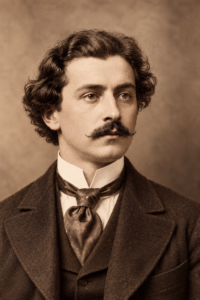 My research identified him as George Bradford Frederick Carpus Weippert (commonly known as Fritz) who was born in London in October 1844. His baptism in St Pancras in 1845 records he was the son of William Weippert and Corinna Gooch Bradford.
One of the most interesting discoveries was that Fritz belonged to a family with a substantial musical heritage. His story becomes much more intriguing when set against the professional world into which he was born.
His father, William Weippert, was born in Huntingdonshire in 1809, and the 1851 census shows William, a musician, living in Marylebone with his wife Corinna and their 8 children.
William’s father, John Weippert, was born in Schweinfurt, Bavaria, in 1776. His migration to England connects the family with the wider movement of continental European musicians into Britain, where London offered opportunities in theatre orchestras, fashionable entertainment, teaching and music publishing.
A particularly striking piece of evidence comes from the marriage certificate of Fritz’s brother, Henry Nelson Weippert, when he married in Sydney in 1906. Henry gave his father’s occupation as “Bandmaster to Queen Victoria”. His mother’s obituary likewise described the late William as a professor of music and quadrille bandmaster to the Royal Family.
What were Weippert’s Quadrilles?
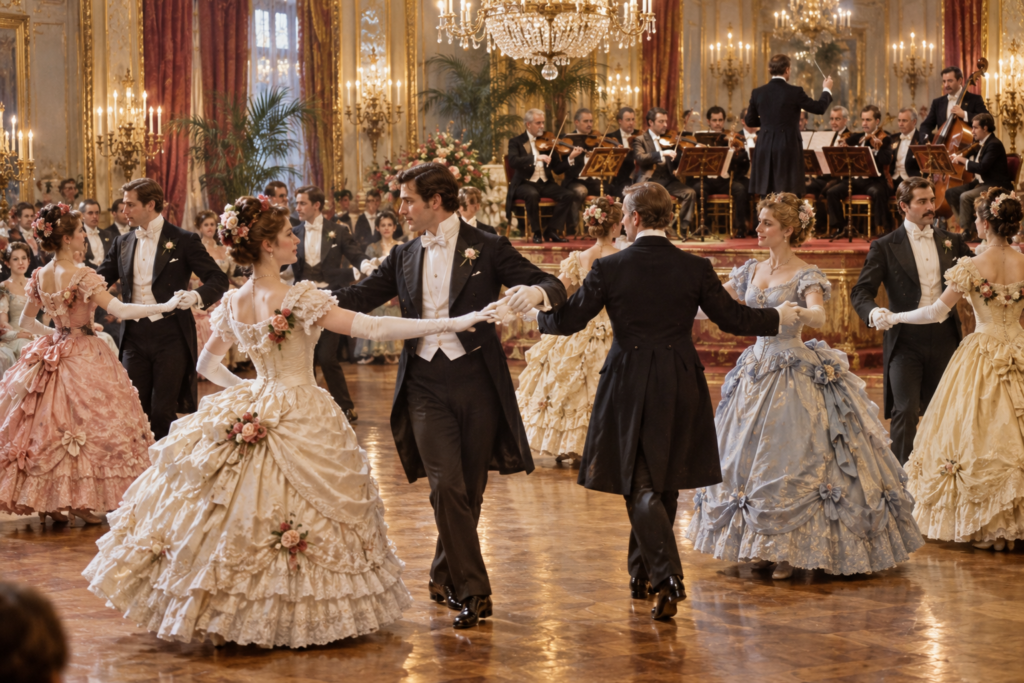 The quadrille was a fashionable social dance that became particularly popular in Britain during the late eighteenth and nineteenth centuries. Usually danced by four couples arranged in a square, it consisted of a succession of figures performed to carefully structured music. It was an important feature of balls, assemblies and private dances, bringing together the worlds of music, fashion and social display.
The Weippert name became associated with this musical tradition. Historical research on dance music describes Weippert quadrille bands as prestigious ensembles led by Weippert and drawing accomplished players from major London orchestras, including the orchestra of the King’s Theatre. These were not simply groups of amateur musicians: they drew on the skills of professional performers and catered to the demands of fashionable society.
Quadrilles required coordination, a clear sense of rhythm and music suitable for dancers to follow. A successful bandleader therefore needed not only musical ability but also professional connections, organisational skills and an understanding of the expectations of elite audiences.
The family’s association with royal circles would have been valuable in a competitive musical world. A royal appointment or connection could confer status, attract private engagements and distinguish a musician from numerous rivals. Music was both an art and a business, and reputation was an important commercial asset.
Marriage, identity and the respectable household
On 19 November 1863, George Bradford Frederick Carpus Weippert married Susannah Webster at St Mary’s Church, Marylebone. The marriage certificate described him as a “Professor of Music”, while his father William was also recorded as a professor of music. The certificate gives Fritz’s age as “full age”, although his birth and baptism evidence suggests that he was only about eighteen or nineteen.
Marriage was an important social and legal institution in Victorian Britain. A respectable household was commonly expected to be supported by a husband who earned a living, while a wife was expected to manage domestic affairs and care for children. These ideals were never a complete reflection of reality, particularly among poorer families, but they shaped how courts, newspapers and local authorities judged marital conduct.
For a professional musician, the boundary between public reputation and private life could be especially important. Musical work might involve travel, irregular earnings and a network of theatres, concert halls, patrons and publishers. A household dependent on such income could be vulnerable when work failed or a breadwinner disappeared.
Fritz and Susannah had a large family. In the 1881 census (9 years after the sensational episode in the newspapers), Fritz, recorded as a musician, was living in Marylebone with Susannah and their children. But the apparent stability of the census household did not last.
In February 1883, the Marylebone and Paddington Mercury reported proceedings under the heading “Neglecting to Support a Wife and Family”. Frederick George Weippert, aged 38, and described as a musician, was accused of failing to maintain his wife and children.
The report described a family who had become chargeable to the parish. Fritz’s wife and four children had been admitted to the Marylebone workhouse, and the parish was reportedly spending 27 shillings a week on their maintenance. Fritz himself had also entered the workhouse following a contribution order, remaining there until shortly before Christmas. He subsequently left with his family, but when they again became chargeable in January, he could not be found.
He was later located at a comfortably or luxuriously furnished house at 61 Harrow Road, on the Queen’s Park Estate. The newspaper suggested that he was lodging at a woman’s house and that Susannah had followed the woman when she moved. The magistrate sentenced Fritz to one month’s hard labour for neglecting his responsibilities towards his wife and family.
The Victorian workhouse and the family left behind
 The workhouse was intended to provide relief to people who could not support themselves, but admission was often accompanied by stigma. Under the Victorian poor-law system, local authorities had responsibilities for those unable to maintain themselves, while officials could investigate whether relatives were failing to meet obligations towards dependent family members. For a wife with several children and an absent or unreliable husband, the workhouse might be a last resort rather than a choice. Relief could mean food and shelter, but it also brought the family under institutional supervision and exposed their private circumstances to public scrutiny.
The prosecution of Fritz illustrates the way poverty could become a legal matter. The proceedings were not simply about whether a family was destitute; they were also about whether a husband was meeting the responsibilities expected of him. His comfortable lodging, as described by the newspaper, made the contrast with his family’s circumstances particularly damaging in the eyes of the court and its readers.
There is a further complication here. The newspaper’s account gives us the allegations and the court’s decision, but it cannot tell us everything about the family’s private life or the reasons for Fritz’s behaviour. His circumstances may have involved financial irresponsibility, relationship difficulties, illness or other factors that the surviving report does not explain. We can document the prosecution without pretending to know his private motives.
A proposed second marriage?
The next important clue comes from 1887, when banns were published at St Stephen’s, Walworth, for a proposed marriage between Frederick George Bradford Carpus Weippert and Ann Church. The entry describes him as a bachelor. This is conspicuous because Fritz had married Susannah in 1863, and she was still alive. However, the parish register suggests that the proposed marriage did not take place.
This episode adds yet another layer to the mystery. Was Fritz attempting to establish a new domestic life? Was the proposed marriage abandoned when his existing circumstances became known? Or was there some other explanation for the entry? The available evidence does not answer these questions.
It does, however, provide a potentially significant chronological marker: a man bearing Fritz’s unusually distinctive full name was named in banns in England in 1887.
The wife who became a widow
Perhaps the most tantalising later clue is Susannah’s appearance in the 1891 census, when she was recorded as a widow. Although Susannah did not die until 1935, and she continued to use the surname Weippert. The census description raises an obvious question: what had happened to Fritz by 1891, and why was Susannah recorded as a widow?
There are several possibilities. She may have believed he was dead; she may have used the term to describe a marriage that had effectively ended; or the information may have been supplied inaccurately. Without further evidence, it is not possible to choose confidently between these explanations.
The distinction between a legal widowhood and an informal description matters. A woman whose husband had disappeared might face years of uncertainty about her status, finances and prospects. Divorce was expensive and socially difficult for many people, and a missing husband could leave a wife in a particularly awkward position. Yet separation alone did not make her a widow in law.
The 1887 banns and the 1891 census therefore form an intriguing sequence: Fritz may have been named in a proposed marriage while Susannah was still alive, and within four years she was described as a widow. We do not know what happened in between.
This is where the documentary trail becomes frustratingly thin.
The Australian Weipperts
One of the most absorbing branches of the investigation concerned Fritz’s relatives in Australia. At first, the family’s Australian connections seemed to offer a possible explanation for his disappearance. Although no convincing immigration or death record for Fritz has been found, the Australian research uncovered a substantial story of its own.
After the death of his father, Fritz’s mother, Corinna Weippert, emigrated to Australia in 1864 on the assisted-passage ship Coldstream, and she died in South Melbourne in 1899. Several of her children also had Australian connections:
- Mary Eleanor Weippert emigrated in 1864 with her mother, and became an actress and singer and died in Tasmania in 1874.
- Emma Elizabeth Weippert also emigrated in 1864, and after her marriage was known as Madame Weippert Patey. She performed publicly in Australia and sang the dedicatory ode at the opening of Melbourne Town Hall.
- Henry Nelson Weippert established himself in Australia and pursued a musical career. Australian newspaper advertisements from 1878 identify Henry as a pianist and vocalist. At concerts in Geelong and Hobart, he performed alongside his sister, Madame Weippert Patey. One advertisement features Henry’s composition, “Rolling Home to Merry England”.
Henry’s own history introduced a striking parallel with Fritz’s marital difficulties. He fathered an illegitimate child aged nineteen, then later married Julia Harris in 1862, and had five children with her. Julia was recorded as a widow in the 1891 census and died in Oxfordshire in 1900, when her death notice described her as the widow of the late Henry Nelson Weippert. Yet Henry was still alive: his 1906 marriage in Sydney records him marrying again as a widower.
The records do not establish exactly what Julia believed had happened to him, or whether she had any reliable news of his whereabouts. Nevertheless, the description of Henry’s first wife as a widow, years before his subsequent marriage in Australia, is a remarkable parallel to Susannah’s description in 1891.
It raises the possibility that prolonged absence, estrangement or a belief that a missing husband had died could have affected both households. We cannot establish that the circumstances were the same, but the parallel deserves recording.
Did Fritz follow his family to Australia?
It was tempting to suppose that he joined Henry or his other relatives in Australia. His family connections would have offered a destination, and his earlier work as a commercial traveller, reportedly connected with music publishing, might have given him relevant professional contacts.
However, searches of Australian newspapers, passenger lists and other records have produced no convincing evidence that Fritz emigrated. Searches for travel to America were similarly unsuccessful. The absence of a record does not prove that he never left Britain. Passenger lists can be difficult to search, and names can be mis-transcribed. But after such extensive research, emigration remains a possibility rather than an evidenced explanation. The Australian branch of the family is therefore an important part of the wider story, but it does not yet solve Fritz’s disappearance.
His story, however, touches on several wider themes that help explain why his case attracted attention and why it remains difficult to reconstruct.
The power of a name and a reputation
In Victorian society, professional identity mattered. Calling oneself a professor of music suggested skill, respectability and a recognised occupation. A family connection to prestigious quadrille bands and royal circles could reinforce that impression. Fritz’s background makes the 1872 allegations particularly ironic. He came from a genuine musical family, but the newspaper accounts accused him of exploiting a musical identity to deceive others. The distinction between real professional credentials and the appearance of respectability is central to the mystery. The evidence does not show exactly how much musical talent Fritz possessed or how he used his family background. It does show that the world of music offered him a plausible professional identity.
The vulnerability of deserted wives
The expectation that a husband should provide for his family had practical as well as moral consequences. When a man disappeared or withheld support, his wife could be left with children to feed, accommodation to find and few independent means of support. Poor relief might be available, but it could expose a family’s hardship to public scrutiny. Court proceedings could also turn domestic distress into a matter of public record, as happened when Fritz’s wife and children entered the workhouse. If Susannah believed Fritz was dead, or described herself as a widow because he had disappeared permanently from her life, she may have been trying to make sense of a situation for which the surviving records provide no clear resolution. That remains an interpretation, not an established fact.
CONCLUSION
Despite extensive research, Fritz’s later life remains elusive. The investigation has not established whether he died in England, emigrated, lived under another name or spent his later years in an institution. The 1887 banns offer a potential late sighting, while Susannah’s description as a widow in 1891 provides a further clue, but neither resolves the mystery.
The Australian theory was attractive because several members of the family had emigrated and established successful musical careers. Yet no direct evidence places Fritz there. The most responsible conclusion is therefore to leave his fate open rather than force the records into a solution they do not support.
What the investigation has achieved is still considerable. It has traced Fritz’s family background, established his marriage and children, distinguished his 1872 acquittal from his 1883 conviction, uncovered the proposed marriage to Ann Church, and reconstructed the wider Weippert family’s musical and Australian connections. It has also revealed a family whose history was far more complicated than its respectable musical pedigree might initially suggest.
This mystery remains unresolved, but it is no longer simply the story of a missing man. It is an investigation into a Victorian musical dynasty, the fragility of professional reputation, the hardships faced by families when husbands disappeared, and the ways in which newspapers and official records preserve fragments of lives without necessarily revealing the whole truth.
Perhaps the most intriguing question is not simply where Fritz went, but why the documentary trail ends when it does. For now, Fritz remains missing from the historical record, leaving behind a family story rich in musical achievement, personal difficulty and unanswered questions.
SUMMARY IMAGE
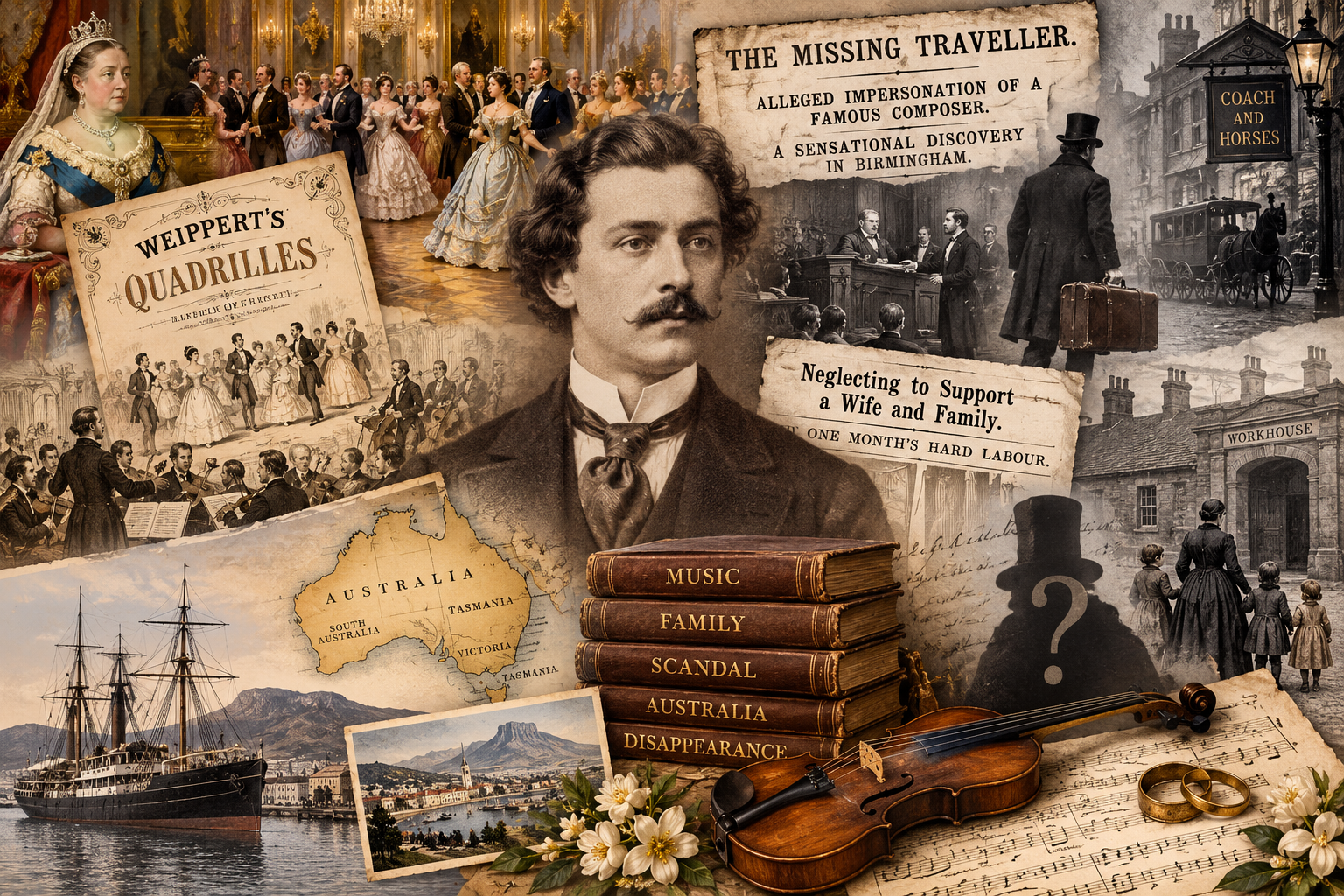
All images generated by ChatGPT