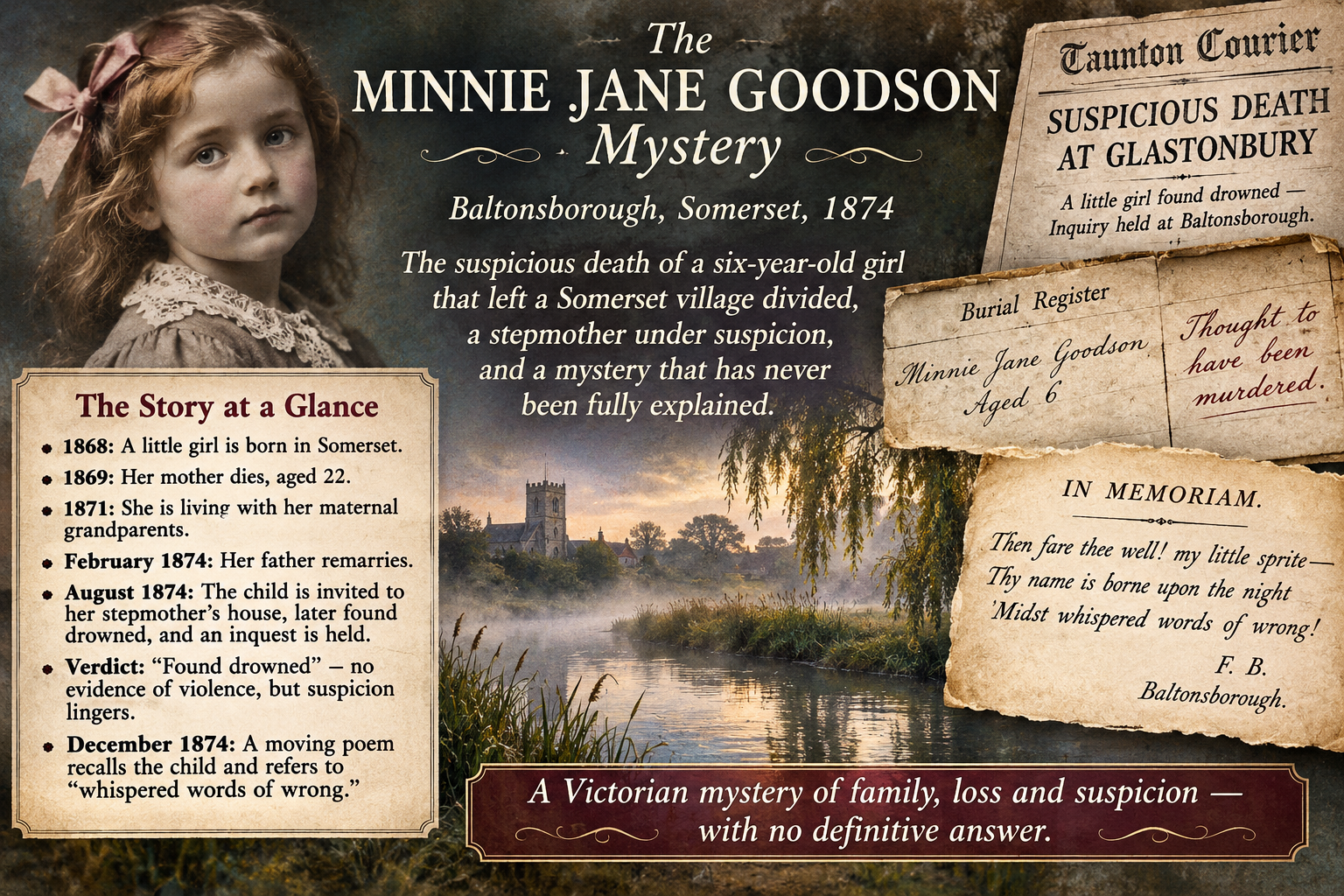
This mystery began with the suspicious drowning of a six-year-old girl but developed into an investigation of a Victorian family, a bereaved child’s upbringing, a stepmother under suspicion, an inconclusive coroner’s verdict, and a haunting poem that kept whispers of wrongdoing alive long after her burial.
THE NEWSPAPER ARTICLE
Taunton Courier, 2 September 1874
|
SUSPICIOUS DEATH AT GLASTONBURY. The death, under suspicious circumstances, of a child named Minnie Goodson, who has been residing with her grandmother, named Kingston, has occurred at Glastonbury. Her father had married a second wife, and she had the child over to their house occasionally. On Thursday last Mr. Goodson decided to go to the Wincanton races, and this wife appears to have been desirous of going also, but her husband objected to it, and this annoyed her. After Mr. Goodson had left, his wife called upon the grandmother and asked her to send over the child Minnie to tea with her, it being lonely without her husband. Later in the afternoon Mrs. Goodson came to her house and told the servant to go out and fetch the child, who she said, had run away from her as they were crossing the field. The servant girl went accordingly, but was unable to find the child, and amid much excitement the villagers were soon making search in every direction but without effect, until Friday morning, when the poor little child was found dead in a pond near the field in question with a mark on the forehead as from a blow. The painful case is now in the hands of the police. |
THE FACTS
 Minnie Jane Goodson was born in Somerset in the third quarter of 1868, the daughter of Thomas Goodson and Jane Kingston.
Her parents had married at Baltonsborough on 15 September 1867. Sadly, their marriage was to be short-lived. Jane was buried at Ditcheat on 18 September 1869, aged just 22. Minnie would have been about eleven months old when her mother died.
The 1871 census provides an important glimpse into what happened next. Minnie, then aged two, was living with her maternal grandparents, William and Jane Kingston, at Hornblotton.
Her father, meanwhile, was living separately at Baltonsborough. He was recorded as a farmer with 40 acres, employing a female servant, Fanny Parsons.
It seems that Minnie’s maternal grandparents had taken on the responsibility of bringing her up. This arrangement is worth considering in its historical context.
The death of a mother in Victorian Britain could leave a young child in a particularly vulnerable position. There was no modern system of social support, and the care of children depended heavily upon family networks. Grandparents, aunts and other relatives frequently stepped in when parents died or were unable to provide care. For Minnie, her maternal grandparents appear to have become her principal family home.
We should not assume that her father had abandoned her. He may have considered her grandparents the best people to care for his young daughter, particularly while he continued to manage his farm. Nevertheless, the arrangement meant that Minnie was growing up in one household while her father maintained another. It was a family arrangement which would become significant when Thomas married again.
 On 19 February 1874 Thomas Goodson, now aged 36, married Louisa Evans, aged 34, at Long Sutton, Somerset. The marriage certificate describes Thomas as a widower and a yeoman, residing at Baltonsborough. His father was named as Champney Goodson. Louisa was a spinster, residing at Long Sutton, and the daughter of the late Richard Evans, a yeoman.
The newspaper announcement gives us a rather more colourful account of the wedding. The marriage was described as the occasion of considerable gaiety in Long Sutton. Her brother-in-law acted as best man, while several young women served as bridesmaids. There were decorated church entrances, peals of bells, a sumptuous wedding breakfast at Bineham House and a honeymoon departure amid the cheers of the assembled villagers. It sounds a very respectable and prosperous occasion.
 Thomas was a widower with a young daughter. Louisa was an unmarried woman in her mid-thirties. Their marriage would have brought together two people with different family circumstances.
For a widower with a young child, remarriage could be a practical decision as well as a personal one. A new wife might provide companionship and help establish a settled household. In a society where domestic responsibilities were generally assigned to women, a stepmother could be expected to take on a substantial role in the upbringing of her husband’s children. For a widow, remarriage could likewise provide financial security and a recognised place within a household. Although Louisa was not a widow, the wider Victorian emphasis on marriage and domestic respectability is relevant. It would, however, be misleading to suggest that every widow or widower had to remarry to remain respectable. Many did not. But marriage was an important social and economic institution, and a settled household was widely regarded as desirable.
What we do know is that Thomas and Louisa married, but Minnie continued to live with her grandparents. We cannot tell whether this was a temporary arrangement or whether everyone understood that her grandparents would continue to bring her up.
The inquest
A report of the inquest into Minnie’s death stated that it was held at Baltonsborough by Dr Wybrants, the district coroner. Several witnesses were examined, including the servant who had been involved in the events of the previous day. One particularly interesting passage stated that the servant’s evidence had exonerated Minnie’s stepmother from the suspicion which had previously surrounded the case.
The medical evidence was also important. Although the first newspaper report had mentioned a mark on the child’s forehead, the medical examination found no marks of violence on the body. There were a few scratches, but these might have been sustained when Minnie fell into the water.
There was no evidence to establish how she had entered the water. The jury returned an open verdict of: “Found drowned.” This was not a finding that Minnie had been murdered. Nor did it establish that she had drowned accidentally. It simply recorded the discovery and cause of death without determining how she came to be in the water. The evidence was insufficient to reconstruct the final moments of her life.
So what might have happened? There are several possibilities.
Minnie may have fallen into the water accidentally. She was only six years old, and a child of that age could easily have got into difficulty. Alternatively, she may have been struck or pushed into the water. If that had happened, the medical evidence might not necessarily have revealed it, particularly if there were no obvious injuries. But there is no proof of either scenario.
The inquest did not establish that Louisa had harmed Minnie, and the servant’s evidence was reported as clearing her of the suspicion surrounding the case. It is important that we do not turn suspicion into a conclusion.
Minnie’s burial
Minnie was buried at Ditcheat on 3 September 1874. The burial entry is particularly interesting because of the additional handwritten note in the margin, which appears to read: “Found in the river at Boltonsboro’. Thought to have been murdered.”
It is a remarkable addition. The vicar was recording something which went beyond the simple details of the burial. It does not tell us whether he personally suspected murder, whether he was recording local opinion, or whether he was repeating something he had heard. Nor does it establish that he possessed any evidence which was not presented at the inquest.
Nevertheless, it suggests that the official verdict did not necessarily put an end to the questions surrounding Minnie’s death.
There is a parallel here with my earlier investigation into the death of Elizabeth Stanton. In that case, too, a clergyman’s comments suggested that the official conclusion might not have represented the whole story as understood by those closer to the events. Such observations are not proof, but they are valuable historical clues.
Perhaps the most poignant discovery in this investigation is a poem published in the Central Somerset Gazette on 12 December 1874.
In Memoriam: Minnie Jane Goodson
The willow spreads its weeping shade,
O’er some memorial, newly made—
Some dear, beloved spot:
The silent tear is often shed.
It falls on some respected dead—
To prove they’re not forgot.
Dear child! a stranger weaves for thee
A wreath—to lovely infancy—
So humble, yet sincere:
He strikes the lyre of virtue fair,
For thee; beloved by some, laid there
Upon thy little bier.
And may he tune the lyric lute?
Although thy gentle ear be mute—
To listen to its notes:
Perchance, the wintry leaves, among
Will listen to a stranger’s song:
Where sweetest music floats,
The hand that pens this simple lay,
Oft tends the path where thou didst play—
Beside the river Brue
And thinks how oft thy timid feet
Have wandered to their lov’d retreat
The spot so sought by you!
Then fare thee well! my little sprite—
Thy name is borne upon the night
‘Midst whispered words of wrong!
From worldly cares thou’rt ever freed!
Thy infant lips can never read,
These simple lines of song.
F. B.
Baltonsborough.
It is difficult to read this poem without feeling that the writer was troubled by Minnie’s death. The author describes themselves as a stranger, but also says that they often tended the path where Minnie had played beside the River Brue. That is an intriguing distinction. F. B. may not have been a close family member, but clearly knew the locality and was familiar with the places where the child had played.
The poem was published more than three months after Minnie’s death. By then the inquest had taken place and the jury had returned its verdict. Yet the writer refers to whispered words of wrongdoing which continued to surround her name. Was F. B. referring to gossip about Louisa? Was the writer expressing a more general sense of unease? Or was this simply a poetic way of acknowledging the rumours which had circulated after the tragedy? We cannot know.
The poem is not an accusation, and it does not name anyone. But it preserves something which the official record does not: the sense that Minnie’s death continued to trouble people in the neighbourhood.
The identity of F. B. remains unknown. The poem’s reference to the writer as “He” suggests a male author, although it is not conclusive. Whatever the identity, this anonymous writer has left us one of the most memorable documents in the case.
What became of Thomas and Louisa?
Although our investigation is centred on Minnie, the later lives of her father and stepmother provide a little additional context.
In the 1881 census, Thomas and Louisa were living together at Hill Town, Baltonsborough. Thomas was 42 and described as a retired farmer. Louisa was 40. There were no children in the household.
However, by 1891, Louisa was living alone at Othery. She was recorded as married, aged 47, and working as a teacher of music. In 1901, she was at Curry Rivel, now described as a widow, and still earning her living as a music teacher.
We have not been able to establish exactly what happened to Thomas.
An Australian death registration for a Thomas Goodson at Granville, New South Wales, in 1903 gives his father as Champney and his mother as Elizabeth. The father’s name matches the 1874 marriage certificate, which names Champney Goodson as Thomas’s father. This is a promising identification, although it is not conclusive. There is also a chronological difficulty: Louisa was already describing herself as a widow in 1901.
It is possible that Minnie’s father eventually emigrated to Australia, perhaps joining relatives there, leaving Louisa to establish an independent life in Somerset. But the records we have do not allow us to state that as fact. What we can say is that Louisa appears to have made a living for herself as a music teacher. By 1891 she was living independently, and she continued in that occupation into the following decade.
The grand wedding of 1874 and the circumstances of her later life make an interesting contrast. But we should resist the temptation to use her subsequent circumstances as evidence of her character or of what happened to Minnie. Her later life remains a separate, unresolved part of the story.
CONCLUSION
There are cases in which the evidence leads us steadily towards a conclusion. There are others in which every document seems to offer a fresh question, and the more one discovers, the less certain one becomes. The death of Minnie Jane Goodson is one such case.
A child of six, deprived of her mother before she had reached her first birthday, was brought up by her maternal grandparents while her father established a separate household. When he married again, Minnie was occasionally invited to spend time with his new wife. On one such occasion, she went out with her stepmother and did not return.
The coroner’s jury could establish that Minnie had drowned, but not how she had entered the water. The medical evidence did not demonstrate violence, and the servant’s testimony was said to have cleared Louisa of suspicion. Yet the vicar’s marginal note, if correctly read, leaves us with a disturbing possibility. And the anonymous poet, writing in December, spoke of whispers of wrongdoing which had not entirely disappeared.
I cannot say that Louisa Goodson was responsible for Minnie’s death. It would be unjust to accuse a woman when the evidence does not support such a conclusion. But neither can I claim that the circumstances have been satisfactorily explained. Perhaps Minnie fell into the water. Perhaps something happened which no witness saw and which the medical examination could not reveal. We shall probably never know.
I find myself returning to the words of F. B., written in the months following the child’s death. Whoever the author was, they remembered Minnie playing beside the River Brue, and they felt moved to write a little memorial to her. It is those final words which remain with me:
Thy name is borne upon the night
‘Midst whispered words of wrong!
There is something deeply melancholy about them.
The jury had delivered its verdict. The child had been buried. Life in the Somerset villages would have continued, the harvest gathered, the bells rung, and the winter drawn in. But somewhere, beside the River Brue, people still remembered a little girl whose death had left them uneasy.
And perhaps that is all we can responsibly take from this investigation: not a solved murder, nor an established accident, but the story of a small child whose final afternoon remains hidden from us.
THE SUMMARY IMAGE
All images generated byChat GPT