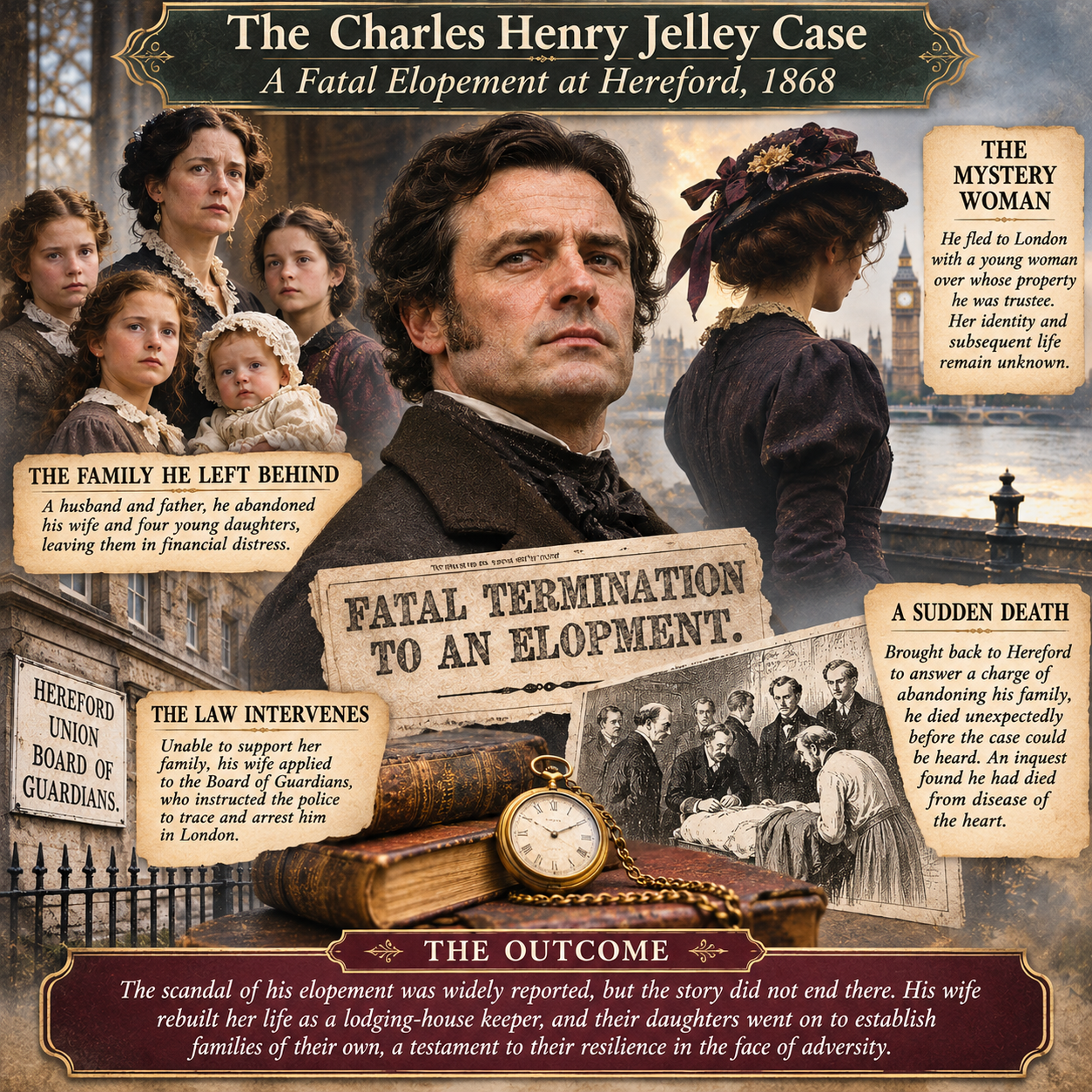
This mystery began with a newspaper account of a scandalous elopement and a sudden death, but became a wider investigation into a Victorian businessman, an abandoned wife and family, financial ruin, an unidentified young woman, and the resilience of those left behind.
THE NEWSPAPER ARTICLE
Birmingham Journal, 10 October 1868
|
FATAL TERMINATION TO AN ELOPEMENT. – Some weeks since a gentleman named Jelley, largely engaged in the coal trade of South Wales, and residing with his family in the city of Hereford, suddenly left home with, it is said, a young lady, over whose property he had been appointed as trustee. In the meantime, his creditors began to be alarmed, and his whereabouts having been ascertained, he was induced to make an assignment of his effects. His wife, having become estranged from him, and as all creditors had taken all the trade effects, she became dependant upon her own resources, and the assistance of her relations for support. Influenced by advisors, she applied to the Hereford Board of Guardians for support, and the consequence was that they directed the Superintendent of the Hereford City Police to endeavour to effect the apprehension of Jelley, who was said to be living incognito in some part of London, with the lady with whom he had eloped. On Thursday last the officer succeeded in tracing out the fugitives, and on being ushered into a drawing room was soon joined by Jelley, who, of course, was astonished to find who his guest was., and was equally astonished to learn his business. When the Superintendent also told him he must consider himself in custody, he desired to be allowed to go upstairs for two minutes to put on another dress, but this was refused. On his way to Hereford, Jelley said to the superintendent, “If you had only given me half-a-minute, when I asked, you would have had to take me home a corpse.” On Saturday morning the prisoner was taken before the Mayor of Hereford, and remanded to Monday, to answer a charge of having left his wife chargeable to the Hereford Union. About eleven o’clock on Saturday night he was suddenly and mysteriously taken ill, and before a medical man could arrive he was dead. His death has produced a painful sensation throughout the city. Deceased had early £100 in his pocket when apprehended. An inquest has resulted in a verdict that deceased died of diseased heart. |
THE FACTS
The newspaper account offered a dramatic conclusion to an already scandalous affair. Yet a closer examination of the surviving records reveals a much longer story: the life of a businessman whose fortunes changed considerably, the difficulties faced by the wife he abandoned, and the subsequent lives of the daughters who grew up without him.One question remains unanswered: who was the young woman who accompanied him?
 Charles Henry Jelley was born on 1 June 1817 at Alwalton, Huntingdonshire, and baptised there on 30 June. He was the son of Valentine Jelley and his wife Ann, formerly Ann Lowe, who had married at St Michael’s Church, Stamford, on 3 June 1805. The couple had several older daughters before Charles’s birth: Ann, born in 1806; Elizabeth, in 1808; and Emma, in 1813.
Charles’s own occupations suggest a man whose working life underwent several changes.His first marriage certificate, in 1845, describes him as a farmer. By the time of his second marriage in 1855, he was a machinist. In 1863, a Hereford directory lists him as manager to the Hereford Coal Company, at 28 Eign Street. By 1868, he appears in the directory under lime merchants, with an address at 4 Commercial Road.
The newspaper described him as being largely engaged in the coal trade of South Wales. The precise nature and ownership of his various business interests remain uncertain.
On 17 August 1845 Charles married Elizabeth Ann Channings at St George’s Church, Hanover Square, London. Charles was described as a farmer and a bachelor. Elizabeth was the daughter of Daniel Channings, also a farmer. Their daughter, Elizabeth Lowe Jelley, was born in the final quarter of 1846 in the Oundle registration district.
Tragically, Elizabeth Ann Jelley died in May 1847, aged just 26, and was buried at Elton, Huntingdonshire. Charles was therefore left a widower with a very young daughter.
 On 15 July 1855 Charles married Sarah Dawes at St James’s Church, Shoreditch, London. Charles was described as a widower, residing at 16 Paul Street. Sarah was a spinster, living at the same address.
The couple subsequently established their family in Hereford, and they had four daughters: Annie, Mary Jane Augusta, Rosa, and Gertrude Amelia,
It is worth noting that Gertrude’s recorded birth falls after Charles’s death in October 1868. This means that Sarah was likely pregnant when the events of the elopement unfolded.
Charles Henry Jelley died in Hereford on 3 October 1868, aged 51. The newspaper reported that he became suddenly and mysteriously ill at approximately eleven o’clock on Saturday night. A medical practitioner was summoned, but he died before the doctor could arrive. The death registration records disease of the heart as the cause of death.
An inquest was held on 9 October, and the verdict was that he had died from diseased heart. A further newspaper account of the post-mortem examination reported that the surgeons had found his heart to be extraordinarily enlarged, weighing nearly 32 ounces. (compared to a normal heart of about 8-9 ounces). They reportedly described it as the largest human heart they had ever examined. Although this observation may help explain the suddenness of his death, we cannot establish a more precise medical diagnosis from the surviving description.
The original newspaper also remarked that Jelley had nearly £100 in his possession when apprehended. This is an interesting detail, given the financial distress that had brought his wife before the Board of Guardians. It is not clear how this money related to his wider financial affairs or whether any of it was available to support his family.
Perhaps the most rewarding part of the investigation has been following the Jelley family after Charles’s death. The contemporary newspaper account presents Sarah as a deserted wife who had been left in difficult financial circumstances. The later census records show a woman who nevertheless managed to establish an independent means of support.
In the 1881 census Sarah was living at 3 Park Street, Hereford, and was described as a lodging-house keeper. By 1891, she was still in Hereford and described her occupation as letting apartments. She had evidently found a way to support herself through the provision of accommodation.
Her daughters also went on to establish their own lives.
- Annie remained part of the family household in the later census records.
- Mary Jane Augusta was found at a school in Leominster in 1871. We subsequently traced her into adulthood and established her marriage to William Stone.
- Rosa appears in the 1881 and 1891 census returns with her mother.
- Gertrude Amelia also remained with the family in the later census records. She married Arthur James Densham in 1901 and had three children by the time of the 1911 census.
So, the family had continued; the scandal of 1868 had not prevented the daughters from establishing households and raising families of their own.
 Despite the considerable progress made in reconstructing Charles’s life, the identity of the young woman who accompanied him to London remains unknown. The newspaper described her as a young lady whose property Jelley had been appointed trustee to administer. Another contemporary account referred to her as his ward.
We have been unable to establish whether she was legally a minor, an adult beneficiary whose property was held in trust, or whether the newspaper was using the word ward in a less precise sense. No name has been discovered in the newspaper reports examined, and searches of the Hereford press and local archival material have produced no further identification.
It is tempting to wonder whether her anonymity was deliberate. Perhaps the newspaper, or the family concerned, wished to protect the reputation of a respectable young woman and avoid exposing private family or financial arrangements. This remains conjecture.
We have no evidence to establish her age, her circumstances, her motives or her subsequent life. Nor do we have evidence that she was responsible for the situation in which Charles and his family found themselves. Her identity must therefore remain an open question.
There are several aspects of this case that offer a glimpse into the social expectations and institutions of Victorian England.
Marriage and respectability: Marriage was regarded as a fundamental social institution, and the abandonment of a wife and children could carry serious social consequences. A married man’s departure with another woman was likely to be regarded as a serious breach of both marital duty and public respectability. The newspaper’s description of Sarah as estranged from her husband, and without correspondence from him, emphasised the extent to which she had been abandoned.
The responsibility of a husband and father: Victorian society generally expected a husband to provide financially for his wife and children. A wife whose husband failed to support her could find herself in a particularly vulnerable position. Sarah’s application to the Board of Guardians demonstrates how a private family breakdown could become a matter for the local Poor Law authorities. It also illustrates the difficult position of a woman who had no independent means of support.
The Poor Law and the stigma of dependency: The Hereford Board of Guardians became involved because Sarah and her children were at risk of becoming chargeable to the Union. The Poor Law system was intended to provide relief to those unable to support themselves, but applying for assistance could carry considerable social stigma. Sarah’s subsequent ability to support herself through keeping lodgings and letting apartments is therefore significant.
Women and economic independence: Sarah’s later occupations illustrate how women could earn their own living through domestic and commercial activities. Although Victorian society continued to place considerable emphasis on women’s domestic responsibilities, widows and deserted wives frequently had to find ways of supporting themselves. Sarah’s experience is a useful reminder that women were not always passive recipients of family circumstances. She appears to have adapted and made a living for herself.
Trusts, property and guardianship The mysterious young woman introduces another aspect of Victorian social life. Women could inherit property, but depending on their age, marital status and the arrangements under which the property was held, they might not have been able to manage it independently. The appointment of a male trustee or guardian was not unusual. The fact that Charles held such a position makes his relationship with the young woman particularly important, although we cannot establish the precise legal arrangement. It also raises the possibility that the scandal involved not only marital misconduct but private financial and family affairs.
CONCLUSION
The story of Charles Henry Jelley initially appeared to be one of Victorian scandal: a businessman who abandoned his wife and children, eloped with a young woman, was traced by the police and died suddenly before he could answer the charge against him. But the records have allowed us to look beyond the sensational newspaper account. We have reconstructed much of Charles’s earlier life, identified his two marriages, followed his changing occupations and established the circumstances of his death. More importantly, we have followed the family he left behind.
Sarah appears to have rebuilt her life and supported herself. Her daughters grew up, married and established families of their own. We cannot know how much pain or embarrassment the events of 1868 caused them, or how often Charles’s name was mentioned in the family home. But the subsequent records suggest that his actions did not determine the course of their lives. The newspapers remembered the scandal. The census returns record the lives that continued afterwards.
The young woman who accompanied Charles remains unidentified. We may never discover her name, and we should not presume to judge her without knowing her circumstances. There is a distinction between what we can establish and what we might imagine. As investigators, we must respect that distinction.
Perhaps the most appropriate conclusion is that the Jelley family survived a difficult episode in its history and went on to make lives of its own.
THE SUMMARY IMAGE