This mystery began with a newspaper account of a young servant accused of stealing from her employer, but developed into an investigation of an alleged assault, a clergyman’s reputation, the contrasting reactions of the public, and the subsequent lives of the two people at its centre.
THE NEWSPAPER ARTICLE
Newcastle Weekly Chronicle, 4 January 1868
| EXTRAORDINARY CHARGES AGAINST A CLERGYMAN AND HIS WIFE – The Shropshire court of quarter sessions was engaged till midnight on Wednesday in the investigation of an extraordinary charge of felony preferred against a servant by her master. The prisoner was a respectably-dressed girl named Rose Charles, and the prosecutor was the Rev. Richard Jones, curate of Llaybodwel, near Oswestry. The indictment charged the prisoner with stealing a silk dress and a large quantity of other articles, the property of her employer; and the defence set up was that the articles alleged to have been stolen had been designedly placed in the prisoner’s box by the prosecutor and his wife, that the charge was trumped up against the girl to cover an indecent assault committed upon her by the Rev. Richard Jones. The trunk was, according to the evidence of the prosecutrix herself, without ock or othre fastening, and stood in a place accessible to everyone in the house. Mrs. Jones took out of the box as much of her property, as she could carry away on a tray, still leaving in the trunk a considerable number of articles. On the Saturday following the prisoner sent for the trunk, which was delivered to her, and taken to her father’s house, and a policeman being sent thither a few hours later, found in the box the articles in the indictment. The story told by the prisoner placed the matter in quite a different light. She stated that at noon on the Wednesday she left her master’s service, she and himself being the only persons in the house; he entered the bedroom which she was cleaning out, and throwing her on the bed, attempted to take indecent liberties with her. She resisted, and as soon as she could get away from him, she ran out of the house and went home. On the following Saturday she sent for her box; and till the policeman searched it and found the articles alleged to have been stolen, she had not the slightest knowledge of their presence there. After a brief deliberation, the jury return a verdict of acquittal, which was received with great applause by the crowd that had filled the court during the day. On the prisoner reaching the street she was greeted with loud and repeated cheers, and was escorted to her lodgings by an enthusiastic crowd. |
THE FACTS
The newspaper account immediately raised questions. Was Rose a dishonest servant, as her employers alleged, or had she been placed in an impossible position after an incident in the household? And why had a clergyman and his wife found themselves prosecuting a young servant who was also accusing him of misconduct?
The surviving reports do not allow us to establish precisely what happened, but they provide a fascinating glimpse into the circumstances of the case.
The incident in November 1867
The most detailed accounts of the proceedings appeared in the Wrexham Advertiser of 16 November 1867 and the Birmingham Daily Post of 3 January 1868.
Rose had been employed in the Jones household for approximately five weeks. The incident which led to her departure took place on Wednesday 6 November 1867. Mrs Jones was away from home, and Rose was working in the Reverend’s bedroom. Jones admitted that he had entered the room while Rose was making the bed and that he had helped her move a chest of drawers. He said he had been there for about a minute. He denied touching Rose or behaving improperly. Rose’s account was different. She alleged that her employer had offended her, and she subsequently left the household.
The following day, Reverend Jones visited Rose at the home of her brother-in-law, Walter Davies, apparently to discuss her departure and wages.
The subsequent theft allegations involved a considerable collection of household and personal articles, including a silk dress, gloves and ribbons, lace and embroidery materials, a hairbrush and toothbrush, and a small bottle of otto of roses. A £5 note and a cheque for £9 11s 9d were also mentioned, although these were not found in Rose’s trunk.
One particularly important detail emerged during the evidence: Rose’s trunk had no lock or fastening and was accessible to other members of the household. Mrs Jones acknowledged that she had examined it and had handled or removed its contents. This did not, by itself, establish that the articles had been planted, but it meant that the circumstances surrounding their discovery were open to question.
At the preliminary proceedings in November 1867, Colonel Lovett, the magistrate, commented that there was not a tittle of evidence against Reverend Jones and that his character remained unstained. Rose was committed for trial, although bail was accepted.
At the trial, the prosecution relied upon the alleged thefts and the evidence of members of the household. Rose maintained her innocence and her allegation against her former employer. The evidence also established that Rose had respectable connections and that she had people prepared to speak in support of her character. The jury acquitted her.
The reaction outside the court is especially interesting. The verdict was greeted with considerable applause, and Rose was escorted back to her lodgings by an enthusiastic crowd. This is an important part of the story. It suggests that at least some members of the public were sympathetic to Rose, or were unconvinced by the prosecution’s case. We cannot know exactly what motivated the crowd, but their reaction is difficult to reconcile with any suggestion that everyone automatically accepted the Reverend’s version of events.
The Reverend’s supporters
The story did not end with Rose’s acquittal. A further report, published in the Birmingham Daily Post on 13 January 1868, reproduced an announcement concerning a meeting held in the schoolroom at Llanyblodwel on 8 January 1868. The meeting was attended by a large number of parishioners who wished to express their sympathy and support for Reverend Richard Jones.
The chair was John Bamer, Esq., of Glanrhyd Hall, Rhiwlas. Resolutions supporting Jones were passed, and a collection raised £37 6s 6d, with a further £17 subsequently subscribed.
A correspondent signing himself “R. B. C.” argued that those who knew Jones’s character, or who had carefully read the judge’s address to the jury, would recognise that the reflection cast upon him by the verdict was unjust.
Nevertheless, the meeting is significant. It demonstrates that Jones had supporters willing to defend him publicly and financially.
So we now have two contrasting reactions to the case: In court, a crowd applauded Rose’s acquittal and escorted her away In Llanyblodwel, parishioners gathered to express support for the Reverend and raise money for him. Both Rose and Jones had their supporters. The two reactions reveal something of the divisions and differing loyalties within the local community, but neither tells us what actually happened in the bedroom.
Rose Charles
 Rose Charles was baptised on 23 June 1850 at Llansilin, Denbighshire, the daughter of Robert and Mary Charles, of Pentrecwn. Her father was described as a labourer.
In the 1851 census the family was living at Pentrecwn, in the Oswestry area: Robert Charles, aged 40, was a labourer, his wife, Mary, was aged 36, and there were 4 daughters, Jane, Mary, Ann and Rose By 1861 there was another daughter, Eleanor.
So, at the time of the events of November 1867, Rose was seventeen years old.
Perhaps the most satisfying part of this investigation has been discovering that Rose’s life did not end with the newspaper reports of her trial. The 1871 census places her in Oswestry, where she was working as a nurse in the household of Richard and Jane Richards. This suggests that she remained in the area and was able to find employment after the case.
On 5 June 1876 Rose Charles married William Hanby Bowser at Birkenhead Parish Church, Cheshire.. The couple established a family and were recorded in Cheshire in later census returns. By 1911, William and Rose were still together, and reported that they had had four children
Rose died in December 1921 in the Nantwich district, aged 71. William survived her, dying in March 1925.
So, the young servant who had stood trial in 1868 had gone on to marry, raise a family and live a life that extended more than fifty years beyond the events which had first brought her to public attention
Reverend Richard Jones
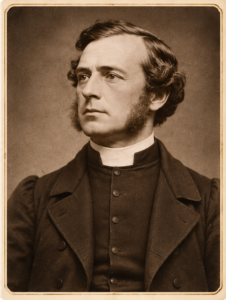 Richard Jones was born in Corwen, Merionethshire in 1831, the son of Richard and Sarah Jones. His father was a farmer. The 1851 census records Richard Jones, aged 20, unmarried, living with his parents in the Corwen area.
A marriage certificate dated 2 September 1865 at Llangollen records the marriage of Richard Jones, aged 32, bachelor, to Ellen Evans, aged 31, the daughter of Robert Evans, a draper.
By the time of the 1871 census – 3 years after the trial – Richard Jones, aged 36, was still the curate of Llanyblodwel and living at Blodwell Cottage with his wife Ellen Emily Jones, aged 37, and their son, Arthur Trevor Richardson Jones, who was aged 2.. (Arthur later attended Oswestry Grammar School and matriculated at Oxford in October 1888. His university record confirms his birthplace as Llanyblodwel and identifies his father as Richard Jones, clergyman. He went on to become a surgeon)
So despite the controversy, Richard Jones appears to have continued his clerical caree, and in fact in 1881 he was recorded as rector of Rhydycroesau, and remained there in 1891.
Ellen died in 1893 and Richard died in March 1901.
Victorian social history
The case is interesting not simply because of the allegations, but because of the social circumstances in which they arose.
Rose was a young domestic servant, dependent upon her employment and the references she might receive from her employers. Reverend Jones was a clergyman, a married man and a person of standing in his community. Their positions were very unequal.
A servant’s reputation could be damaged by an accusation of theft, and a young woman who challenged her employer’s conduct might risk losing both her position and her future prospects. A clergyman, meanwhile, was expected to embody moral conduct. His standing within the parish was not merely professional; it was bound up with the trust placed in him by the community.
This does not mean that every Victorian automatically believed a clergyman rather than a servant. The applause for Rose’s acquittal demonstrates that public opinion could be more complicated. Nor does the parish meeting necessarily mean that everyone who supported Jones believed Rose had lied. Some may have been defending his character, others his position in the parish, and others may simply have considered the trial’s outcome unjust.
What we can see is how important reputation and social standing were, and how differently the same incident could be interpreted by different groups of people.
There is also an interesting question about the expectations placed upon men of the clergy. If Jones did behave as Rose alleged, why might he have thought he could do so without serious consequences? Did he believe his position would protect him? Did he assume that a young servant would remain silent? Or did he simply misjudge the situation?
We cannot answer these questions from the surviving records, but they are legitimate questions to ask when considering the relationship between authority and vulnerability in Victorian domestic life.
CONCLUSION
There is one line from the contemporary reporting which seems to sum up the case rather neatly:
“And the Rev. Richard Jones returned to his cure of souls.”
It is a memorable contemporary comment, and one that deserves to be retained. For Rev. Jones, life appears to have continued. He remained a clergyman, advanced in his career and eventually became rector of Rhydycroesau.
Rose, too, continued with her life. She found work, married and raised a family. She did not disappear into the margins of history, although the newspapers had little more to say about her.
Perhaps neither was entirely untouched by the events of November 1867. We cannot know what either remembered, or how they privately understood what had happened.
But I find myself returning to the question of why a young curate might have thought he could behave as Rose alleged. Was it confidence in his own respectability? An assumption that a servant would not dare challenge him? Or something else entirely? We may never know.
What we have recovered, however, is more than a sensational Victorian newspaper story. We have traced two lives, examined the evidence presented in court, discovered the contrasting reactions of their communities and gained an insight into the delicate relationship between class, gender, authority and reputation.
And perhaps that is the real value of this mystery: not that we can solve every question, but that we can see how much more there was to the story than the newspaper headlines first suggested.
THE SUMMARY IMAGE
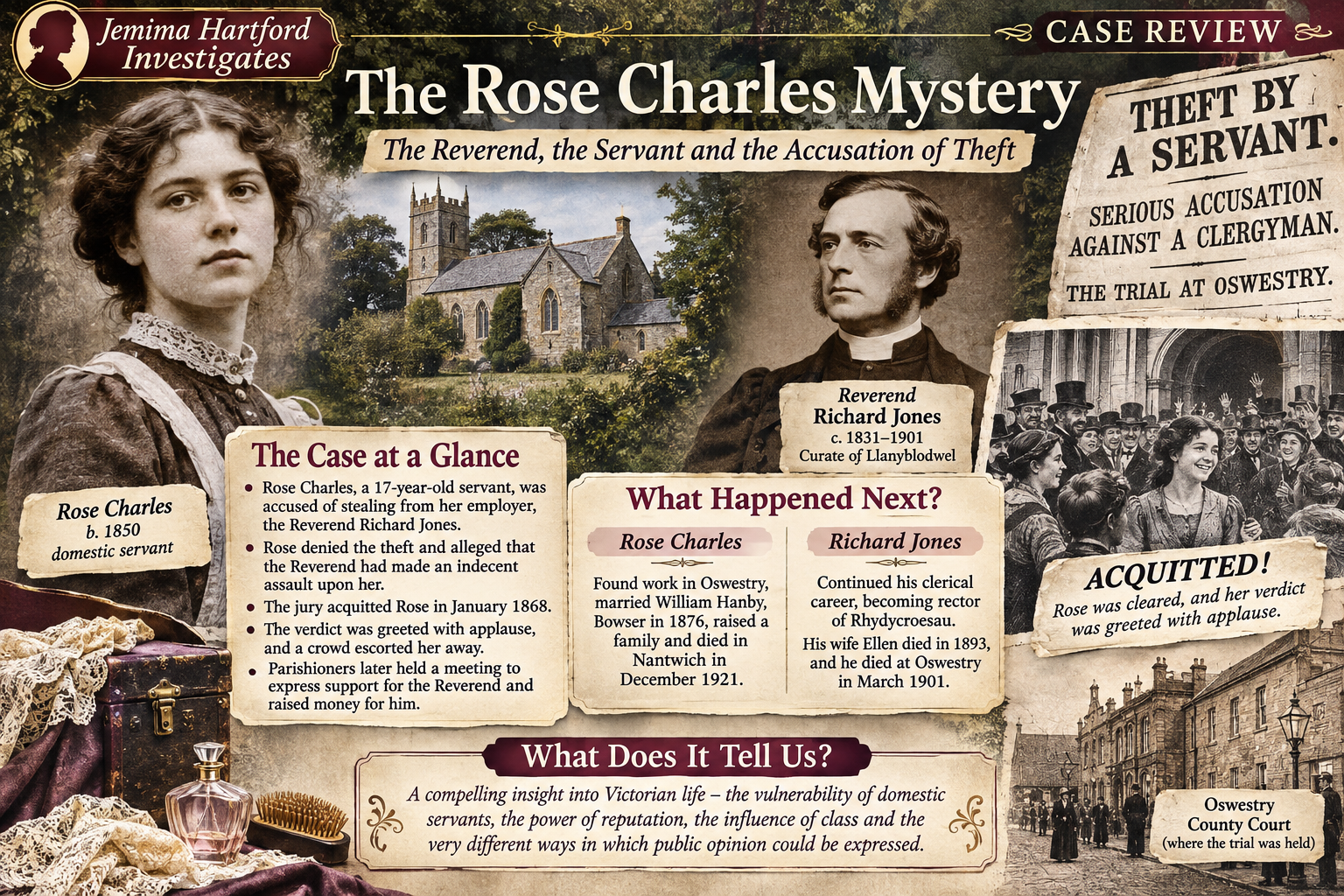
All images generated by ChatGPT