This mystery began with a newspaper account of a suspicious infant death but developed into a wider investigation of a Victorian family, a concealed birth, a grandmother’s prosecution, a fractured marriage, and the unanswered question of whether a baby who lived for just fourteen hours had been deliberately killed.
THE NEWSPAPER ARTICLE
The Heywood Advertiser, 23 January 1880
|
SUSPICIOUS DEATH OF A CHILD. An enquiry has been held at Louth, in Lincolnshire with regard to the suspicious death of an infant, whose body had been left at the cemetery as that of a still-born child when it was subsequently discovered that the child had lived some hours. The body having at the Coroner’s order been disinterred, was examined by several doctors. They found it to be that of a fully developed and apparently healthy child of the average weight. There were, however, marks on the back of the neck, seven ribs were fractured on the right side, and one broken on the left. At the inquest a woman named Fanny Fife was called. She stated that the mother of the child was her daughter, who was a married woman, but had lived apart from her husband for four years. The child was born early in the day; it appeared healthy, took a little food, and lived for 10 to 12 hours. The next morning, before it was light, she took it in a box to the cemetery, and paid 2s for it to be buried as a still-born child. – The medical gentlemen who examined the body then gave evidence, but could not state positively what was the cause of death nor whether the injuries they discovered had been inflicted before or after the death. The coroner said the result of the inquiry was most unsatisfactory, and it was for the police, if they could obtain additional evidence, to take the matter up. – The jury returned a verdict that there was no evidence to show the cause of death of the child. |
THE FACTS
The law and the burial of stillborn children in 1880
To understand why this incident attracted the attention of the authorities, it is necessary to consider the law governing the registration and burial of infants.
At that time, the civil registration of live births had been compulsory since 1837, but there was no corresponding requirement to register a stillbirth. This did not change until 1 July 1927, when the Births and Deaths Registration Act 1926 came into operation. Consequently, a genuinely stillborn child might leave no entry in the civil registration records at all.
However, the absence of compulsory registration did not mean that a stillborn child could simply be buried without any formalities.
The Births and Deaths Registration Act 1874 had introduced specific safeguards under Section 18. It prohibited anyone from deliberately burying, or arranging for the burial of, a child who had been born alive as though it had been stillborn.
It also placed responsibilities on those in charge of burial grounds. Before accepting a stillborn child for burial, they had to receive one of the following:
- A written certificate from a registered medical practitioner who had attended the birth or examined the body, confirming that the child had not been born alive.
- A declaration from an appropriate person confirming that no medical practitioner had been present, or that a medical certificate could not be obtained, and that the child had not been born alive.
- An order from the coroner if an inquest had taken place.
A person who deliberately misrepresented a live-born child as stillborn, or otherwise contravened the provisions, could be fined up to £10.
The distinction was therefore quite clear. A mother or another family member could arrange for a genuinely stillborn baby to be buried without civil registration, but a child who had lived, even briefly, was legally a live birth and should have been registered as such.
Under the 1874 Act, information about a live birth had to be given to the registrar within 42 days. A subsequent death also had to be registered.
In this case, the authorities were not investigating an unusual burial custom. They were investigating the deliberate presentation of a child who had lived as one who had never been born alive.
Subsequently an unnamed male child with the surname Brumpton , was
The grandmother’s prosecution
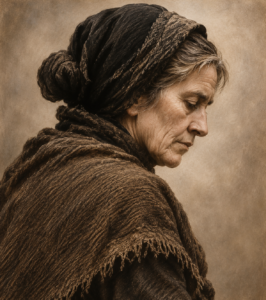 The medical witnesses could not establish whether the injuries had been inflicted before or after death. Nor could they determine the precise cause of death. The findings naturally raised the possibility of violence, but the medical evidence was insufficient to establish that the child had been deliberately killed. The coroner was dissatisfied with the evidence available and suggested that the police should continue their enquiries. The possibility of a murder charge was considered, but the Public Prosecutor concluded that the evidence would not sustain such a prosecution. The inquest therefore failed to establish how the infant had died.
Although murder could not be established, Fanny Fife was subsequently prosecuted at Louth Borough Police Court.
The prosecution was brought at the instigation of the Registrar General, relating to her deliberate misrepresentation of the child as stillborn in order to procure its burial. The newspaper reported that she was fined £5, including costs. This was a considerable sum for a woman of Fanny’s apparent circumstances. She was a widow whose husband had died in 1868 and who was recorded in the 1881 census as working as a laundress. The fine would have represented a substantial financial burden. How she found the money to pay it is unknown.
Unfortunately, no further surviving criminal or court records have so far been located. The contemporary newspaper reports appear to be our principal evidence of the prosecution and its outcome.
Reconstructing the family
Some of the newspaper reports explicitly identify the mother of the child as Ann Brumpton, so this allows us to connect the unnamed woman in the original inquest report with the family we have now reconstructed.
The grandmother was named in the newspapers as Fanny Fife. She was born Frances Appleby in 1821 and had a daughter Ann Appleby in 1855. She then married William Fife in 1861, and their son Richard William Fife was born at the end of that same year. William died in 1868, leaving Frances a widow.
Her daughter, Ann Appleby, married George Brumpton in 1872, and they had three children, Betsy Ann, born in 1873, who died in infancy, George William, born in 1874 and Fanny, born in 1876.
The 1881 census shows Ann Brumpton living with her mother Frances Fife and her young daughter Fanny Brumpton. George Brumpton, meanwhile, appears as a visitor at his parents’ home, where their son George William Brumpton was also staying.
Ann Brumpton subsequently had two more children, John Brumpton, born in 1882. and Eva Jane Brumpton, born in 1888, who died in 1889. Ann died in 1890, so the 1891 census shows her two children Fanny and John living with their grandmother, Fanny, who was actually recorded as Appleby Fife.
Ann’s husband, George, was living elsewhere with another woman as his, wife, Rebecca, and a household containing a number of children. Rebecca had previously been married to George Glover and had children from that relationship. By 1901, George and Rebecca were still living together at Mill Farm, Appleby, Lincolnshire. No marriage between George Brumpton and Rebecca Glover has been located.
So what actually happened to the infant child?
This is where the surviving evidence becomes frustratingly incomplete.
We know that Ann and George had been living apart for approximately four years, according to the newspaper evidence. That would place their separation around 1876. It is tempting to regard this as a clue to the identity of the infant’s father. My own inclination is that the child was unlikely to have been George’s; it is quite possible that Ann had subsequently formed another relationship.
There are also questions about why the birth and death were concealed.
It is possible that the child was unwanted, perhaps because Ann was already experiencing difficult domestic or financial circumstances. Another infant would have represented an additional responsibility for a family that does not appear to have been particularly prosperous.
We might also consider the possibility that the child died as a result of deliberate violence and that Fanny helped her daughter conceal the circumstances. The injuries to the infant, particularly the fractured ribs and marks on the neck, make that possibility difficult to dismiss.
One possible explanation is that the child was suffocated, with Fanny, the grandmother, subsequently attempting to disguise the death as a stillbirth. But the doctors could not establish the cause or timing of the injuries, and there is no direct evidence that either Ann or Fanny caused the child’s death.
Fanny’s possible involvement
When considering Fanny’s actions, I think there are three possible levels of involvement, and it is important to distinguish between them.
The first possibility is that Fanny acted simply as a protective grandmother. The baby had died, and she may have been trying to spare her daughter further distress, embarrassment or expense by arranging a burial and presenting the child as stillborn. If this was the case, her actions may have been motivated by maternal loyalty and a desire to protect Ann, rather than by any knowledge of how the child had died. She may have believed that she was helping her daughter through a desperate and distressing situation.
The second possibility is that Fanny knew, or strongly suspected, that something untoward had happened. She may not have played any part in the baby’s death, but could have been aware that Ann had done something, or that the circumstances surrounding the death were not as they appeared. In that situation, her decision to arrange the burial and make a false statement would have been an attempt to conceal what she knew, rather than simply an act of protection after a natural death. Her involvement would then have been considerably more serious, even if she had not directly caused the child’s death.
The third, and most serious, possibility is that Fanny was actively involved in the baby’s death, either directly or by assisting Ann in some way. There is no evidence establishing this, and it would be wrong to present it as anything more than a possibility. The medical evidence did not establish how the baby died, and Fanny was not prosecuted for murder or for causing the child’s death. Her conviction concerned the false statement made in order to secure the burial.
We cannot know which, if any, of these explanations comes closest to the truth. The evidence establishes that Fanny took responsibility for arranging the burial and falsely represented the baby as stillborn. It does not tell us what she knew about the death itself.
Women, pregnancy and family circumstances in Victorian England
There is another aspect of this case that deserves consideration: the position of women who found themselves pregnant without the support of a husband or an established partner.
For a working-class woman, separation from a husband could create considerable practical difficulties. A woman might have to provide for herself and her existing children, find somewhere to live and continue earning a living, all while coping with pregnancy and childbirth.
A married woman whose husband had deserted her could, in certain circumstances, receive Poor Law assistance on similar terms to a widow. However, such provision was not necessarily generous, and the local guardians could scrutinise a woman’s domestic circumstances and ability to support herself.
The position of an unmarried mother could be even more difficult. Under the Poor Law arrangements of the period, the mother was generally regarded as responsible for maintaining her illegitimate child. Although legislation provided a means of seeking maintenance from the child’s father, establishing paternity and obtaining financial assistance could be difficult.
For working women, pregnancy could threaten their livelihood. A domestic servant, for example, might lose both her employment and her accommodation if her pregnancy became known. Other women worked as laundresses, charwomen or in various forms of casual employment, often without the security of regular wages.
There were, however, different ways in which women managed these circumstances.
Some kept their children and brought them up with the assistance of their mothers or other relatives. Grandmothers frequently played an important practical role in childcare, particularly where a daughter needed to continue working.
Others relied on neighbours, friends or charitable organisations. Poorer women might seek assistance from the parish, enter a workhouse for their confinement, or arrange for their babies to be cared for elsewhere. Some returned to employment and left their children with relatives or other carers.
There was no single Victorian experience of pregnancy outside a secure marriage. Much depended on a woman’s financial circumstances, family relationships, occupation and the availability of support.
Nor should we assume that a child born outside marriage was necessarily rejected by the family. Many women received considerable assistance from their mothers and other relatives.
This is perhaps worth remembering when considering Fanny Fife’s involvement in her daughter’s circumstances. Her actions might have been an attempt to protect Ann or simply an expression of a mother’s determination to help her daughter through a difficult situation.
CONCLUSION
The Louth Infant Death Mystery began with a newspaper account of a suspicious infant death and an unusual cemetery burial. It developed into a much wider investigation of a Victorian family, uncovering the identities and circumstances of the grandmother, the mother and the children who formed part of their lives.
It is tempting to construct a complete explanation from the fragments that survive. There are certainly possibilities that might make sense of the concealment, the family separation and the injuries discovered on the infant. But we must distinguish between what the records tell us and what we can only imagine.
Perhaps the most disturbing aspect of this case is that a baby lived for only a few hours, suffered injuries whose origin remains unknown, and was subsequently buried under circumstances that concealed the fact of its birth.
We have recovered some of the family’s story, but the central mystery remains unresolved. We may never know what happened to the little boy in Louth in January 1880.
THE SUMMARY IMAGE
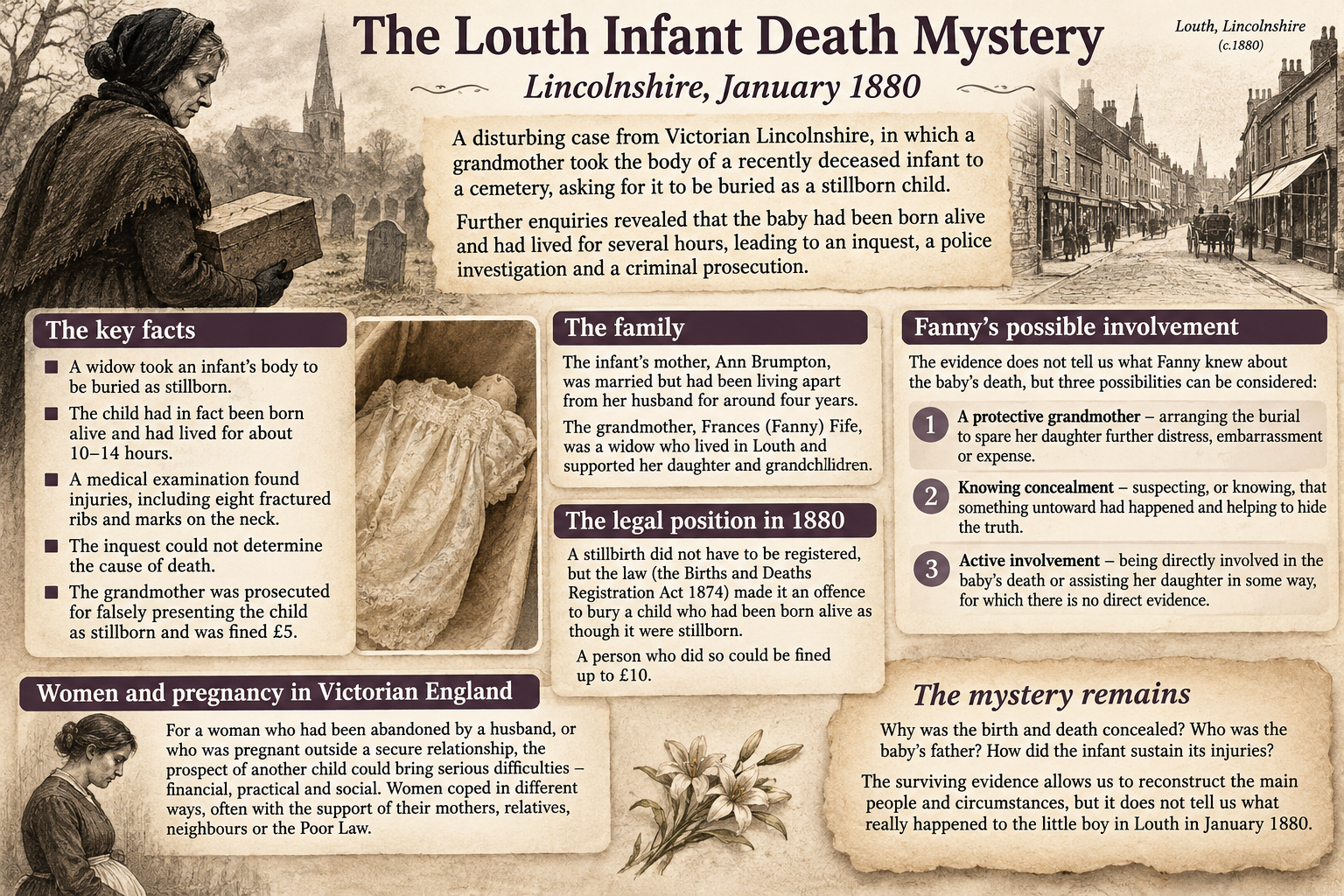
All images created by ChatGPT