This mystery began with a newspaper account of a suspected poisoning but became a far-reaching investigation into a Victorian family, a troubled marriage, a possible suicide, an elusive young woman, a mysterious male companion, and the hidden private lives that remained tantalisingly beyond the reach of the police.
THE NEWSPAPER ARTICLE
Birmingham Evening Mail, 17 August 1876
|
REMARKABLE POISONING CASE At Southwark,, yesterday, Fanny Smith (25) was charged on suspicion with causing the death of Edward Holmes, 40, by poison. George Coucher, inspector of the M Division, said that about ten o’clock on Tuesday morning he was called to the Waterloo Coffee-house, 11, St George’s Circus, and in a bedroom on the second floor he found a man lying dead. He called in Dr. Donahoo, but the deceased had been dead four or five hours. Witness found a tumbler half filled with a liquid near the body, and on examining the deceased’s pockets an open packet containing a white substance, which he had since ascertained to be cyanide of potassium. The deceased was Edward Holmes, a hairdresser, of 2, Jewin Street, E.C., and 124, Adrian Terrace, West Brompton. He went to the coffee-house with a young woman between 11 and 12 on Monday night, and paid the landlady 3s. for the room. The young woman was let out by the servant a little after 5 on Tuesday morning. From a description witness received of her he stopped the prisoner at the corner of the New Cut, and asked her if she had been with the deceased to the Waterloo Coffee-house, St George’s Circus, on Monday night. At the same time he described the deceased and his dress. She said that she knew nothing of such a man, but, on his pointing out the coffee-house to her, she admitted having gone there with the deceased. “I left him,” she added, “at half past 5 this morning, and he was all right then.” The deceased, it had been ascertained, left home early in the morning, apparently in good health, but on arriving at his shop he was unable to attend to business, owing to some nervous excitement. He had very little money with him, and had not been robbed of anything. He met the prisoner in the Waterloo Road about 11 on Monday night. The body was first discovered by the servant in the house. Mr. Thomas Malcomson Donahoo, M.R.C.S., 199, Blackfriars Road, said that on Tuesday morning he was called to the coffee-house. The deceased appeared to have been dead four or five hours. A tumbler on the table close by was half filled with some liquid, which appeared to be a solution of cyanide of potassium, a deadly poison. The deceased’s clothing was hanging behind the door, and the sergeant took from a pocket the packet produced. It was unfastened and contained a large portion of cyanide of potassium in a solid state. It was labelled “poison” but had nothing on it to show where it was obtained. Witness added that it was a very poisonous article, much used by photographers, hair-dyers, and others requiring strong dye. Mr. Partridge observed that with such a deadly drug surely there ought to be the chemist’s label outside. Mr. Donahoo was of the same opinion. Five grains was sufficient to destroy life. He had not yet made a post-mortem examination of the body. Mr. Partridge asked the prisoner whether she wanted to ask any questions of the witnesses. She declined to do so, or to say anything in answer to the charge. The magistrate remanded her until after the inquest, accepting her own recognisances in £50, to appear. He also directed Inspector Micklejohn to find out, if possible, where the poison was purchased. |
At the subsequent inquest Fanny Smith was questioned, having been cautioned that she was not obliged to answer questions that might incriminate her. She chose to give her account and denied any involvement in the poisoning. The jury ultimately returned a verdict that Edward Holmes had committed suicide while labouring under temporary insanity.
The verdict brought the immediate question of Fanny’s involvement into a different perspective. Although she had initially been suspected of causing his death, the inquest did not find that she had poisoned him, and there is no evidence in the reports examined that she was subsequently prosecuted for his death.
As I began to investigate this case it gradually developed into a very different story.
Edward Holmes
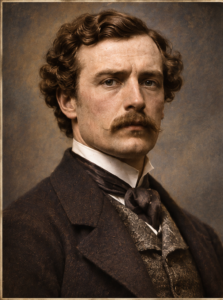 I first wanted to find out who Edward Holmes was.
Edward Holmes was born in approximately 1837, and he married Jane Lamport on 9 August 1860 at St James’s Church, Westminster. .
By 1871, Edward and Jane were living in Chelsea. The census recorded Edward’s occupation as perfumer, suggesting that his business interests extended beyond hairdressing.
Edward and Jane had six sons, and the youngest was born just seven weeks before his father’s death.
Jane’s evidence at the inquest gives us an insight into their domestic circumstances. She described a husband who had recently been in poor health, suffering from chest pains, nervousness and disturbed sleep. He had become increasingly agitated and appeared to be under considerable strain. She acknowledged that his business was not as prosperous as he had hoped and that he was experiencing financial difficulties.
She also described an incident involving a fire at his business premises. Although the initial report that the premises had been burned down proved exaggerated, the news had greatly distressed him. He returned home looking very ill and appeared to have lost his usual composure.
Jane was asked whether Edward had ever stayed away overnight before the Monday on which he died. She replied that he had not done so for some years.
She also spoke of their family life, describing their home as happy, although the evidence suggests that Edward’s recent state of mind had become a considerable source of concern.
One of the most significant aspects of the inquest was the evidence concerning Edward’s interest in poison. Jane was asked whether her husband had ever spoken about taking his own life. She said he had not.
However, he had recently discussed the subject of poison when reading newspaper reports and medical evidence concerning the celebrated Bravo poisoning case.
(The Bravo Poisoning Case, also known as the Balham Mystery, became one of Victorian England’s most notorious unsolved murder investigations. In April 1876, 30-year-old barrister Charles Bravo died after suffering three days of agonising illness, having been poisoned with tartar emetic at his home, The Priory, in Balham. Suspicion fell upon his wealthy wife, Florence Bravo, her companion Jane Cox and a former associate, Dr James Gully, but the circumstances surrounding the poisoning remained deeply mysterious. A second inquest concluded in August 1876 that Bravo had been wilfully murdered, although the jury could not identify the perpetrator. Nobody was ever prosecuted, and the case remained unresolved. Its extensive newspaper coverage fascinated Victorian readers.)
Edward had remarked that it was a mistake to believe that members of the public could not obtain poison if they knew how to go about it. Jane also explained that Edward used poisonous substances in his business for dyeing hair, although she was not aware of him keeping poison at home.
Another witness, William Irving, a railway employee who knew Edward, described meeting him on Monday afternoon, shortly before his death. They discussed the Bravo case and the subject of poisons. Edward asked questions about the easiest way for a man to die, and the conversation included drowning and throwing oneself in front of a railway train.
Irving described Edward as increasingly excited and agitated. His hands trembled, and he appeared unusually nervous. The witness also recalled that they discussed hydrocyanic acid, although cyanide of potassium was not specifically mentioned in their conversation.
There was further evidence concerning a visit Edward had made to Glover & Co., a chemist’s establishment at 13 George Street, Tottenham Court Road. A bottle of oil of roses found among his possessions bore the chemist’s label. The establishment confirmed selling the oil to a man answering Edward’s description on the Monday afternoon.
The customer had also enquired about obtaining two ounces of cyanide of potassium. He was referred back with a written requisition, but the staff could not identify the writing. The police were unable to establish where the cyanide eventually found in Edward’s possession had been obtained.
The Waterloo Coffee-house
The Waterloo Coffee-house was more than simply a place to obtain refreshments. It also provided bedrooms for customers. The landlady, Emma Bedman, explained that Edward and Fanny arrived together between eleven o’clock and midnight on Monday. They requested a room and were shown to a bedroom on the second floor. They appeared sober when they arrived. Edward paid three shillings for the room.
Emma subsequently discovered that Fanny had left, but when Edward failed to come downstairs, she went to investigate. Receiving no answer, she eventually opened the bedroom door and found him lying motionless on the bed.
The servant, Elizabeth Thomas, also gave evidence. She confirmed that she had let Fanny out at approximately quarter to five on Tuesday morning.
The room contained a tumbler and jug of water. The tumbler was found near the washstand, and the medical examination established that the liquid contained cyanide of potassium.
The mysterious Fanny Smith
 Perhaps the most intriguing person in the entire investigation is the young woman who spent Edward’s last night with him. The newspapers gave her name as Fanny Smith. At the initial police proceedings she was described as 25, while the inquest report estimated her age at 23 or 24. She was described as plainly dressed and apparently pregnant.
Her own evidence provided an account of how she met Edward. She said that on Monday night, at approximately eleven o’clock, she encountered him on Westminster Bridge Road, near the Baths. He spoke to her and invited her to have some beer. They had two half-pints on their way to the coffee-house.
Fanny admitted that she was not sober, although she said Edward was. He drank nothing further at the coffee-house. They spent several hours together in the bedroom.
Fanny said that at about half-past three in the morning she asked Edward the time and told him that she needed to leave early. She eventually left shortly after five. Edward gave her five shillings and asked her to tell the people in the house not to call him until half-past nine.
She said that she had not seen a pocket-book with him and denied knowing anything about his taking poison. She also denied giving him any.
So why did Fanny leave so early? Her explanation is particularly revealing. She said:
‘I have a key of the house in which I live, and I do not want the people in it to know that I go out at night.’
She explained that she wanted to return before the other occupants got up.
This statement raises several possibilities about her circumstances. She might have been living with a partner, relatives, an employer or in a lodging establishment. She could equally have been employed as a domestic servant in a household where her nocturnal activities would have been disapproved of.
The fact that she possessed a key does not establish which of these arrangements applied. Her address was reported as Newport Cottage, New-Lambeth-walk. Unfortunately, it has not been possible to identify the property confidently in the contemporary census records.
So, was Fanny a prostitute? This is one of the questions that remains unresolved. There are circumstances which might suggest that she was working as a street prostitute:
- She apparently met Edward as a stranger on the street.
- She accompanied him to a private bedroom.
- He paid for the room.
- He gave her five shillings when she left.
- A policeman subsequently encountered her on a street corner.
However, none of the reports explicitly identifies her as a prostitute. The five shillings may have been payment for her company, but the precise arrangement is unknown.
Her reference to returning home before the other occupants awoke could equally suggest that she was concealing her activities from an employer or household in which she lived. We should therefore retain prostitution as a possibility rather than an established fact.
The police evidence also introduces another puzzle.
The constable who arrested Fanny said that he had never seen her before. He had stopped her near the corner of the New Cut after receiving a description of the woman who had accompanied Edward. Fanny initially denied knowing the deceased. When confronted with the description and the coffee-house, she admitted having been there. The constable also reported that she called out ‘Charley!’ to a man across the street and told him:
‘That is my husband.’
Yet another newspaper account described Fanny as unmarried and living with a man called Charles Leonard. These accounts are difficult to reconcile.
One possible candidate is Charles T. Leonard, a draper recorded in the 1881 census at 109 High Street, Lambeth. He was 42, married to Lizzie, and had a daughter. His household also included two female servants. If he were the man in question, it is conceivable that Fanny had been employed in his household or had some other private connection with him. But there is no evidence establishing this identification. Nor can we be certain that Charles Leonard was the man Fanny called Charley.
So, was Fanny Smith her real name? We cannot be sure about that either.
There was no central register through which the police could routinely verify a person’s identity. Fanny might have given her real name, an assumed name, or a name she habitually used in her private life.
I have made attempts to trace her through the censuses and through birth and marriage records. I found one possible Frances Smith in Lambeth, appearing in the 1861 census as the daughter of Stephen Smith and in 1871 as a domestic servant. She subsequently married James Bucknall in 1878. However, the later family records do not fit the reported pregnancy particularly well, and there is insufficient evidence to identify her as the woman involved in the Holmes case.
The search for Fanny therefore remains inconclusive.
Several aspects of this case reveal the values and assumptions of Victorian society:
Respectability and female sexuality
A married man spending the night with a young woman who was not his wife was potentially embarrassing for his family, particularly his widow. The newspapers reported the bedroom, the payment and the circumstances of Fanny’s departure, but did not explicitly label her a prostitute. This may reflect editorial discretion, uncertainty about her occupation, or simply the fact that prostitution was not the subject of the proceedings.
Street prostitution was a familiar concern in Victorian London. Contemporary newspaper correspondence discussed women soliciting in public streets, particularly at street corners and in areas such as Kennington and South Lambeth. Women suspected of prostitution could attract police attention and moral condemnation, sometimes on relatively slight evidence. It is therefore important not to confuse the assumptions that might have been made about Fanny with facts established about her life.
The unequal expectations of men and women
Victorian attitudes towards sexual behaviour were markedly unequal. A man’s visits to a woman outside marriage might be regarded as a lapse in judgement, whereas a woman involved in selling sexual services could be categorised as morally disreputable. The distinction between the respectable wife and the supposedly fallen woman was an important feature of contemporary social attitudes.
In this case Jane and Fanny occupied very different positions in the public account of Edward’s death: one was the respectable widow and mother, the other the unidentified young woman whose presence in the bedroom required explanation. Yet neither woman’s complete circumstances can be reconstructed from the newspaper reports alone.
Suicide and temporary insanity
The verdict is also revealing. Suicide retained a considerable moral and religious stigma during the nineteenth century. Although legal reforms had reduced the traditional punishments associated with self-destruction, the distinction between suicide and suicide while temporarily insane remained significant. The latter verdict allowed a jury to acknowledge that a person had deliberately ended their life while recognising that their judgement might have been seriously impaired.
By the 1870s, medical and social explanations of suicide were becoming increasingly important, although religious and moral interpretations remained influential. The Edward Holmes jury’s verdict therefore reflects a contemporary attempt to understand self-destruction through the language of mental disturbance rather than simply condemning it as a deliberate moral offence.
CONCLUSION
The investigation began with a newspaper report suggesting that a young woman might have poisoned a man with whom she had spent the night. The subsequent evidence revealed a considerably more complicated story.
Edward Holmes was a married man with six children. He had been experiencing financial difficulties and poor health, and his behaviour had become increasingly disturbed. He had discussed poisons and methods of dying with an acquaintance, and had attempted to obtain cyanide on the day before his death. The medical evidence established that he died from cyanide poisoning, and the coroner’s jury concluded that he had taken his own life while temporarily insane. The immediate mystery of his death was therefore resolved, at least according to the inquest.
But Fanny Smith remains an enigma. We cannot establish whether that was her real name, whether she was married, whether she was a prostitute or domestic servant, or who the man called Charley really was. Her statement about possessing a key to the house where she lived suggests that she had a private life she did not wish the other occupants to discover. Whether that was because she was concealing an illicit relationship, working as a prostitute, or simply enjoying freedoms that her household would not have approved of, we cannot know.
She may have been economical with the truth. She may have been protecting someone else. Or she may simply have been telling the police as much as she wished them to know.
The newspapers recorded her evidence, but apparently nobody thought it necessary to establish her identity more thoroughly once the inquest had reached its conclusion.
That leaves us with an unusual historical imbalance: we can reconstruct Edward’s family, occupation, marriage and final days in considerable detail, but the woman who shared his last night remains almost entirely unknown.
The death of Edward Holmes may have been explained, but the identity of Fanny Smith remains a mystery.
THE SUMMARY IMAGE
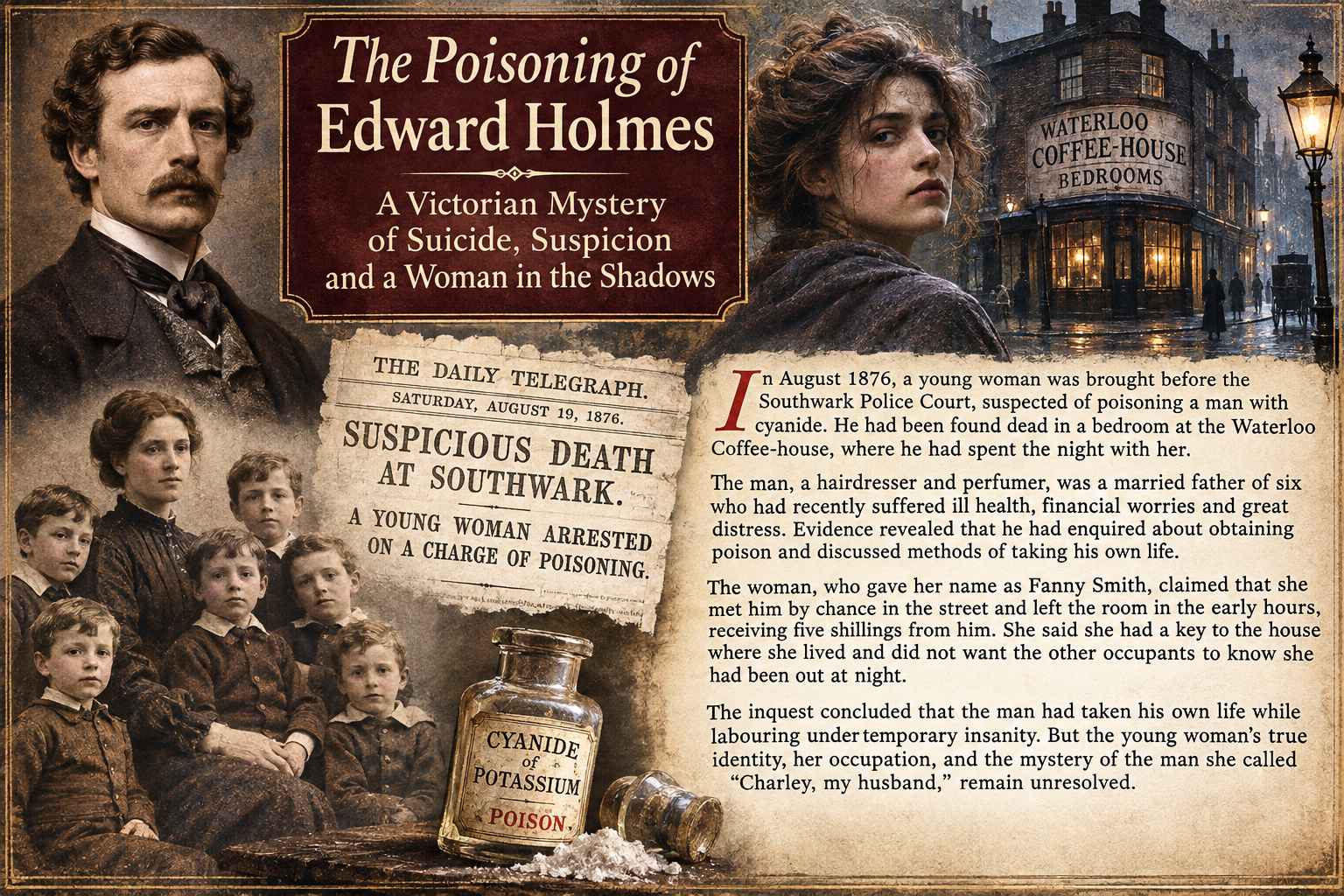
All images generated by ChatGPT