This mystery began with the discovery of a two-week-old baby, left alone in a field at Fishponds on a November night. It became an investigation into the identity of the young mother, her family circumstances, the treatment she received from the authorities, and the fate of a child whose life appears to have begun in extraordinary uncertainty.
THE NEWSPAPER ARTICLE
The Bristol Mercury and Daily Post, 12 November 1880
|
THE CRUEL CASE OF CHILD DESERTION. Mary Ann Wheeler was brought up on remand charged with abandoning her infant child in Oldbury-park, on Nov. 8th, whereby the infant’s life was endangered. The prisoner stated that she had written to her parents in Fairford, but had received no reply. It will be remembered that the woman’s infant, which was about a fortnight old, was left on Sunday afternoon under a wall in Oldbury-park, Fishponds, and was found shortly after three o’clock on Monday morning. Mrs. Jane Davis stated that she lived at 5, Host-street. Last June, the prisoner came to her house and took lodgings there. She said that she had been in Stapleton Union. She was then enceinte. Witness thought she was about 25 years of age. The prisoner was confined three weeks ago. She remained in witness’s house until the beginning of September, when she went to live in Pipe-lane; but about a week previous to her confinement she returned to Host-street. She remained a short time, and was then removed to St. Peter’s Hospital, where the baby was born. On November 3rd witness went to the hospital, in consequence of receiving a letter from Wheeler, and took some warm clothing for the child. She wrapped the baby in a shawl and took it, with the mother, to her house. After dinner the accused commenced to sew some buttons on her jacket, and witness told her she ought to be ashamed of herself to sew on a Sunday, and if she continued she must leave her place. Wheeler stated that she was going to take the baby out, but witness told her she ought not to, as it was a damp day. The defendant, however, insisted on taking the child out, and went away with it. She left the house at two o’clock, and returned without the infant at ten minutes to seven o’clock in the evening. Witness said, “Lucy” (which was the name the girl went by), “oh where is the baby”, and she replied, “My mother has it.” Witness rejoined, “That is not satisfactory to me. I will have the baby found; I will send for a policeman.” The accused replied she could do as she liked, but her mother had the baby. She rushed out of the house and went in the direction of the Stone-bridge, but was stopped and brought back. She said she should have drowned herself if witness had sent for a policeman. Witness sent to the Central Police-station for a constable, and the officer (Perkins) came and arrested Wheeler, who asked witness to say nothing against her, as she would be sure to be hung. Wheeler’s parents knew that she was in the family-way, as she had received a letter from them telling her not to come near them while she was in that condition. The prisoner, who had nothing to say in her defence was committed for trial at the Quarter Session, but the magistrates offered to admit her to bail, in two sureties of £25 each. |
THE FACTS
Mary was committed to custody on 12 November 1880, under a warrant dated the previous day. The prison register records that she was tried on 5 January 1881 at Gloucester Quarter Sessions. The offence concerned unlawfully exposing a child in a field and endangering its life. The child was described as fourteen days old. Her plea or verdict was recorded as “Confesses”.
A report in the Bath Chronicle of 13 January 1881 confirms that Mary Wheeler, aged 19, appeared at Gloucestershire Quarter Sessions and pleaded guilty to abandoning her young child in a field at Fishponds. She was sentenced to one month’s imprisonment.
The prison register specifies one calendar month with hard labour.
It also describes Mary as a “prostitute”. This is a word that can easily dominate our interpretation of Mary, but it needs to be examined rather than accepted uncritically.
First, having a child outside marriage did not, in itself, make a woman a prostitute. Unmarried motherhood and prostitution were distinct circumstances, even though Victorian moral attitudes sometimes blurred the distinction. A woman could be condemned for sexual behaviour without there being evidence that she had exchanged sex for money.
The prison register is an official record, and its classification should not be ignored. It may indicate that the authorities understood Mary to be engaged in prostitution. But the register does not tell us how they reached that conclusion. We have no evidence at present of a prostitution-related charge, a police report describing her work, or a statement by Mary herself.
There are several possibilities. Mary may have been working as a prostitute before or after becoming pregnant. Alternatively, the classification may reflect information supplied to the prison authorities which we have not yet found.
The broader social context is important. For a working-class woman without family support, the choices available could be severely restricted. Domestic service and other forms of women’s employment were poorly paid, and the responsibility for an illegitimate child fell heavily upon the mother. Historians have shown how contemporary charitable and Poor Law institutions could regard unmarried mothers with suspicion, sometimes treating them as women at risk of falling into prostitution.
That does not mean that Mary was necessarily a prostitute because she was a single mother. It means that the two categories could become entangled in the eyes of Victorian authorities and moral reformers.
The prison register’s description is therefore a significant clue, but not a complete biography. We should retain the word as the record gives it, while making clear that its basis is unknown.
So who was Mary Wheeler?
Mary had told the police that her mother lived at the Bull Hotel Tap in Fairford, so from this piece of information. we were able to track down her family there.
 The 1881 census recorded Thomas and Catherine Wheeler living at the Bull Hotep Tap with 2 young children, Lucy and George. Thomas was a former soldier and Chelsea pensioner.
(This is an intriguing detail. Mrs Davis knew Mary as Lucy,- so was she concealing her true identify by using this her younger sister’s name)
Thomas Wheeler was born at Poulton, Wiltshire, and served in the Royal Horse Artillery. He had married Catherine Johnson in Ireland, and their first child, Mary Theresa Wheeler was born at Secunderabad, India, on 16 December 1860, and baptised there on 2 January 1861.
The 1871 census places the family at Aldershot, with Thomas serving as a sergeant in the Royal Horse Artillery.
Mary in prison
Mary and her baby son remained together in the prison hospital wing, rather than her undertaking hard labour.
This may seem surprising, but it was not without precedent in the Victorian prison system. Women who gave birth in prison, or entered prison with very young babies, could be accommodated with their infants for a period. Prison infirmaries and special arrangements for mothers and babies existed, although conditions varied between institutions.
A family record states that Catherine visited Mary in prison on 1 February 1881, spending two hours with her. If that account is correct, it suggests that the relationship between mother and daughter may not have been entirely severed.
However, it also goes on to say that Mary became ill, and although she was expected to be released the following day, she died in the prison on 7 February 1881 and that Mary’s parents did not attend after her death.
The parents and the question of rejection
One of the most troubling details in this story is that Mary’s parents apparently knew she was pregnant and had told her not to come near them while she was in that condition. If accurately reported, this was a devastating rejection at a moment when Mary was particularly vulnerable. She was pregnant, unmarried, and apparently living away from her family. It is difficult not to ask what kind of family circumstances could have led to such a response. Were her parents concerned about their standing in the community? Did they regard her pregnancy as a disgrace? Was there an earlier disagreement or estrangement? The records do not answer these questions.
Victorian society placed a heavy burden of sexual respectability on women. An unmarried woman who became pregnant could face condemnation from her family, neighbours and potential employers. The child’s illegitimacy was not simply a private matter: it could affect the mother’s ability to earn a living and the family’s public reputation.
Catherine’s Irish birth and Catholic faith are part of the family’s history. These details may help us understand the family’s social and religious world, but they do not establish that religion played any part in the treatment of Mary.
There is a particularly poignant contrast between the family’s public reputation and the story that emerges from Mary’s case. When her father, Thomas, died in 1896 his obituary entitled “Death of a Crimean Veteran” extolled his activities in the Royal Horse Artillery, but it is the final sentences that struck me.
“His kindness and urbanity endeared him to all. A good solder has gone to his rest, and not only so, but a good husband, father, friend and neighbour.”
What became of Mary’s baby?
Mary’s son, John Thomas Wheeler, was born on 21 October 1880 St Peter’s Hospital Workhouse, Bristol.
Two months after his mother’s death, the April 1881 census of Gloucester Prison includes an entry for:
“Wheeler, Male Infant, 5 months.”
This is a particularly important discovery. It provides independent evidence that a male infant with the surname Wheeler was still in the prison institution several months after the Fishponds incident and his mother’s death.
But after that John Thomas disappears from the records.
He does not appear to have died as a child, so it is quite possible that he was informally adopted by another family and may even have been given another first name or surname.
The wider social picture
Mary’s story is not simply one of a mother abandoning her child. It is a story about the limited choices available to a young working-class woman who became pregnant outside marriage, and about the way that society could make her responsible for the consequences while offering her little practical support.
The 1834 Poor Law placed responsibility for an illegitimate child upon the mother. The father could potentially be pursued for maintenance, but the practical burden of caring for the child fell heavily upon the woman. The historical literature describes the difficulties faced by unmarried mothers: low wages, limited employment, the stigma of illegitimacy and the risk of being excluded from respectable domestic service.
The burden of responsibility fell visibly upon Mary. She was the person questioned by the police, prosecuted, imprisoned and described in the register as a prostitute. The father is not identified in the material we have found.
There is also a wider question about the role of family. Victorian ideals placed great emphasis on the family as a source of moral guidance and practical support. Yet families could also enforce the very standards of respectability that made it difficult for a daughter to seek help. If Mary’s parents did reject her because of her pregnancy, they may have believed they were defending the family’s reputation. But the consequence for Mary may have been to leave her without the support she needed.
We must keep the qualification: the newspaper account reports that her parents had told her to stay away, while the later family tree describes a visit by Catherine to the prison. The relationship may have been more complicated than either account alone suggests.
Nor should we overlook Mrs Davis. She provided lodging, visited Mary in hospital, brought clothes for the baby and took them both into her home. Her actions suggest that Mary was not entirely without kindness or assistance. Yet the arrangement was evidently fragile. Mary was a lodger, not a member of the family, and the disagreement on the Sunday afternoon may have made her feel that her place there was uncertain.
We cannot know whether that particular disagreement precipitated the abandonment. It may have been one more pressure in a much longer sequence of difficulties; it may have had little to do with her decision. The evidence does not allow us to say.
CONCLUSION
There is no need to excuse what Mary did to acknowledge the circumstances in which she lived. Leaving a two-week-old infant alone in a field was a dangerous act. The child could easily have died. Mary’s guilty plea and the contemporary evidence leave little room to doubt the seriousness of the offence. But the case should not end with the word guilty, nor should the prison register’s description of her as a prostitute be allowed to define her entire life.
What we cannot recover is Mary’s own explanation. We do not know what had happened between her and her parents, whether the child’s father had abandoned her, why she used the name Lucy, or what she intended when she left the baby at Fishponds. We cannot know whether she was frightened, desperate, angry, confused, or some combination of these things.
And we cannot say what became of her son after April 1881.
Perhaps the most uncomfortable feature of the case is that the records preserve the consequences of Mary’s actions much more clearly than they preserve the circumstances that brought her to that point. The baby survived the night, but his later life disappears from view. Mary was prosecuted and imprisoned, but her personal history is only partly recoverable. Her parents’ response is suggested by a newspaper report, while their private feelings remain hidden.
The case began with an abandoned child. It has led us to a young woman whose life was shaped by family expectations, poverty, sexual stigma and the institutions that dealt with the consequences of illegitimacy. We cannot know whether a different kind of support would have changed what happened at Fishponds. But we can recognise that Mary was more than the offence for which she was convicted.
THE SUMMARY IMAGE
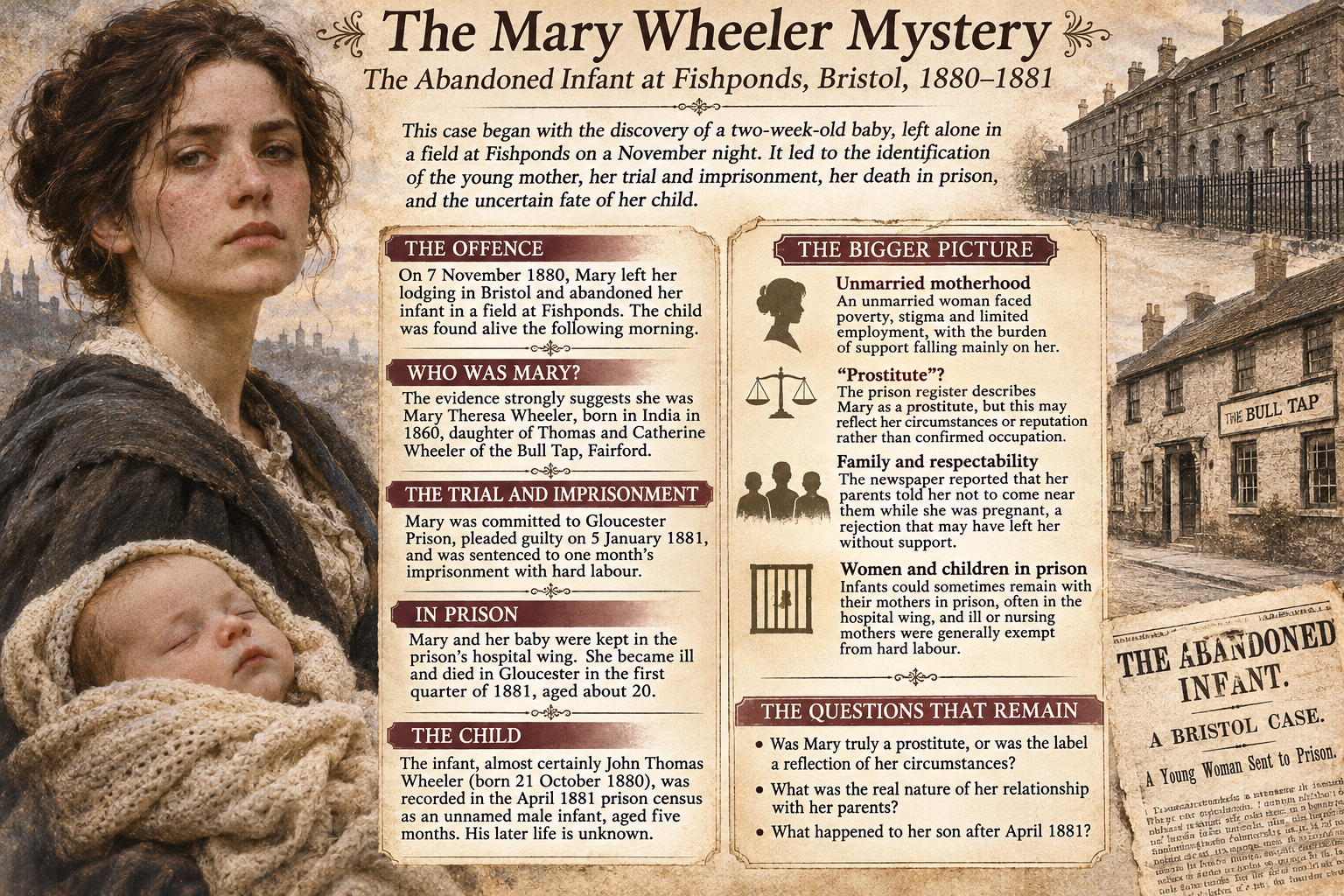
All images generated by ChatGPT