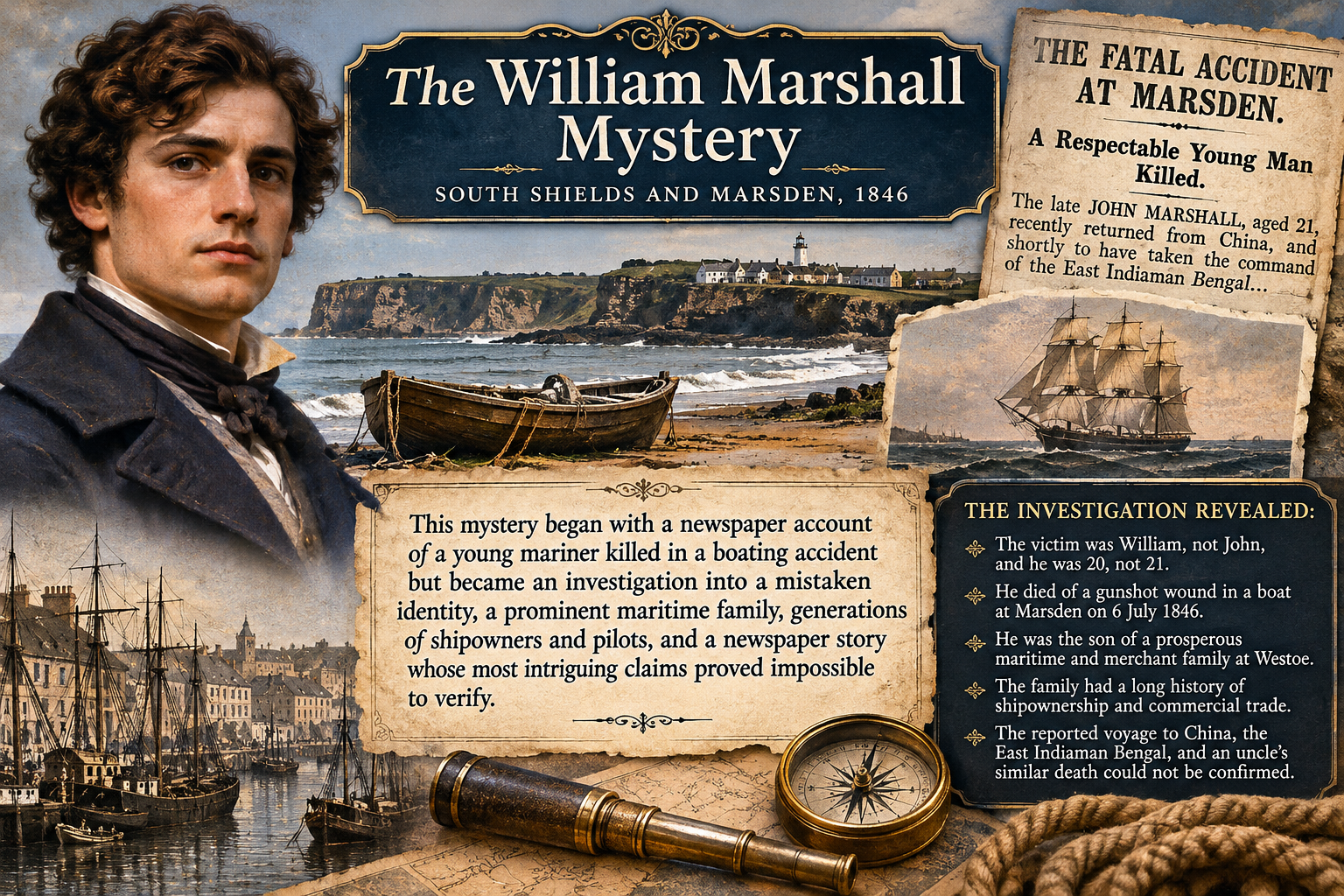
This mystery began with a newspaper account of a young mariner killed in a boating accident but became an investigation into a mistaken identity, a prominent maritime family, generations of shipowners and pilots, and a newspaper story whose most intriguing claims proved impossible to verify.
THE NEWSPAPER ARTICLE
The Birmingham Journal, 18 July 1846
| MELANCHOLY ACCIDENT. On Monday afternoon, between four and five o’clock, an accident of a very serious and melancholy character happened at Marsden, near South Shields. Mr. John Marshall, son of Mr. William Marshall, of the firm of Bell and Marshall, merchants of that town, with a party of ladies, and another gentleman, had been off to sea, and they were landing on the beach to enjoy a “picnic.” The ladies had got on shore, and the gentlemen were about doing so, Mr. Marshall having one foot upon the shore, and the other upon the boat’s gunwhale, when a fowling piece, which was lying in the bottom of the boat, went off, and lodged the whole charge in his abdomen, the concussion knocking the other gentleman down. He reeled a few paces and fell; the ladies ran to his assistance, and tried to stench the bleeding with their dresses; and in this fearful position they were left till assistance was produced from a neighbouring house, to which he was conveyed. An express was sent to town for a surgeon, who was promptly on the spot, but it was soon seen that his help would be of little avail. After calmly taking leave of his friends, he expired at about eight o’clock. It is supposed that the cause of the accident was the boat rolling and beating on the shore. Mr. Marshall was a noble-looking young man, twenty-one years of age, who had just returned from China, and was about to take charge of the Bengal East Indiaman. His melancholy fate is heightened by the recollection that his uncle, a gentleman in the prime of life, and highly respected by all who knew him, met a similar fate some five or six years ago. – Newcastle Guardian. |
THE FACTS
An earlier newspaper account of the accident, published in the Sunderland Herald and Daily Post on 10 July 1846, gave a little more detail of the accident. It also reported that the accident had taken place on Monday 6 July but like the newspaper report above – that had come from the Newcastle Guardian – it reported that the young man who died was called John Marshall.
 However, on locating the young man’s death certificate, it was found that his name was in fact, William Marshall, who was aged 20 and a mariner. It was clear this was the same individual as the cause of death was given as “Shot in the stomach by a gun in a boat, when on a party of pleasure.”
The fact that several newspapers carried the same errors initially gave the impression of corroboration. In reality, the later publications were repeating information that had already appeared elsewhere. We cannot establish precisely where the original mistake originated. The Sunderland Herald was the earliest account located, but it is possible that both newspapers obtained their information from the same local source.
The investigation also uncovered several Marshall families in the South Shields area. There were numerous men named William and John, many of them involved in maritime occupations. Some were merchants or shipowners, others were pilots and mariners. The families may have been related, and their recurring names and occupations could easily have caused confusion.
One particularly interesting possibility was an older John Marshall, born around 1815, who was a South Shields pilot. His father was also named William Marshall. This provides a possible explanation for how the name John entered the newspaper account, although no direct evidence has been found to prove that this was the source of the mistake.
The Marshall family of Westoe
Once William’s identity had been established, attention turned to his family.
His father was William Marshall (1798–1877), a member of an established maritime and merchant family living at Westoe, near South Shields. The 1841 census described him as a shipowner, while the 1851 census recorded him as a merchant.
His father, George Marshall (1767–1841), had also been a shipowner. A memorial inscription provided further information about George’s family, including several of his children and connections with the wider merchant community.
The family had links with the Bell family, and the firm of Bell and Marshall was mentioned in connection with William’s father in the newspaper account. A surviving archival reference to Bell and Marshall also provided evidence of the firm’s involvement in export trade.
The family reconstruction revealed a substantial maritime background extending across several generations. William junior was therefore born into a family familiar with shipping, seafaring and commerce.
The 1841 census also revealed a young William Marshall, aged approximately 15, apprenticed as a sea pilot.
The mystery of the Bengal and China
Perhaps the most intriguing part of the newspaper account concerned William’s supposed maritime career.
The Newcastle Guardian described him as having recently returned from China and being about to take command of an East Indiaman called the Bengal. Yet the investigation could not independently establish either claim.
Several vessels carried the name Bengal, and one merchant vessel launched in 1815 for the East India trade was recorded as wrecked in the 1846 edition of Lloyd’s Register. The vessel’s recorded master in 1846 was not William Marshall.
It is possible that the newspaper was referring to another vessel, or that the information about William’s appointment was itself confused with the career of another man. The fact that the newspapers had already misidentified William makes this an important possibility, together with the point that it would be unlikely that a mariner aged 21 years old in 1846, was a ship’s master; he would have more likely served as an ordinary seaman, or junior mate.
The question of whether William had actually travelled to China, and whether he had been offered command of a vessel, must therefore remain unresolved.
The uncle who died in similar circumstances
The newspaper also claimed that William’s uncle had died in a similar accident five or six years earlier.
The Marshall family reconstruction identified several possible paternal uncles, but none has been conclusively connected with such an accident. Indeed, given the inaccuracies elsewhere in the newspaper report, it would be unwise to assume that this detail was correct.
It remains an intriguing but unverified part of the original story.
CONCLUSION
The investigation began with a newspaper account of a young man called John Marshall, aged 21, a promising mariner whose career had apparently taken him to China and who was about to command an East Indiaman.
Official evidence established that the victim was actually William Marshall, aged 20, a mariner from a prosperous South Shields family with deep maritime connections.
The investigation uncovered his family background, traced the Marshall family’s involvement in shipping and commerce, and revealed the possibility of confusion between several local families bearing the same names. But the China voyage, the Bengal and the uncle’s earlier accident could not be verified.
Perhaps the original journalist had made enquiries and received a mixture of accurate and inaccurate information. Perhaps details belonging to another member of the extended Marshall family had become attached to William’s story. We cannot know for certain.
What we can say is that the newspaper account, repeated in several publications, contained fundamental errors which only became apparent when it was tested against official records.
This investigation therefore became less about solving the circumstances of an accident than about discovering the truth behind a misleading newspaper narrative.
Sometimes the greatest mystery is not what happened, but how the story of what happened became confused in the first place.
THE SUMMARY IMAGE
All images generated by ChatGPT